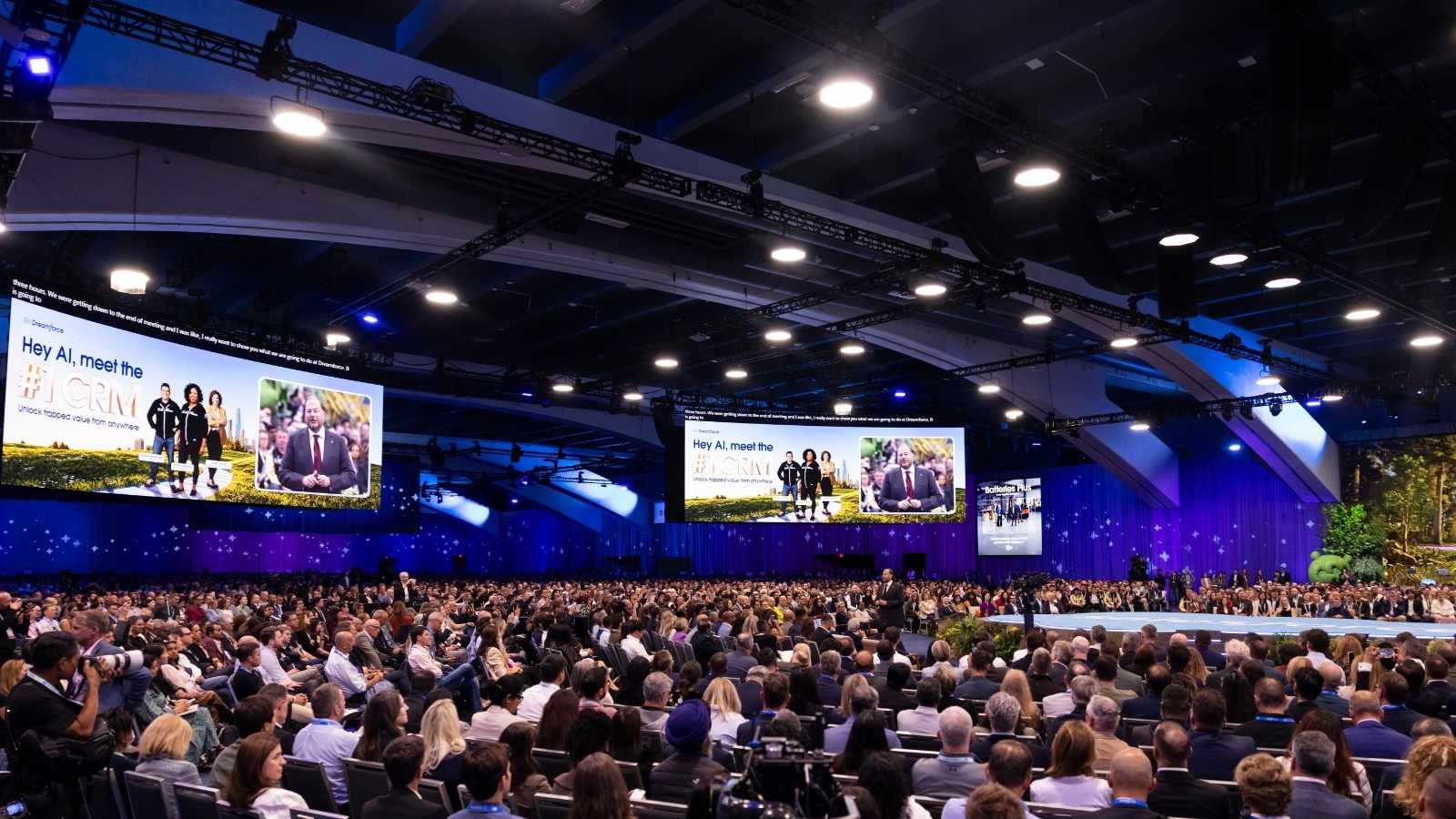
Dreamforce 2026 has been a show of big claims, big screens, and an even bigger vision for how AI will reshape enterprise work.
Salesforce has announced AIforce, a new interface strategy designed to bring CRM context and actions into Claude, Slack, Lightning, and custom experiences. It has expanded Agentforce, added new customer-service capabilities, announced Contact Center as a Service, introduced Koa with NVIDIA, and made a case for its platform as the governed foundation of an “agentic enterprise.”
It is a lot for CX leaders to absorb.
But speaking to CX Today at Dreamforce, Liz Miller, VP and Principal Analyst at Constellation Research, cut through the product sprawl with a more practical interpretation of the week’s announcements.
“Honestly, the story is an easy button.”
— Liz Miller, VP and Principal Analyst, Constellation Research
That does not mean Salesforce is making agentic AI simple. The technology, data, governance, and operating-model questions remain formidable. But Miller’s point is that Salesforce is trying to reduce the time and specialist expertise required to turn an AI idea into a working enterprise capability.
“It’s about being able to stand up agents, stand up skills in days rather than years,” she said.
That is the promise. The harder question for CX leaders is whether the pursuit of faster deployment will lead to better customer outcomes—or simply faster automation of processes that were already broken.
As CX Today reported from Dreamforce, Salesforce wants to take CRM out of Salesforce by making customer data, business rules, permissions, and approved actions available in multiple AI interfaces. Its wider agentic CX strategy goes further, positioning agents as operational workers capable of resolving issues rather than simply answering questions.
Miller’s analysis helps explain what that means in practice.
Start With the Work, Not the Interface
Salesforce has spent much of Dreamforce talking about interfaces. AIforce is intended to let users work through Claude, Slack, Salesforce Lightning, or a custom-built experience. Meanwhile, the company’s headless architecture is designed to let organizations use Salesforce data and business semantics without being restricted to its traditional user interface.
For CX teams, that can sound like another technology decision to make.
Miller’s advice is to start somewhere else: the work itself.
“You have to think about work first.”
— Liz Miller, VP and Principal Analyst, Constellation Research
Different enterprise functions have different operating realities, she argued. A marketer, a seller, and a contact-center agent do not use the same tools, or work in the same interface. Yet they should draw on a consistent taxonomy, shared metadata, and trusted organizational data.
That is the central AIforce proposition. A seller who prefers to work in Claude could retrieve Salesforce context there. A contact-center agent should not be forced into Slack simply because Slack is a strategic Salesforce surface. They should receive what they need in the agent desktop where they already work.
“They don’t want to swivel chair between tabs,” Miller said of contact-center agents. “They don’t want to have to learn another interface.”
For CX leaders, this is an important distinction. The future of agentic CX is not necessarily one universal interface. It is trusted customer context and approved actions delivered in the places where employees and customers can use them effectively.
Headless CRM Is Not Just a Developer Story
Salesforce’s “headless” message could easily be mistaken for a developer-led architecture play. But it has larger CX implications.
It means an organization can use Salesforce as the governed data, workflow, and action layer while designing a different front end around the specific needs of customers, service employees, managers, or field teams.
That range was visible across Salesforce’s Agentic Enterprise City. Brands demonstrated ready-made Agentforce experiences, custom interfaces, and new front ends created with AI-assisted development techniques.
For Miller, the significance is that businesses can begin to rethink how work gets done, rather than simply place AI inside the interfaces they already have.
“This is the opportunity to try that.”
— Liz Miller, VP and Principal Analyst, Constellation Research
That should come with a warning. A custom interface does not automatically create a better customer journey. It must still be grounded in accurate data, clear business rules, reliable permissions, accessible design, and an escalation route when the agent cannot safely proceed.
The risk is that organizations focus on the novelty of AI-generated interfaces while overlooking the operational work beneath them. A slick new service experience will not resolve an order issue if inventory data is wrong, entitlement rules are unclear, or the employee receiving an escalation cannot see what the agent has already done.
Koa Is About CRM Context, Not Just Another Model
One of the most notable announcements of the week was Koa, Salesforce’s new CRM reasoning model, developed with NVIDIA.
Salesforce says Koa is designed for complex, multi-step CRM work, including next-best-action recommendations in sales and customer-service scenarios. The company has also said the model was trained on synthetic data, rather than customer data.
Miller’s view is that Koa should not be understood as a model-for-model’s-sake announcement.
“Koa understands the function of CRM. It understands the functionality, it understands the nuance and the difficulty which has been operating these CRM strategies within these technologies.”
— Liz Miller, VP and Principal Analyst, Constellation Research
That is the logic behind a CRM-specific reasoning model. General-purpose models may be capable of producing fluent answers, but enterprise CX depends on more than language. It requires an understanding of the customer, the service history, the product or asset, the entitlement, the applicable policy, and the approved next action.
For a complex support case, that could make a material difference. The goal is not simply to answer the customer more eloquently. It is to help determine what should happen next and progress the work safely.
Still, Salesforce will need to show the evidence. CX leaders should ask how Koa performs on real service cases, against which benchmarks, and whether its use improves resolution, policy adherence, customer effort, and handoff quality—not only model accuracy.
From Bots to Relationship Agents
Miller’s most useful observation for CX leaders may be her insistence that the current conversation is about more than bots.
At Dreamforce, Salesforce has introduced and expanded a broad range of named agents, from customer-service agents to sales, marketing, HR, IT, and operational agents. Fin, Salesforce’s newly acquired customer-service technology, now sits alongside the rest of the Agentforce portfolio.
For Miller, the value lies in making these capabilities easier to deploy without forcing organizations into a full-scale system replacement.
“I don’t want it to be a bot. I want it to be a conversation, and I want it to be part of the relationship.”
— Liz Miller, VP and Principal Analyst, Constellation Research
That is a welcome reframing. The legacy chatbot promised a quicker answer. The agentic CX proposition promises context, action, and an outcome.
But the industry must be careful not to turn “conversation” into another soft metric. A conversational experience is not useful if it leaves the customer waiting for a human, repeating their history, or chasing an update across channels. The real measure remains whether the organization solved the right problem.
The Agentic Enterprise Is a Choice, Not an Inevitable Upgrade
Looking ahead, Miller said organizations have a major decision to make over the next 12 months: do AI things, or become an agentic enterprise?
Those are not the same thing.
Running a limited experiment, deploying a service agent for a narrowly defined task, or using AI to assist an existing process can be useful. But becoming an agentic enterprise requires a different level of readiness: a usable data layer, orchestration, security, governance, and meaningful coordination between IT, digital, operations, and customer-experience teams.
“Are you going to do AI things, or are you going to become an agentic enterprise?”
— Liz Miller, VP and Principal Analyst, Constellation Research
That is the decision CX leaders should take away from Dreamforce.
They should not begin with the question: Which AI interface should we buy?
They should ask:
- Which customer journeys need a better outcome, not just a faster response?
- Which processes have data, policies, and workflows mature enough for agentic action?
- Where should customers be able to self-serve—and where must a human remain available?
- What should an agent be allowed to do independently?
- Can the organization explain, audit, reverse, and recover from an agent’s mistake?
Trust Must Become More Than a Slogan
Trust has been one of the dominant themes of Dreamforce. Salesforce has emphasized the Trust Layer, zero-data-retention protections, agent identity, Salesforce Guardian, and Agent Fabric as part of its answer to enterprise AI risk.
Miller argued that the industry needs to become more precise about what it means by trust.
“Trust has to start meaning something.”
— Liz Miller, VP and Principal Analyst, Constellation Research
She said many supposed trust concerns are really fear concerns: fear about jobs, uncertainty around AI, and anxiety about what happens when systems act in unexpected ways.
But the more concrete trust issue is enterprise risk. What data is being used? What is the agent expected to do? What controls have been put in place? And who is accountable when an automated action affects a customer?
That last point is critical for CX leaders. Customers will not distinguish between Salesforce, a third-party model provider, an integration partner, and the organization that deployed the service. If an agent makes a harmful or incorrect decision, they will hold the brand responsible.
In that sense, agentic CX cannot be treated as a technology deployment alone. It is a customer-accountability programme.
The Dreamforce Test Starts Now
Salesforce has given customers an increasingly broad menu: prebuilt agents, custom interfaces, headless architecture, model choice, AI-generated experiences, voice, and deeper governance tools.
That is impressive. It may also be overwhelming.
Miller’s “easy button” interpretation is useful because it identifies Salesforce’s real commercial objective: make it easier for companies to begin. But no vendor can remove the hardest decisions from the customer.
CX leaders still need to choose the right journeys, establish trusted data, redesign broken processes, define action boundaries, protect vulnerable customers, and hold themselves accountable for the outcomes their AI produces.
Dreamforce has made the next stage of AI feel closer. The next 12 months will reveal which organizations are building useful agents—and which are simply adding more technology to the customer experience.
Read More From Dreamforce 2026
Read Dreamforce 2026: Salesforce Takes CRM Out of Salesforce for CX Today’s analysis of AIforce, ClaudeForce, Slackforce, and Salesforce’s attempt to make CRM context available across AI interfaces.
For the wider customer-service implications, read Salesforce’s Agentic CX Vision: 8 Dreamforce Announcements CX Leaders Need to Act On.