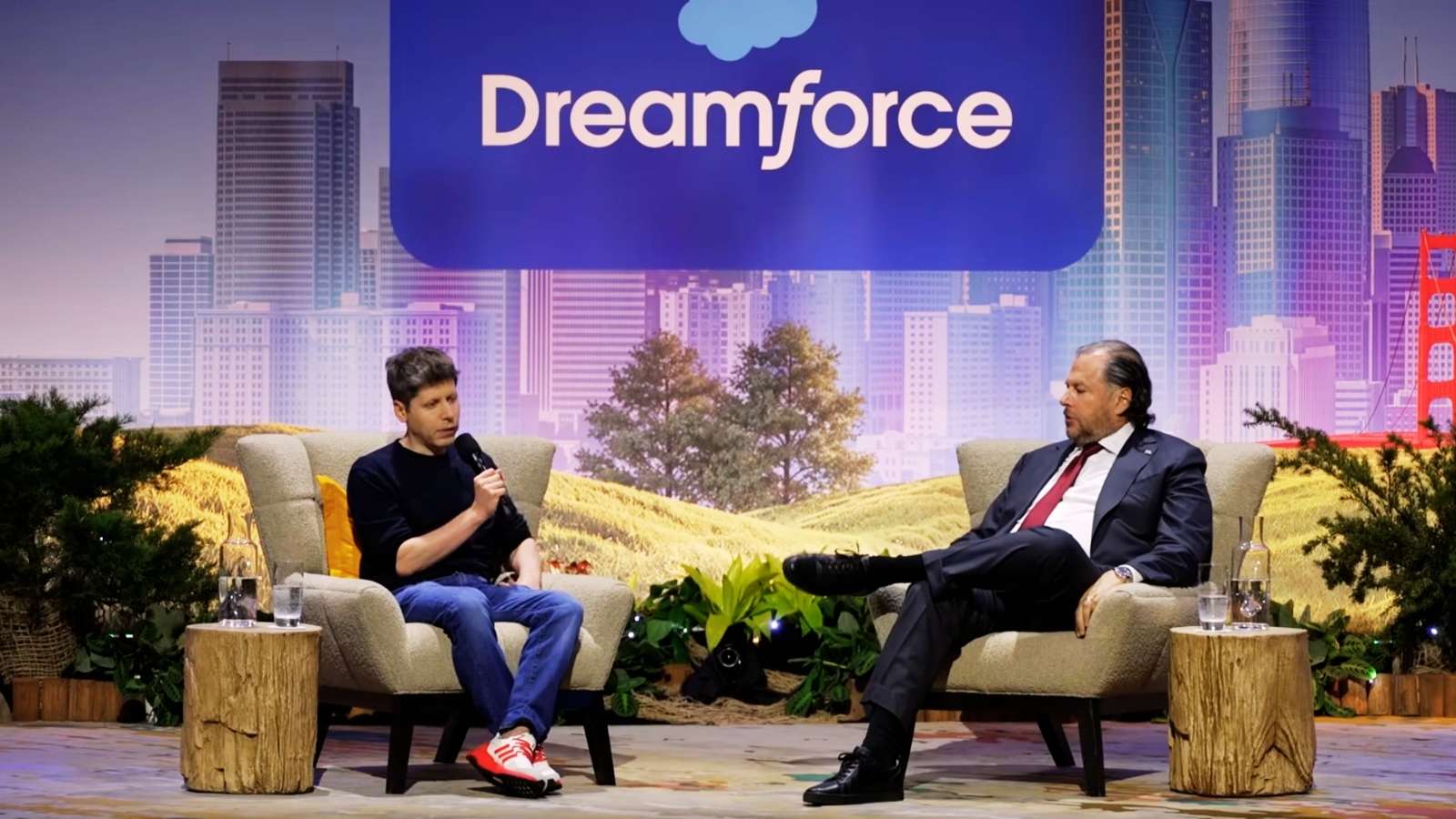
Salesforce has spent Dreamforce making a bold case for the future of enterprise interaction: CRM should no longer be a destination employees have to visit. Instead, the customer data, workflows, business logic, and approved actions within it should be available wherever work is happening.
That could mean Salesforce Lightning. It could mean Slack, Claude, a bespoke customer interface, or a dynamically generated workspace designed around a service issue.
But the practical challenge for CX leaders is more immediate. They do not just need more AI options. They need to understand how to choose between them.
Should they deploy a ready-made agent quickly? Build a tailored experience on top of Salesforce’s data and workflows? Use a specialist model for a particular job? Or redesign their operating model around a more autonomous service layer?
In an interview with CX Today at Dreamforce, John Kucera, Chief Product Officer for Agentforce, argued that this is a false choice. Salesforce’s strategy is to let organizations begin with turnkey agents while retaining the ability to customize for the complex, mission-critical journeys where customer experience is won or lost.
“Customers candidly choose both. You want to get started really fast with turnkey agents… [but] optimize it for their company for those mission-critical scenarios.”
— John Kucera, Chief Product Officer, Agentforce
That is a more grounded version of the broader AIforce story. Salesforce may be talking about an interface revolution, but for CX leaders the real test is whether that flexibility results in better resolution, more useful employee experiences, and fewer customers forced to start again in another channel.
As CX Today reported earlier from Dreamforce, Salesforce is trying to move CRM context and approved actions beyond the traditional Salesforce screen. The company’s latest announcements add the bigger operating-model question: how should businesses deploy, govern, and improve agents when customer interactions increasingly happen across multiple interfaces and models?
AIforce Is Salesforce’s Attempt to Make CRM Available Wherever Work Happens
Kucera described AIforce as a way for leaders and frontline employees to create the tools they need in the environments where they already work.
For a customer-service leader, that could mean an automatically generated weekly summary of performance, a dynamically assembled view of operational priorities, or a command centre built around live service signals. The aim is not to force every manager into a fixed dashboard. It is to make trusted Salesforce data and actions available in the format that suits the task.
“Customers could make the tools that work for them wherever they’re doing that work.”
— John Kucera, Chief Product Officer, Agentforce
That fits with Salesforce’s wider AIforce proposition: a layer that brings Salesforce context and actions into interfaces including Salesforce Lightning, Slack, and Claude. The company is also making more of its applications “headless,” allowing customers to build their own experiences on top of Salesforce data, semantics, and workflows.
The appeal for CX is obvious. Service work is often fragmented between CRM records, knowledge bases, telephony, order systems, workforce tools, and internal collaboration channels. A service operation does not necessarily need another destination. It needs the right context and the right approved action at the moment a customer problem needs resolving.
But the interface is only as useful as the operation behind it. A dynamically generated dashboard cannot fix incomplete customer data. A conversational AI layer cannot resolve an issue when policies are unclear or workflows are disconnected.
That is why the most important part of Salesforce’s interface shift may not be the interface at all. It is the company’s attempt to make data, permissions, business rules, and actions portable without losing governance.
From Suggested Replies to Agents That Complete Work
Kucera said the market has moved quickly in the last year.
Previously, many organizations were still using AI as an assistive layer: a customer message arrives, and the system suggests a response for an employee to review. Salesforce now wants to move beyond that model, toward agents that can handle real tasks rather than simply answer frequently asked questions.
He pointed to Southwest as an example of an organization Salesforce says has achieved a seven-times return on investment and millions of dollars in ROI through agents that go beyond FAQ-style interactions.
Those kinds of figures should always be tested against the full customer outcome. A high automation rate does not automatically mean a better experience. CX leaders need to understand repeat contacts, customer effort, complaints, abandonment, escalation quality, and what the agent was actually permitted to do.
Still, the direction of travel is clear. Salesforce wants agents to become part of the service operation rather than an additional digital channel sitting at the edge of it.
That is the argument behind its named agents, including Casey for customer service, Fin for cross-channel customer interactions, and Agentforce Voice for voice-based experiences. Kucera said Casey can learn from a customer’s case history, messaging transcripts, and voice calls to make agent configuration easier.
For Salesforce, the names are partly an effort to make agents more recognizable and role-specific. For buyers, the important issue is not the branding. It is whether the agent has clearly defined responsibilities, appropriate access, reliable knowledge, and a safe path to a human when a situation becomes complex or sensitive.
Koa Is Salesforce’s Bet on CRM-Specific Reasoning
One of the most closely watched announcements from the keynote was Koa, Salesforce’s CRM reasoning model built in partnership with NVIDIA.
Kucera said Salesforce asked how it could create a model that produced better results for agents, operated quickly, and ran efficiently at scale. The result, he said, is another option for customers looking to balance speed and accuracy in CRM use cases.
“We think that Koa is going to be really revolutionary for CRM use cases.”
— John Kucera, Chief Product Officer, Agentforce
Koa is designed for the kind of work that sits between a simple answer and a completed outcome: understanding a complicated support case, identifying the next best step, using the right business context, and progressing through multiple tasks.
Salesforce has said Koa was trained on synthetic data and not customer data. Kucera also positioned it as one choice in a wider multi-model strategy, rather than a replacement for every third-party model.
That is significant for CX teams. Customer journeys do not all require the same type of AI performance. A public-facing help interaction may need low latency and consistent answers. A background task may be able to tolerate more processing time in exchange for deeper reasoning. An employee-facing workflow may require a different balance again.
Kucera said Salesforce intends to make the default path straightforward for common customer-facing scenarios, while giving customers a wider set of options where their needs differ.
The journalistic question is whether that model choice becomes a benefit or another layer of complexity. Customers will need to understand which model is handling which work, what customer data each can access, how performance is evaluated, and how cost, latency, and governance are managed across the estate.
Trust Has to Follow the Data Into Every Interface
The most consequential part of Salesforce’s strategy may be its claim that trust controls travel with customer data and actions—whether the user is in Salesforce, Slack, Claude, or a custom interface.
Kucera said Agentforce applies existing Salesforce controls to AI interactions through identity, credentials, administrator controls, data access boundaries, and restrictions on whether a third-party interface can read or write information.
He described the example of a user asking Claude for major case drivers from the previous week. The system, he said, identifies who is logged in, applies that person’s credentials, and limits retrieval to the tables, fields, and records they are authorized to access.
“It uses my credentials. It scopes the request only to the data I have.”
— John Kucera, Chief Product Officer, Agentforce
Salesforce is also emphasizing zero-data-retention agreements with AI providers, its Trust Layer, data masking, toxicity and bias checks, hosted-model options, audit capabilities, and MuleSoft Agent Fabric for discovering and applying controls to agents and models.
That architecture is compelling in theory. But it raises the questions CX buyers need to keep pressing: can they see the data sources, policies, tools, and actions behind an agent’s decision? Can they reverse an action? Can they prove what happened if a customer challenges an automated outcome? And when a journey involves Salesforce, a model provider, a connector, and a customer-built workflow, who leads incident response?
Shared responsibility must not turn into shared evasion.
The Next Challenge: Self-Improving Agents
Looking ahead to Dreamforce 2027, Kucera expects “self-improving agents” to become a major market theme.
Salesforce has introduced Agent Optimizer, which Kucera said can help customers identify case drivers an agent was not originally designed to handle, propose changes, deploy them, and assess whether they improved ROI.
That prospect should excite—and concern—CX leaders in equal measure.
A service agent that can improve based on emerging customer needs could reduce the long lag between identifying a service problem and updating a digital experience. But any self-improvement loop needs strong controls. Who approves changes? How are new behaviours tested? What happens when an optimization improves a narrow operational metric while making the customer journey worse?
The answer cannot simply be more automation. It needs to be better operational accountability.
What CX Leaders Should Do Now
Dreamforce has delivered an increasingly broad menu of options for organizations looking to modernize digital service: prebuilt agents, custom agent development, headless architectures, external and Salesforce-hosted models, conversational interfaces, voice, and AI-generated workspaces.
The range is impressive. It is also a reason to be disciplined.
CX leaders should begin by deciding which customer outcomes matter most—not which technology looks most advanced. They should identify journeys where the customer problem is clear, data is reliable, policies are well defined, and action boundaries can be safely established.
Then they should decide what deployment model fits:
- Fast and simple: Start with a prebuilt agent and a high-volume, bounded journey.
- Distinctive experience: Use headless capabilities to build an interface around the organization’s customer journey and operating model.
- Complex enterprise estate: Establish model choice, identity, permissions, data controls, evaluation, and incident ownership before scaling.
- Long-term transformation: Treat agentic CX as an operating-model redesign, not a chatbot implementation.
Salesforce’s message is that businesses no longer need to choose between an easy agent and a powerful one. The reality is that they still need to choose where autonomy is appropriate, what customer outcomes they will measure, and where a human remains accountable.
For CX leaders, that is the work that will determine whether Salesforce’s interface revolution becomes a genuine service improvement—or simply a more sophisticated way to access the same unresolved operational problems.
Read More From Dreamforce 2026
Read CX Today’s earlier live coverage, Dreamforce 2026: Salesforce Takes CRM Out of Salesforce, for the full AIforce, ClaudeForce, Slackforce, and agentic-interface story.
For a broader analysis of the announcements affecting service and contact-centre leaders, read Salesforce’s Agentic CX Vision: 8 Dreamforce Announcements CX Leaders Need to Act On.