

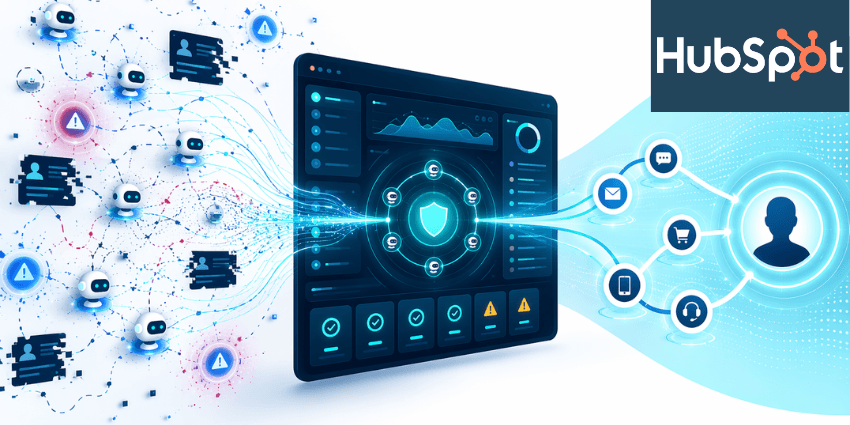
HubSpot has launched Agent Hub and Agent Builder to help go-to-market teams manage AI agents from one CRM workspace.
The public beta targets AI agent sprawl, a growing challenge for teams that have tested multiple automation tools without clear ownership, customer context, or performance visibility.
Agent Hub gives teams one place to view, activate, and manage agents across marketing, sales, and service.
HubSpot positions the product as a control layer for businesses that already use AI, but struggle when different agents work from disconnected customer data. That matters because scattered automation can create uneven customer journeys.
The company says Agent Hub lets users track live agent status and performance. Teams can also activate new agents with one click and organize outcomes around goals such as building demand or winning deals. For Duncan Lennox, Chief Product and Technology Officer at HubSpot, the issue is no longer whether one agent can complete one task:
"The problem isn't managing a single agent in isolation. It's that once you have multiple agents, they become fragmented, all working from different pictures of the customer, or even worse, no picture at all."
That shared context sits at the heart of HubSpot’s pitch. The company wants AI agents to work from CRM data instead of separate workflows that need manual setup or repeated field mapping.
Why AI Agent Governance Now Matters
HubSpot’s launch lands as analysts and CX leaders warn that AI agents need clearer management models.
In customer service, the stakes can rise quickly. A human agent error may affect a handful of interactions, while a faulty AI agent can reach thousands of customers before leaders spot the issue.
Speaking to CX Today, Kathy Ross, VP Analyst at Gartner, warned that businesses should manage AI agents as technology rather than human talent:
"We have to remember that AI agents are tools. They're very powerful tools, but they're not employees, they're not teammates, and they have to be managed like technology."
That warning fits the broader market shift HubSpot is trying to address. Once AI agents spread across marketing, sales, and service, leaders need a way to understand what each agent does and how it affects the customer.
Ross also pointed to the scale of potential failure. If an AI agent fails while serving hundreds or thousands of customers, the impact can hit operations, trust, and brand reputation at once.
For CX leaders, that makes management visibility more than an IT concern. It becomes part of customer journey design.
Agent Builder Brings No-Code AI Into the CRM
Agent Builder lets teams create custom AI agents using natural language instructions.
HubSpot says the tool can use deal history, contact records, call transcripts, and buying signals already inside its platform. Breeze Assistant then turns plain-language instructions into automated actions.
That could help teams automate routine work without pulling developers into every workflow. It also gives CX and revenue leaders a way to test AI agents closer to real customer data.
Agents can run on schedules, contact updates, webhooks, or third-party integrations. That gives teams flexibility while keeping agent logic inside HubSpot’s customer platform.