

Speak to frontline agents and CX leaders about the future of customer service, and you'll notice something that doesn't show up in the metrics dashboards or vendor presentations.
AI was supposed to make contact center work easier. That was the promise, anyway. Fewer repetitive tasks. Smarter routing. Real-time guidance that helps agents deliver better service without the stress.
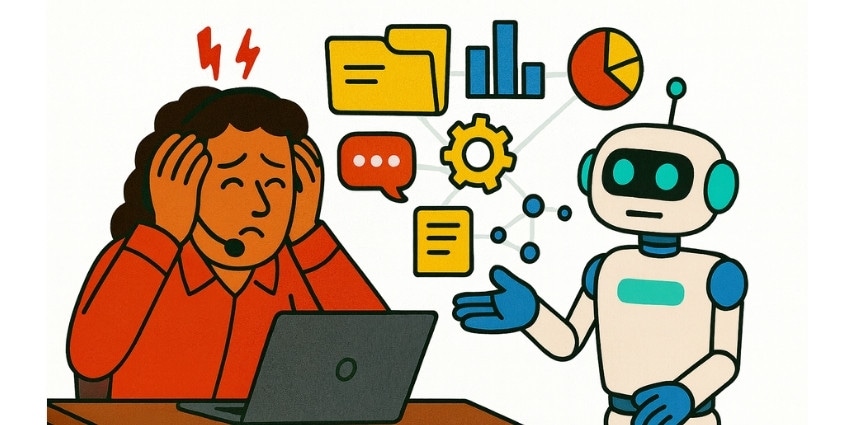
But when you sit down with agents away from their supervisors and their performance scores, many will tell you a different story. They're tired. Not from handling difficult customers or meeting ambitious targets, but from something more subtle and harder to name.
They're exhausted from being watched, guided, and scored by systems that never stop paying attention.
The Well-Intentioned Digital Supervisor
The technology itself is impressive. Modern AI systems can now analyze 100% of customer interactions rather than the traditional 1-3% sample size, tracking everything from sentiment shifts to script adherence in real time.
Contact centers have embraced these tools enthusiastically. According to Omdia's 2025 Digital CX Survey, the top reason North American contact center leaders invest in AI-powered CX technologies is to minimize agents' cognitive load, stress levels, and burnout.
The intentions are good. AI drafts responses during live calls. It surfaces customer data automatically. It whispers coaching advice through headsets. It summarizes interactions the moment they end.
For supervisors, the benefits seem clear. Dashboards display sentiment scores, performance metrics, and coaching opportunities across the entire team. No interaction goes unanalyzed. No pattern goes unnoticed.
But here's what the metrics don't capture: According to Omdia's survey, 75% of North American contact center leaders expressed concern about AI's impact on agents' well-being.
Something isn't working as planned.
The Cognitive Tax of Constant Guidance
Consider what it's like to work with an AI assistant that never stops helping.
You're on a call with a frustrated customer. The AI pops up a suggested response. You're already forming your own reply based on years of experience, but now you need to decide whether to use the suggestion or follow your instinct. That's one decision.
The system flags the customer's rising frustration. You already sensed it, but the alert adds pressure. That's another decision.
Your response goes slightly off-script. The AI doesn't flag it as an error, but your performance score adjusts slightly. You notice. That's mental energy spent wondering if you made the right choice.
According to research on AI in contact centers, these AI-based tools are often used to intensify monitoring through AI-enabled cameras and perpetual real-time coaching, which drives up stress and burnout, increases insecurity, and decreases satisfaction at work.
Psychologists call this vigilance tax. It's the extra cognitive effort required to monitor and correct a system that's supposed to reduce your workload. Every time an agent pauses to evaluate an AI suggestion, or worries about how their natural response will score against the algorithm, they're paying that tax.
Recent data shows 87% of agents report high stress levels, and over 50% face daily burnout, sleep issues, and emotional exhaustion. The paradox is striking: technology designed to help is contributing to the problem it was meant to solve.
From Assistance to Algorithmic Management
The shift has been gradual but significant. AI tools don't just assist anymore. In many contact centers, they manage.
AI-based coaching software serves as an algorithmic manager, providing automated coaching and direction during calls while also generating performance data that can influence variable pay, training, or disciplinary recommendations.
The system decides which calls agents take. It monitors tone of voice. It measures empathy. It tracks when agents pause, when they deviate from suggested language, and when they take too long to respond. All of this data feeds into performance evaluations that can affect pay, promotion opportunities, and job security.
Research indicates around 70% of workers feel that performance data is used primarily for disciplinary purposes rather than skill development, creating a sense of constant surveillance rather than support.
One agent described it this way: "I feel like I'm in a driving test that never ends. Even when I know I'm doing the right thing for the customer, I'm wondering how the algorithm will score it."
The Reality Behind the Dashboard
Let me share a real-world scenario that plays out across contact centers every day.
An experienced agent handles a complex financial services call. She's been with the company for five years and knows the products inside out. A customer is confused about a recent charge.
Her AI assistant, trained on thousands of similar interactions, immediately suggests a scripted response that technically addresses the question. But the agent senses the customer needs something different. A more personal explanation. An acknowledgment of their frustration before diving into the details.
She follows her instinct. The call ends well. The customer is satisfied.
But her performance score for that interaction dips slightly because she deviated from the AI's recommendation. Her supervisor doesn't question it, but she notices. Next time, she hesitates a fraction longer before trusting her judgment.
These trends are bad for workers, as they drive up stress and burnout, increase insecurity, and decrease satisfaction at work.
Multiply this scenario across hundreds of interactions, and you begin to understand why agents feel drained not by customers, but by the technology layer between them and their work.