

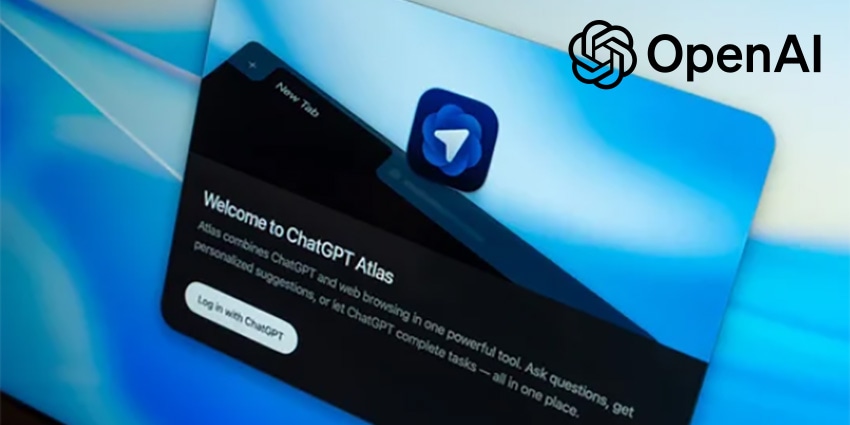
OpenAI’s new Atlas web browser is making waves across industries, stirring debate about how AI could fundamentally change the way consumers search, shop, and engage with content online.
Atlas is designed to bring ChatGPT directly into everyday browsing. The macOS-only release integrates AI-powered search, summarization, and agent capabilities in one window, allowing users to ask questions, receive contextual answers, and complete actions without switching between tabs or relying on traditional search engines.
An optional memory feature allows ChatGPT to recall context from the sites the user visits, helping it deliver more accurate and personalized responses over time. OpenAI is expected to release versions for Windows, iOS, and Android soon.
In an interview with CX Today, Tom Hay, Senior Manager at PSE Consulting, described Atlas as “an evolutionary experience from existing browsers in that you've got a normal browser, and then you've got the ability to open up a ChatGPT window beside your normal browsing window.”
The AI is “context sensitive, so it knows what it is that you're browsing, and so you can ask questions and get information about what you're browsing.”
While the integration of ChatGPT marks a shift in how people interact with the web, Hay noted that despite its novelty, “at the moment, I don't think that it is so different from using ChatGPT beside an existing browser.” As Atlas develops, it will become more tightly integrated and powerful, Hay said. But for now,
“It's going to take something significantly better in order to move people away from Chrome, which they might be locked into.”
Indeed, Chrome still dominates the market, holding more than 65% of global web browser share, a position that’s made it a prime target in the ongoing AI data race.
Major chatbot developers, including OpenAI, have been eager to move into the browser space to secure richer, real-world data for training their large language models (LLMs). OpenAI has even hinted at interest in Chrome itself, should regulators ever force Google to divest.
The launch of Atlas follows a recent court decision that allowed Google to keep its browser business intact, leaving OpenAI to carve its own path into everyday web use. Rivals like Perplexity are also moving fast with their own AI-powered browsers.
Dilemma for Merchants as AI Enters the Shopping Journey
Still, over time, OpenAI’s partnership with Stripe, through its Agentic Commerce Protocol (ACP), could redefine how consumers discover and buy products.
Hay explained that ACP “works on the basis of a merchant providing a product catalog feed into OpenAI, which it can then use.” This allows ChatGPT to act as a digital shopping assistant.
“If I say I would like to buy a blue striped T-shirt, then OpenAI can go and look at all the product catalogs that it's got access to and say, okay, here's all the blue striped T-shirts that I know about.” Over time, “it will become better and better, providing you with a very tailored set of products.”
However, the same technology that simplifies purchasing could sideline retailers. Hay warned:
“The merchant's website has been completely disintermediated... They've got no chance to upsell, cross-sell, get your marketing preferences, anything like that.”
That loss of direct engagement leaves many merchants “between a rock and a hard place because they know that if they refuse to play ball with the agentic commerce, then they will start losing more and more traffic.”
Many merchants had expected agentic commerce to be two or three years away, and now they are “scrambling” to respond, Hay said.
“Certainly some of them are saying this now goes close to the top of their priority list.”
When asked whether merchants might block AI agents, Hay replied, “only the biggest ones can afford to. And we've seen even Walmart in the US has come on board, and they're one of the early adopters of ACP.”
He added, “Amazon is the only one that is blocking completely. Presumably they're big enough and they have enough customer loyalty to say, ‘no, we know people are going to come to our website anyway.’”
Hay predicted merchants will eventually negotiate with OpenAI to regain some visibility: “OpenAI will allow merchants to... show through more of their promotions.
“OpenAI want to keep people within their ecosystem, so they don't want them jumping completely out onto the merchant's website. But I’m sure there will be negotiations so that merchants can expose more of their offers and marketing… It will help both parties because a bigger basket means bigger commission and fees for OpenAI.”
From the customer’s perspective, Hay believes that “as long as you are still in the decision loop... making an agentic payment... is not going to be that much different from clicking on the Buy Now button within Amazon, except it will work on any merchant site.”
He distinguished between guided and autonomous shopping:
“It's one thing to say, ‘go and find me some blue T-shirts. I'm going to choose the one that I want.’ It's a whole different level to say, ‘go off and find a blue t-shirt and buy it for me.’”
AI could even amplify loyalty behaviors. “If I'm a brand loyal shopper, then the AI will be able to proactively notify me when my preferred brands launch new product lines.” On the other hand, “if I'm much more of a price-conscious shopper, then it can act like Pricerunner... AI will be able to proactively notify me… of a good bargain which has just come up.”
Beauty and wellness marketplace Fresha says ChatGPT Atlas could revolutionize how people discover and book services online.