
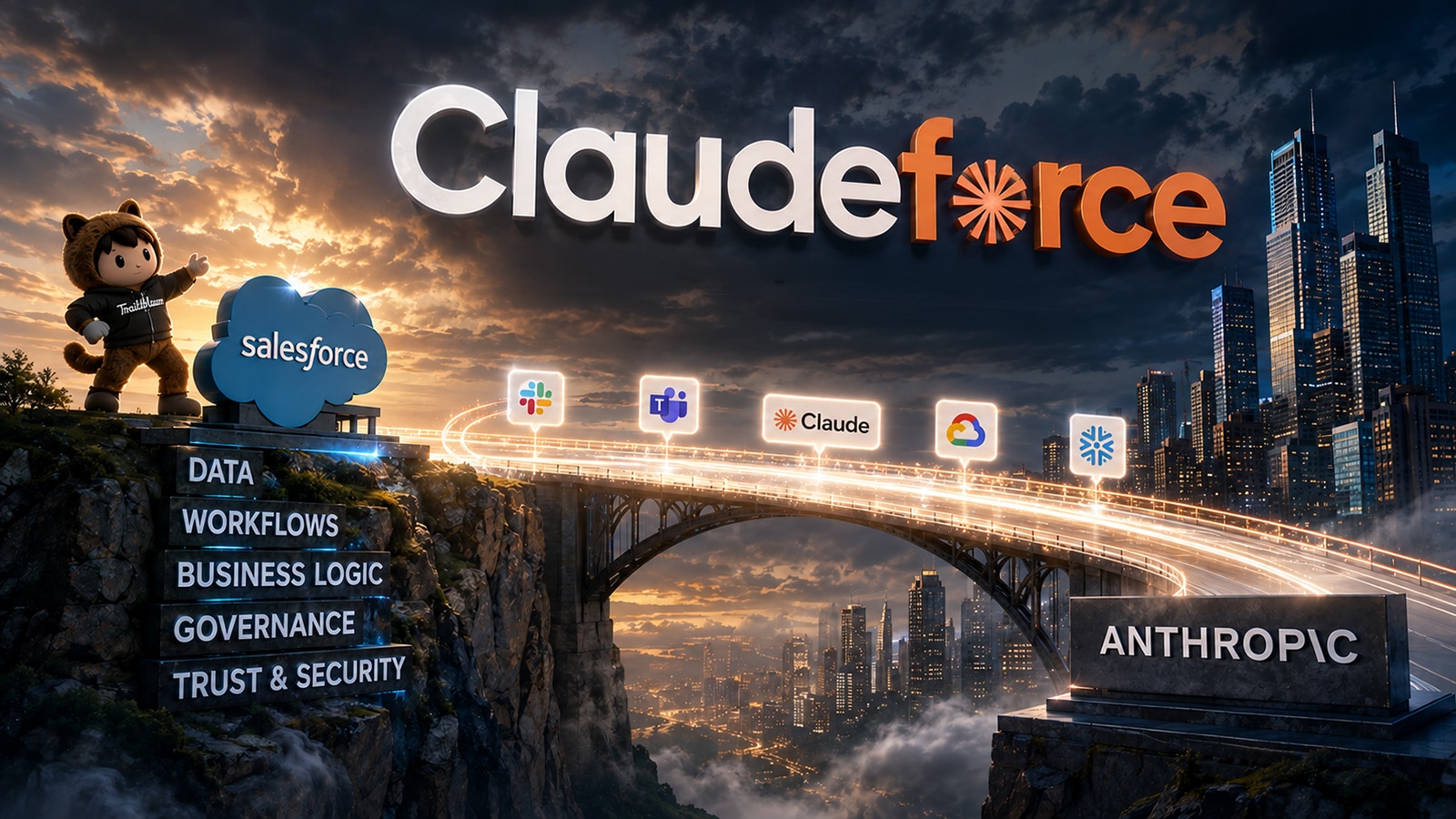
Salesforce and Anthropic have launched Claudeforce, bringing the Claude family of large language models (LLMs) directly into the systems enterprises use to manage customers, data and workflows.
The move is a clear sign that the vendor’s headless architecture strategy acknowledges the future of the business may be outside the Salesforce platform.
“We are bringing together the world’s number one AI and the number one CRM. It is really the best of both worlds,” Salesforce CEO Marc Benioff said on the company’s second quarter earnings call.
“We are combining Claude’s extraordinary intelligence and reasoning with Salesforce’s trusted data and applications and workflows and business rules and governance. While Claude might have been, for example, for developers, now it is also for knowledge workers.”
The first product, Salesforce in Claude, brings Salesforce directly into Claude through a plugin with 37 prebuilt sales skills, allowing sales teams to work with live Salesforce information, review deals and pipelines and take governed actions from within Claude. Salesforce said the integration is enabled by AIforce, which connects business data and workflows to agents through MCP servers, APIs and CLI tools.
In addition, Claude is available in Agentforce, serving as a reasoning model for the Atlas Reasoning Engine that powers Agentforce Vibes and Agentforce Coworker by default, and in Agent Builder. Claude is now the default model for Slack, powering Slackbot, Claude Tag and Slack Code.
The companies plan to expand the integration across Claude, Salesforce and Slack, with Salesforce in Claude available to select pilot customers and an open beta expected in September.
The expanded partnership with Anthropic means that the customer does not necessarily need to open Salesforce to use Salesforce, a concept that is at the core of Salesforce’s headless software strategy.
Salesforce is taking CRM beyond the UI
Salesforce launched the Headless 360 browser-free, API-first architecture in April 2026, acknowledging that AI agents are becoming a new interface for enterprise software that requires access to servers, skills, tools and integrations rather than applications designed for human interactions.
The vendor expanded Headless 360 across its platform last week, adding new MCP servers, Data 360 capabilities, Slack integrations, developer tools and reusable skills that any authorized AI agent can find and use securely through open standards.
The headless strategy reflects Salesforce's recognition that AI agents are fundamentally changing the way enterprises use software. Claudeforce provides a high-profile example of that strategy in action, as Salesforce looks to take the platform beyond its traditional application interface.
“For years, getting value out of sales meant logging in, clicking through screens, and navigating a UI. But AI agents don't use browsers, they call APIs, they invoke tools and they run commands,” Ansar Ahmed, Vice President of Solution Engineering for the UK and Ireland (UKI) at Salesforce, said during the company’s World Tour London keynote in June. “We now expose our data, our workflow, our business logic, and our trust rules directly to whoever or whatever needs it.”
Salesforce’s executives are now using language that may not have been anticipated before the arrival of the so-called SaaSpocalypse.
Natalie Pope, Principal Solutions Engineer at Salesforce, told CX Today at the June event: “If you'd asked anyone in our business two years ago what our business would look like today, I don't think anyone would have anticipated that we are where we are.”
“But I certainly think it's recognized that although the Salesforce user interface might not be the future of our business, the history that we've been building with the data models and the automations and workflows and business processes, and all of the governance and security that many, many customers have spent up to 27 years building, you can't just turn on Claude and have all of that up and running in five minutes, it's not as easy as that.”
Claudeforce is an example of Salesforce trying to establish itself as the governed enterprise layer underneath an increasingly fragmented collection of AI interfaces.
The strategy is already reaching well beyond core CRM.
Salesforce says Headless 360 now spans Marketing, Sales, Service, Commerce, MuleSoft, Informatica and Tableau. Its expanded architecture includes a Headless 360 MCP Server, Data 360 MCP Server, Slackbot MCP Client, more than 100 reusable Agent Skills, a Headless Experience Layer and Salesforce Multi-framework for building React applications with Salesforce authentication and governance.