
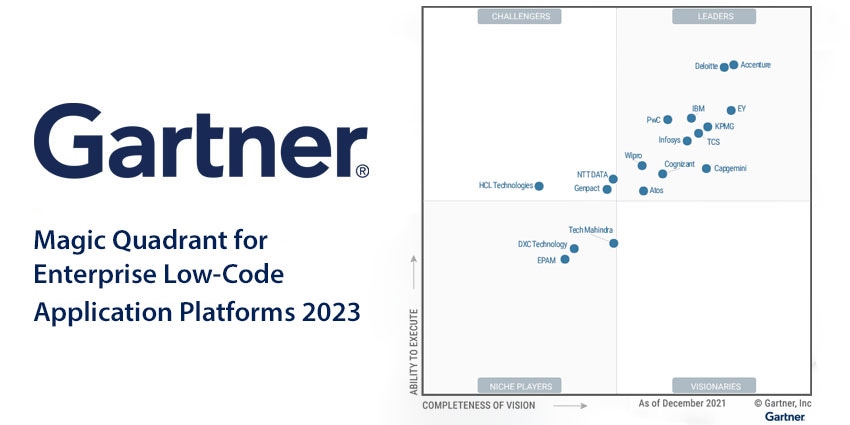
Gartner has released the 2023 version of its Magic Quadrant for Enterprise Low-Code Application Platforms (LCAPs).
LCAP providers offer organizations the tools to rapidly build and deliver applications to enterprises in various industries. Gartner notes that the top vendors support a host of personas, ranging from central IT experts to citizen developers.
The Magic Quadrant report aims to assist business leaders and buyers with a convenient resource for evaluating the top competitors in the industry.
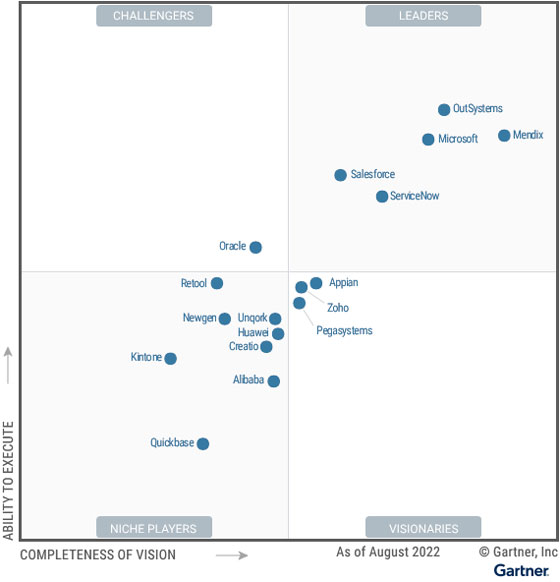
For this year’s report, Gartner has identified 17 competitors, with five market leaders.
Defining Enterprise Low-Code Application Platforms
Gartner defines LCAP solutions as application platforms used to rapidly develop custom applications.
Low-code innovators provide companies with convenient, streamlined ecosystems, which minimize the need for coding knowledge and programming.
According to Gartner, to be included within the Magic Quadrant, an LCAP must offer:
- Low-code capabilities: Graphical or model-driven programming for development.
- Simple application development support: Efficient user interfaces, business logic, data services, and workflow configuration tools.
- Simplified deployment: Streamlined tools for application testing, deployment, and technology management.
Aside from these three core capabilities, Gartner also notes LCAP solutions may feature many optional capabilities, such as catalog support for connectors, components and templates, and custom API generation.
Ideally, vendors will also offer simplistic front-end user experiences, business process automation and management, and AI-augmented assistance for development.
In addition, some solutions will include event-driven architecture support, citizen developer support, and assistance for on-premises and multi-cloud deployment.
Taking this definition into consideration, Gartner divides its list of vendors into four segments: Leaders, Challengers, Visionaries, and Niche Players.
Here, we’ll review each entrant on the 2023 Magic Quadrant.
Leaders
Leaders in the LCAP space demonstrate excellent execution and vision. They stand out in a global market, support a range of use cases, and provide access to a robust selection of tools. Mendix and OutSystems maintained their leadership position for 2023 from the previous year’s report. The complete list of leaders includes:
- OutSystems
- Mendix
- Microsoft
- Salesforce
- ServiceNow
OutSystems
Offering advanced low-code capabilities such as CI/CD and AI-augmented development, OutSystems enables the creation of complex applications with minimal effort. Gartner draws attention to the company’s exceptional marketing execution, initiatives to engage customers, and dedication to outstanding user experience. Additionally, OutSystems focuses heavily on enterprise-level extensibility and security. Nevertheless, according to Gartner, OutSystems does not offer distinct solutions for specific verticals or industries, and the company may rely heavily on partnerships.
Mendix
Mendix provides access to advanced low-code capabilities capable of addressing a range of use cases, including IoT and digital twins. The platform offers access to the MxAssist Performance bot, which proactively detects modeling and architectural patterns which implement app performance. The vendor also scored highly across most key capabilities, particularly in UX design, and offers flexible deployment options. However, Gartner notes Mendix’s marketing strategy relies primarily on support from its parent company, Siemens. Additionally, the brand has had limited success expanding its geographic strategy and vertical approach.
Microsoft
Power Apps has emerged as a valuable LCAP solution for the modern landscape, including access to Dataverse services, Power Pages, and Power Automate. Microsoft includes some Power Apps capabilities in most of its software plans, and users can access a range of connectors for their existing tools. Gartner applauds Microsoft’s product strategy, which targets API-driven development with access to various additional connectors. Plus, Microsoft offers heightened platform extensibility via an app and component store. However, according to Gartner, Power Apps may have some issues with mobile deployment and pricing structure.
Salesforce
Salesforce offers a comprehensive low-code platform as part of 12 industry cloud solutions. The company is committed to consistently unveiling new releases throughout the year. For instance, a recent addition to the platform includes Salesforce Flow. Gartner also commends Salesforce’s platform ecosystem, which comes packed with resources, and its community environment for developers. However, the analyst notes Salesforce has lagged behind other vendors from an innovation perspective. Additionally, due to a fragmented approach, the environment can be somewhat complex compared to competitor solutions.
ServiceNow
ServiceNow has rapidly grown as a SaaS vendor, achieving a massive geographical presence. The App Engine solution has played a significant role in this success. Meanwhile, according to Gartner Peer Insights, ServiceNow has very few complaints and an excellent approach to customer service. The company is also highly responsive, constantly rolling out new apps and components for developers. Despite this, Gartner warns ServiceNow has faced some issues due to its high service costs and limited industry reach.
Challengers
Challengers in the LCAP environment demonstrate strength in execution but lack the vision of market leaders. These companies achieve excellent results in their focus area. However, they have yet to expand beyond their core customers. This year’s only challenger is Oracle.
Oracle
Oracle is currently the third-largest vendor in application and middleware services, enjoying a proven track record in growth, revenue retention, and profitability. It also offers the APEX ecosystem as a value-added service and a cloud-based solution. From a geographical perspective, Oracle provides global support across 37 regions and fosters an active user community. However, the company has lagged behind other LCAP leaders in its workflow capabilities and native mobile support. Gartner also notes Oracle has been slow to implement features offered by other market vendors, such as a graphical application editor for logic.