

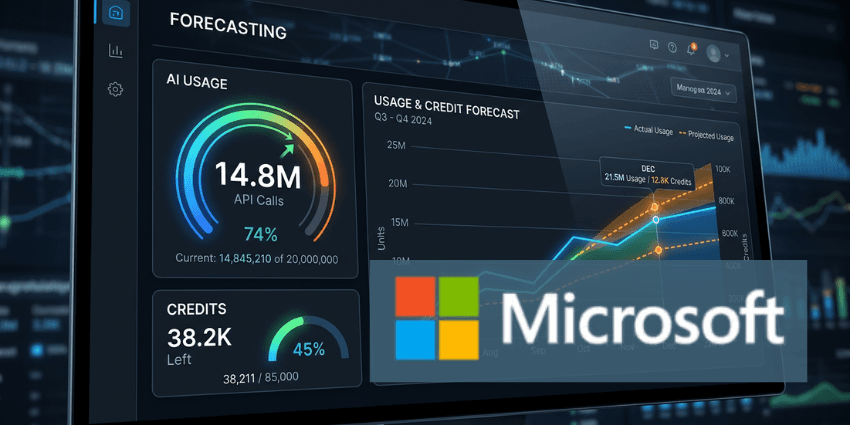
Microsoft has introduced AI Credit Estimation in Dynamics 365 Customer Service and Dynamics 365 Contact Center to forecast AI usage alongside forecasted service demand.
For the contact center, that’s more than a feature update. It is a signal that workforce management is changing shape. WFM is no longer just about scheduling humans to meet service levels.
For three decades, workforce management mostly meant advanced shift scheduling. Now, it is starting to look like the operational and financial control room for a blended workforce. That workforce includes human agents and AI agents that consume credits, tokens, and compute.
Why AI Is Breaking Traditional Workforce Planning
Contact centers know how to forecast demand. They have done it forever, across voice and digital channels. The weak spot is cost visibility once AI agents start doing real work.
AI agents can absorb spikes in demand. But their consumption is variable. Volume changes, and complexity changes too. That is how leaders end up explaining an unexpected ‘AI bill’ after the month closes.
In Microsoft’s framing, the gap is simple. Companies can forecast the work. But they can’t reliably forecast the AI capacity and cost needed to handle it. That is why estimation moves from nice-to-have to necessary. Gopal Yuvaraj, a Product Manager at Microsoft, outlined the intent clearly:
"AI Credit Estimation provides a direct and transparent way to translate forecasted demand into expected AI credit consumption."
AI Credit Estimation connects forecasting scenarios to projected AI credit use. Workforce planners can build a forecast scenario, then estimate AI credits for supported agents, including the Quality Evaluation Agent, Case Management Agent, and Customer Intent Agent.
Microsoft also describes this shift as making AI cost a first-class planning input. That matters because it formalizes AI agents as something you plan for, not something that ‘just runs’ inside a license.
On the practical side, Microsoft’s estimator outputs planning metrics, including total projected credit consumption and average and maximum monthly usage. Teams can also analyze projected consumption by time interval, queue, and channel.
WFM’s New Job: Blended Workforce Unit Economics
This is the bigger story CX leaders should care about. WFM is heading toward blended workforce optimization.
The future WFM analyst will still care about staffing and occupancy. But they will also manage AI unit economics. They will need to answer questions like these in real time:
How much does an AI agent cost per resolved case this week? How does that compare to the fully loaded cost of a human-assisted resolution? When AI performance dips and humans must clean up, does the blended cost rise fast? When demand surges, should the center add overtime or expand AI capacity?
That last point is where the market is heading. AI is starting to behave like a digital employee with a variable salary. It scales fast, but its cost is metered.
Microsoft is not the only vendor pushing this thinking into operations tooling. Contact center platforms are starting to treat AI agents as first-class workforce resources that require lifecycle governance and performance accountability.