
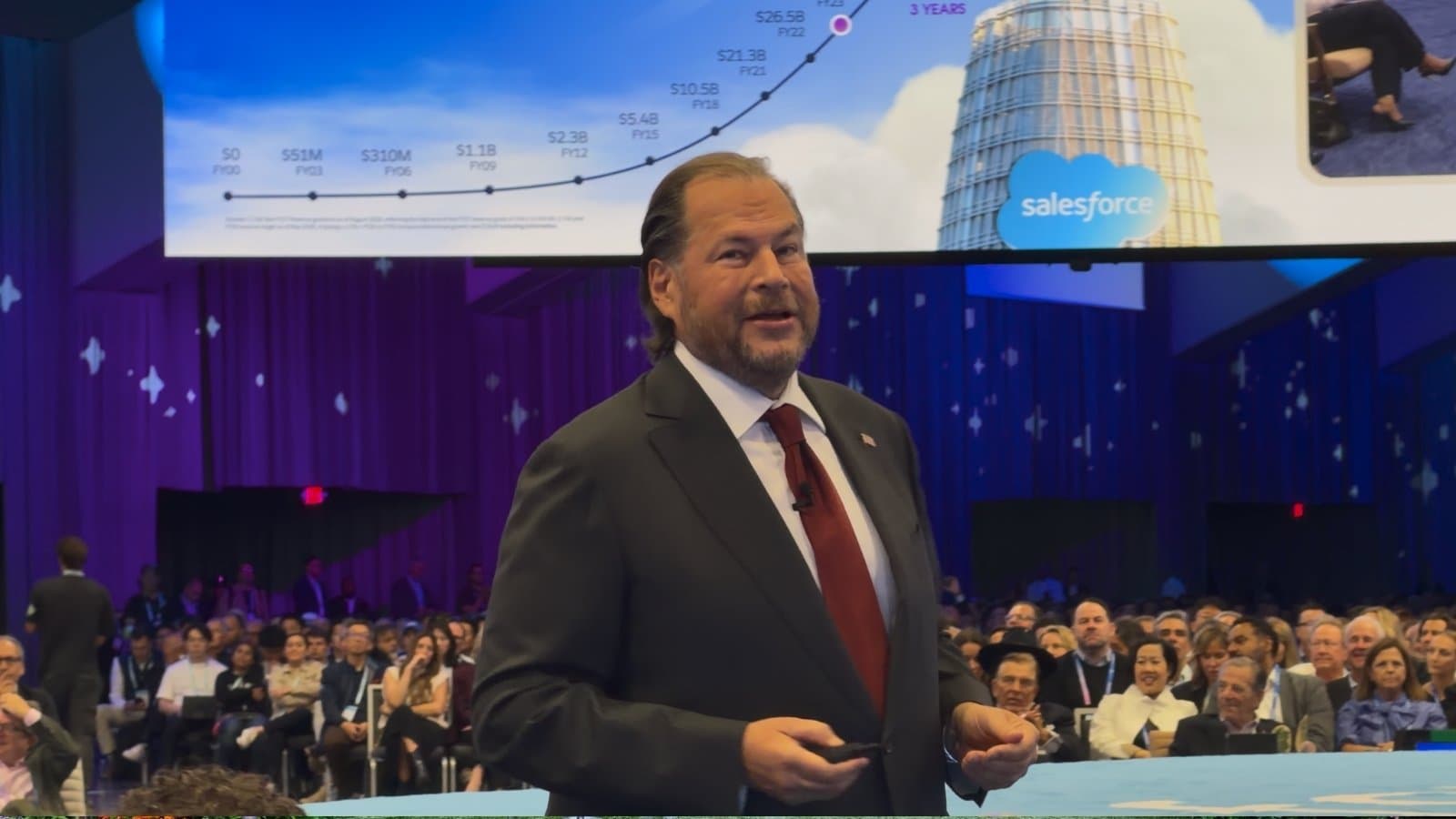
SAN FRANCISCO — Salesforce has arrived at Dreamforce 2026 with an argument that would once have sounded unusual for a CRM company: the future of CRM may involve spending far less time inside the CRM itself.
The company’s ambition is not simply to put generative AI alongside its existing applications. It wants customer data, business rules, permissions, workflows, and approved actions to follow employees into the AI and collaboration tools where work is increasingly happening—starting with Claude and Slack, while extending to other AI experiences through its broader platform strategy.
That is the headline behind AIforce, Salesforce’s new umbrella for its agentic user experiences. It is also a significant rethinking of the company’s own role. Salesforce is betting that the CRM interface becomes less important than the governed system underneath it.
“You may never log in to Salesforce again.”— Parker Harris, Salesforce co-founder, on the Slackforce vision
For enterprise customers, that is a big proposition. It suggests a future where a service leader may investigate a case in Slack, an employee may ask Claude to retrieve customer context and take an approved action, and an AI agent may work across records, workflows, contact-center systems, and knowledge sources without someone manually navigating a traditional CRM screen.
It is an appealing vision for organizations tired of switching between applications. But it is also where the Dreamforce story becomes more difficult than the demos. Enterprise transformation does not move at the pace of AI innovation. Data is fragmented, workflows are inconsistent, permissions are complicated, and a service failure can have real customer, regulatory, and reputational consequences.
The question for CX leaders is not whether this interface shift is coming. It is how quickly their organization can safely make use of it—and whether the result is better resolution for customers rather than simply another way to access the same disconnected systems.
Salesforce Is Reimagining CRM as a Governed AI Layer
Marc Benioff described AIforce as an “interface revolution.” His message was that Salesforce’s real value does not lie in its screens. It lies in the customer and business context behind them: data, metadata, permissions, rules, workflows, security controls, and audit trails.
“AIforce is here to unlock trapped value from anywhere.”— Marc Benioff, Chair and CEO, Salesforce
This is the logic behind Salesforce’s expanding partnerships with AI providers including Anthropic, OpenAI, and NVIDIA. Salesforce is not presenting one model as the answer to every enterprise problem. Instead, it is positioning itself as the layer that connects models and agents to the information, controls, and tools needed to do work inside an enterprise.
In theory, that means a model can help reason through a customer issue, but Salesforce’s permissions, business rules, and workflows determine what information can be accessed and what action can be taken.
That distinction matters. An AI model may produce a useful answer to a service question. But answering “Where is my order?” is different from checking entitlement, finding an exception, updating a record, issuing an approved refund, arranging a replacement, or recognizing that the customer should speak to a person.
Salesforce’s pitch is that AIforce provides the layer between those two things: AI reasoning and enterprise execution.
ClaudeForce and Slackforce Show What the New Interface Could Look Like
Salesforce used the keynote to demonstrate ClaudeForce, its integration with Anthropic’s Claude Enterprise. The aim is to let employees ask Claude for Salesforce context—such as account information, customer history, or recommended next steps—and take authorized action without opening the conventional Salesforce interface.
Patrick Stokes, Salesforce President of Applications and Marketing, demonstrated Sales Cloud operating in Claude, including a digital version of Salesforce co-founder Parker Harris. Salesforce said the setup could be completed in six to eight minutes.
Anthropic CEO Dario Amodei joined Benioff on stage and said he was surprised that the technology was moving at such a pace in the business world. But he also said there was still “so much diffusion left to do.” That may be one of the more grounded observations from the keynote: the technology is advancing quickly, while widespread operational adoption remains unfinished.
Slackforce is Salesforce’s other major interface bet. It brings CRM context and actions into Slack, while Slackforce Surfaces can turn prompts into live dashboards, reports, and interactive working views based on available Salesforce, Slack, and connected enterprise data.
For CX operations, the use case is clear. A service leader could ask for a live view of critical cases, SLA breaches, customer tier, and case severity within the same Slack channel where the team is coordinating its response.
But the value of a new interface depends on the integrity of the information inside it. Teams will need clarity on data freshness, source systems, permissions, auditability, and what happens when the customer data visible in Slack conflicts with another operational system.
AIforce Is Also a New Operating Model for Customer Experience
Salesforce is pairing its interface strategy with a broader portfolio of Agentforce agents, including Casey, its customer-support agent, and Fin, its cross-channel customer agent.