
Most sales and marketing teams are not short on data. They have engagement scores, intent signals, website analytics, and CRM records. What they often lack is a clear way to turn all of that into a decision: which account to call today, which content to show a visitor, and which deal is actually worth the team’s time.
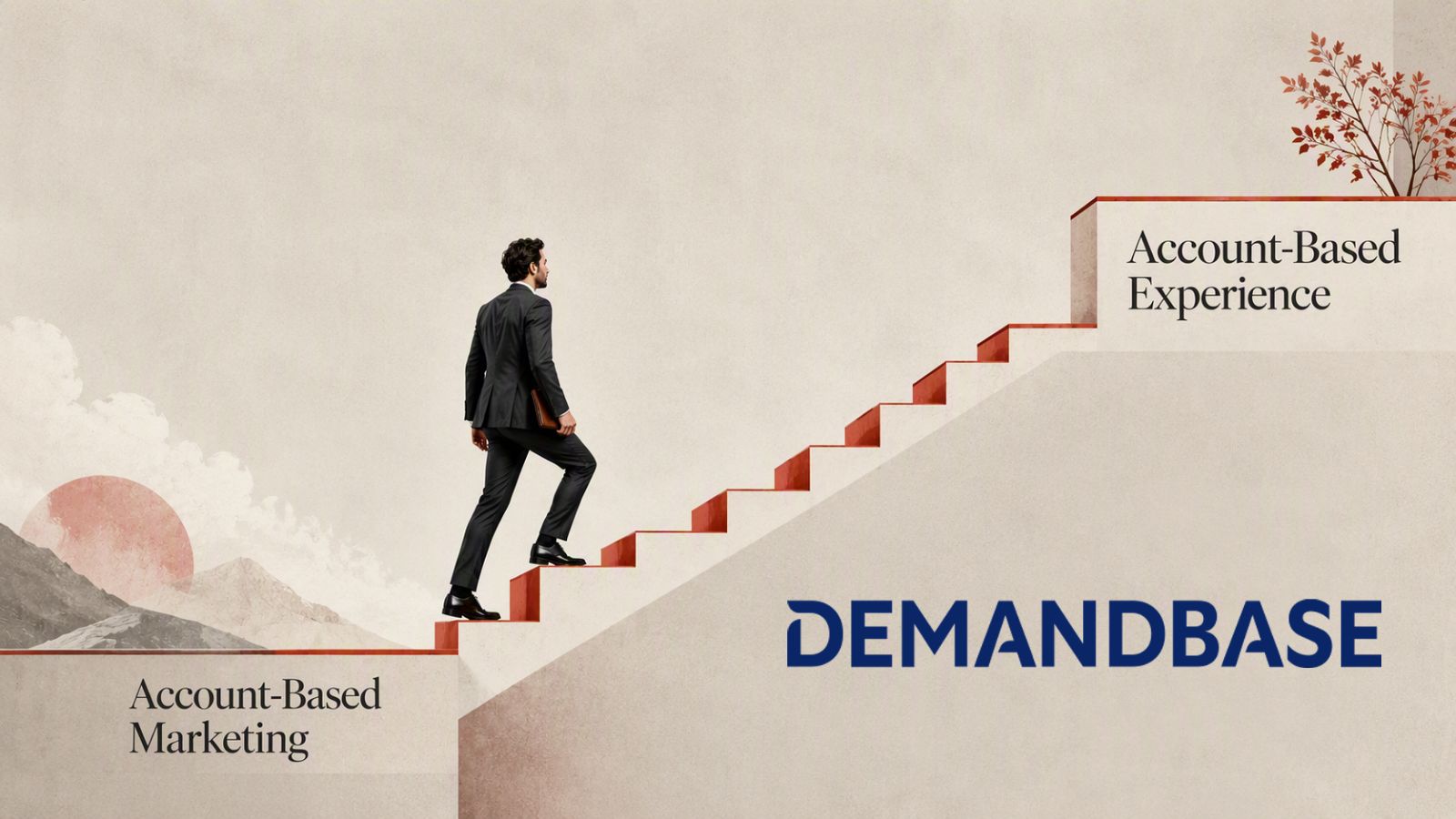
That is the problem account-based experience strategies, or ABX, is designed to solve. Rather than treating marketing and sales as separate functions working from separate lists, ABX asks both teams to focus on the same accounts, use the same data, and act in a coordinated way throughout the buying journey.
Demandbase has built its go-to-market platform, Demandbase One, around that idea. Two of its customers, CyberArk and SAP Concur, offer a useful look at what ABX looks like once it moves from strategy into daily practice, and what results can look like when sales and marketing genuinely work from the same playbook.
What Is Account-Based Experience (ABX)?
Account-based experience is a go-to-market strategy that uses data and insight to guide relevant, coordinated marketing and sales actions across the full customer lifecycle. Rather than casting a wide net and hoping the right buyers respond, ABX starts by identifying the accounts most likely to generate real value, then aligns marketing, sales, and other customer-facing teams to engage those accounts consistently.
Demandbase’s own definition of ABX breaks the idea into a few practical parts. It uses data and AI to know when and how to engage a given account. It works across marketing, sales, and customer success rather than being owned by a single team. And it covers the whole customer relationship, from early brand awareness through to renewal and expansion, not just the initial deal.
Done well, this approach can change how a sales team spends its day. Instead of working down a long, unranked list of accounts, reps can see which ones are showing real buying signals and which conversations are worth prioritizing. Marketing, in turn, can support that same list with content and outreach that matches where each account actually is in its journey.
The two examples below show what that looks like when the theory is put into practice, one from the perspective of a sales team trying to close more of the right deals, and one from a marketing team trying to guide buyers through a smoother digital journey.
How Did CyberArk Use Demandbase ABX to Improve Close Rates?
CyberArk, a global identity security company, had a familiar problem. As the business grew, its solution-specific and vertical-based sales teams ended up working from overlapping account lists, with little shared understanding of which accounts actually mattered most. Its existing account scoring system worked like a black box. Sales teams could see a score, but not the reasoning behind it, and that made the numbers hard to trust.
Working with Demandbase, CyberArk rebuilt its account model. Product marketing, solutions, and campaign teams worked together to redesign the intent and propensity models behind account scoring, using closed-won deal history to understand what a genuinely high-potential account actually looked like. Instead of relying on a single signal, the team combined engagement data with propensity scoring to find what it called its “top quadrant,” the group of accounts showing both strong buying signals and real engagement.
According to the case study, accounts in that top segment converted at four times the average close rate. Just 3% of CyberArk’s targeted accounts went on to generate more than a third of its total pipeline, a sign of how much value was concentrated in a relatively small, well-chosen group.
Getting the model right was only part of the work. CyberArk also rolled out global training at its sales kickoff, set up regional office hours, and gave every account executive and sales development rep automated weekly reports showing which accounts to prioritize and why. That combination of clearer data and consistent enablement appears to have made a real difference to how sales teams felt about the process.
Renske Galema, AVP Northern Europe at CyberArk, said:
“Demandbase has made it so clear which accounts to prioritize and when to engage, and that has had a direct impact on our win rates. We know where spending our time and effort will have the most success.”
Key Takeaways: CyberArk
- CyberArk rebuilt its account scoring model using closed-won deal history to make prioritization transparent, not a black box.
- Combining engagement and propensity data identified a “top quadrant” of high-value, high-likelihood accounts.
- Accounts in that top segment converted at four times the average close rate, with just 3% of target accounts driving over a third of total pipeline.
The bigger shift, according to CyberArk’s team, was cultural as much as technical. Marketing, sales, and operations moved from running separate efforts to operating around one shared account model, something the company now refers to internally as its “ABX Trifecta.”
How Did SAP Concur Use Journey Stages to Increase Funnel Velocity?
SAP Concur, which provides travel, expense, and invoice management software, faced a different kind of challenge. Its digital marketing team wanted to make its website more useful for early-stage visitors, so it removed some gated forms from top-of-funnel pages and replaced them with more open, educational content. The idea was straightforward: let people learn at their own pace before pushing them toward a form.
That change helped some visitors, but it also created a new problem. Some pages saw stronger engagement, while others saw steeper drops in conversion than the team expected. It became clear that removing friction for everyone was not the same as giving each visitor the right experience for where they actually were in their buying journey.
The team, led by Lindsay Hasz, Director of Insights and Optimization, turned to Demandbase’s journey stage data They split website visitors into two groups: an “awareness” segment still in the early stages of self-education, and a “demand generation” segment showing signs of being further along and ready for more substantial content. Demandbase’s intent and engagement signals were combined with SAP Concur’s own first-party data, including repeat visits, video views, and file downloads, to sharpen how each visitor was classified.
Lindsay Hasz, Director of Insights and Optimization at SAP Concur, said:
“Demandbase allowed us to create segments based on journey stage combined with our own first-party behavioral data.”
From there, the website experience was personalized by segment. Awareness-stage visitors continued to see ungated, educational content, while demand-generation visitors were shown higher-value assets such as buyer’s guides, whitepapers, and forms. According to the SAP Concur case study, the demand-generation audience converted at a 52% higher rate than before. The average time those accounts spent in the engaged stage dropped from 137 days to 35 days, which SAP Concur describes as a fourfold increase in velocity. Awareness-stage visitors also moved to the next stage roughly twice as fast as they had previously.
Key Takeaways: SAP Concur
- SAP Concur segmented website visitors into “awareness” and “demand generation” groups using Demandbase signals plus its own first-party behavioral data.
- Each segment saw a personalized web experience, gated content for demand-gen visitors, ungated content for awareness-stage visitors.
- The demand-gen segment saw a 52% higher conversion rate and moved through the funnel four times faster, dropping from 137 to 35 days.
The lesson SAP Concur took from this was not that gated content is always better or worse. It is that matching the experience to where a buyer actually stands in their journey matters more than applying one rule to every visitor.
CX Awards 2026
Applications for the CX Awards 2026 Are Now Open
Is your team improving the customer journey through closer sales and marketing alignment? Find out how to apply for the CX Awards 2026 and put your work in front of the CX industry.
Why Is ABX Becoming More Important for Revenue Teams Now?
Account-based approaches are not new, but what teams expect from them, and what is realistically possible, has changed considerably. Gartner’s Account-Based Marketing Framework notes that account-based strategy has shifted from manual, one-off efforts to something far more data-driven and continuous. Where teams once relied on predefined segments and single touchpoints like a workshop or an assessment, Gartner’s 2026 research describes today’s leading programs as using real-time data for scalable segmentation, and running fully orchestrated programs across inbound, outbound, and sales development efforts.
Why Now?
Gartner’s framework shows account-based strategy shifting from manual, single-touchpoint efforts toward continuous, data-driven programs that require aligned data, technology, and process across the whole revenue team. At the same time, Demandbase has expanded integrations with tools revenue teams already rely on, including Gong, Outreach, and HubSpot, making account intelligence usable inside the systems teams already work in daily, rather than a separate dashboard.
Gartner’s framework also makes a point that lines up closely with what CyberArk and SAP Concur experienced: an account-based strategy depends on more than good intentions. It requires clean data, a workable technology stack, defined processes and handoffs between teams, and a way to measure whether the whole thing is actually working. Skip any one of those pieces, and the strategy tends to stall, regardless of how good the initial account list looks.
Put together, the direction is clear. Account-based strategy is moving away from being a specialist marketing tactic and toward being a shared operating model that spans data, technology, and process across the whole revenue team.
What Should Sales and Marketing Leaders Look for in an ABX Approach?
Both examples point toward a similar set of questions worth asking before adopting or expanding an account-based strategy.
Buyer Checklist: Evaluating an ABX Approach
- Can the platform explain how and why an account is scored, rather than presenting a number with no context?
- Does it combine engagement and intent data to surface accounts that are both likely to buy and actively engaged?
- Can content and outreach be personalized to a buyer’s actual stage in the journey, not applied uniformly to every visitor?
- Does it integrate with the tools your reps and marketers already use day to day, such as your CRM, conversation intelligence, or sales engagement platform?
- Is there a plan for enablement and adoption, not just implementation, so teams actually trust and act on the data?
None of this requires every organization to build the exact same programs CyberArk or SAP Concur built. But both examples point to a consistent idea: ABX works best when it helps a real person, whether that is a seller deciding who to call or a marketer deciding what to show a visitor, make a better decision than they could have made with a generic list or a one-size-fits-all page.
What Can Sales and Marketing Leaders Learn From These ABX Use Cases?
A few practical takeaways stand out from these two examples.
First, account prioritization needs to be something sales teams can actually understand and trust. CyberArk’s experience shows what happens when scoring feels like a black box: adoption suffers, no matter how sound the underlying model might be. Making the reasoning behind a score visible, and tying it back to real closed-won history, appears to have made a meaningful difference to how confidently CyberArk’s sales team acted on it.
Second, one experience does not fit every buyer. SAP Concur’s team learned this directly when removing all gated content did not produce the uniform lift they expected. Recognizing where a buyer actually sits in their journey, and adjusting the next step accordingly, mattered more than applying a single rule across the board.
Third, technology alone rarely changes behavior. CyberArk’s enablement program, including training, office hours, and regular reporting, was just as important to its results as the underlying data model. An account-based strategy tends to succeed or fail based on whether the people using it understand it and trust it enough to change how they work.
Frequently Asked Questions
What is account-based experience (ABX) marketing?
ABX is a go-to-market strategy that uses data and insight to coordinate relevant marketing and sales actions around a defined set of target accounts, across the full customer lifecycle rather than a single campaign.
How is ABX different from traditional demand generation?
Traditional demand generation typically focuses on generating individual leads at scale. ABX instead concentrates effort on a smaller number of high-value accounts, coordinating marketing and sales activity around the same target list and buying groups.
How did CyberArk use Demandbase to improve its close rates?
CyberArk worked with Demandbase to rebuild its account scoring models using closed-won deal data, combined engagement and propensity signals to identify its highest-potential accounts, and paired that with sales training and reporting. CyberArk reported four times higher close rates among its highest-priority accounts.
How did SAP Concur use journey stages to increase funnel velocity?
SAP Concur segmented website visitors into awareness and demand-generation groups using Demandbase signals and its own first-party behavioral data, then personalized which content each group saw. SAP Concur reported a fourfold increase in funnel velocity for its demand-generation segment.
Why do integrations with tools like Gong, Outreach, and HubSpot matter for ABX?
Account and buying-group insight is only useful if sales and marketing teams can act on it inside the systems they already use each day. Integrations help surface that insight directly within existing sales and marketing workflows, rather than in a separate platform.
CX Awards 2026 Category
Best CX and Marketing Alignment
Explore the CX Awards category recognizing organizations that connect marketing, sales, and customer experience around more relevant, coordinated customer journeys.