
Salesforce says businesses are rapidly scaling AI agent deployments, but data readiness, workflow complexity and unclear success measures could determine whether Agentforce adoption translates into better customer experiences.
Enterprise use of AI agents is accelerating, according to Salesforce, with the average number of activated agents per organization nearly tripling over the past year.
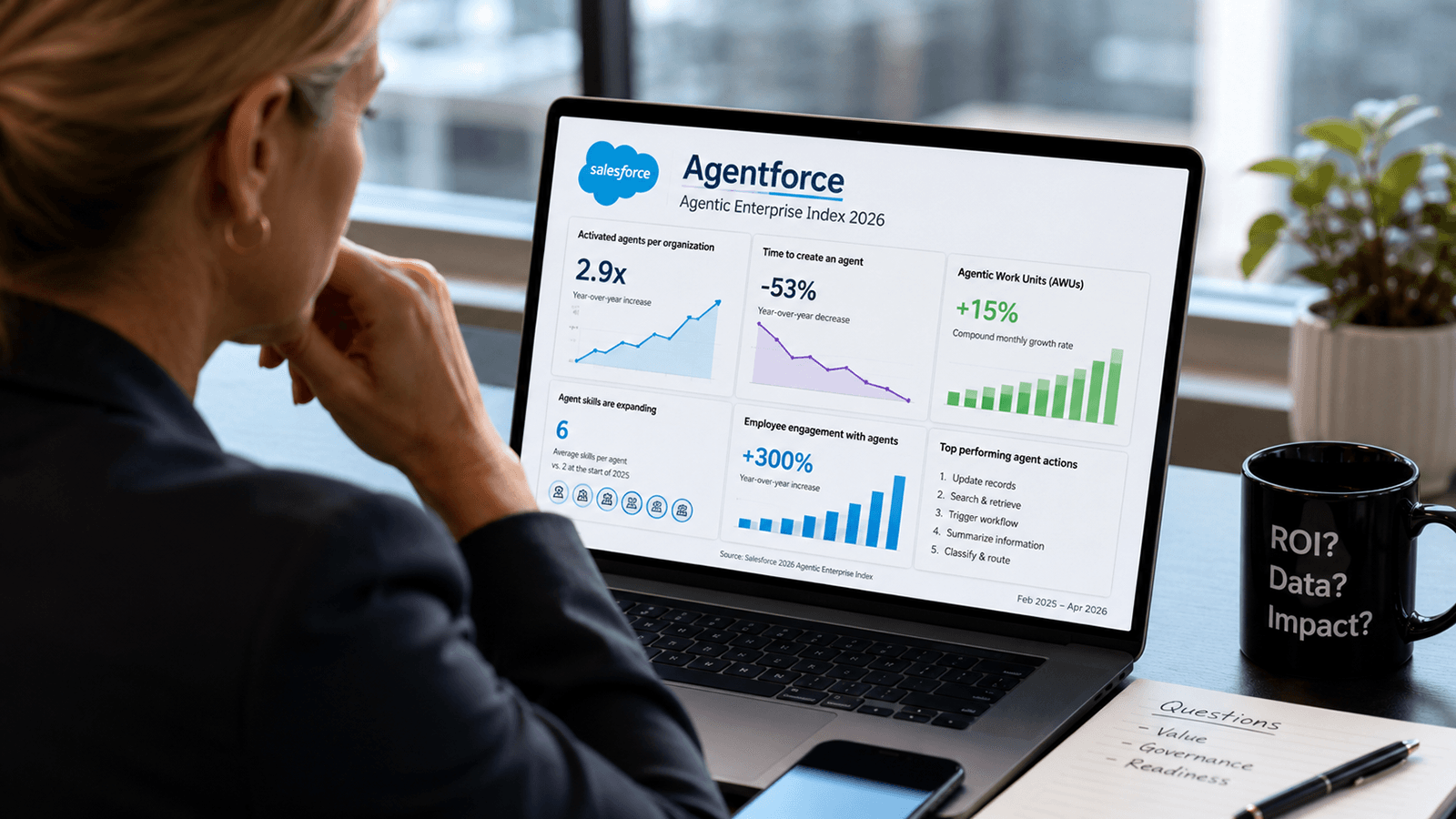
The finding comes from Salesforce’s 2026 Agentic Enterprise Index, which analyzes aggregated usage data from businesses using Agentforce and other Salesforce products between February 2025 and April 2026.
The report found that organizations in its dataset increased activated agents by nearly three times, while the average time required to create an agent fell by 53 percent. Agents are also taking on more capabilities, with the average agent able to perform six distinct business actions by the end of 2025, compared with two at the beginning of the year.
The findings add to Salesforce’s wider push to position agentic AI as the next phase of enterprise automation.
“Whether you're spinning up agents to operate at massive scale or orchestrating them through deep, multi-step pipelines, the bottom line is they’re shipping real value,” said Joe Inzerillo, Salesforce President of Enterprise AI and Technology. “That ROI isn't just showing up on the top line in sales numbers, but execution efficiency. We are moving from passive chatbots and predictive models to execution-driven agents that actually roll up their sleeves and drive real value.”
But there is an important qualification to the figures.
The businesses included in the Agentic Enterprise Index had to have agents activated in production every month throughout the analysis period, indicating how organizations already committed to Agentforce are using the technology, rather than providing a measure of adoption across the wider Salesforce customer base.
Salesforce said the increase in deployments is being accompanied by a rise in agent versatility.
During peak shopping periods, retail agents averaged nine skills, a 350 percent increase that Salesforce said reflects their ability to handle more complex, multi-step customer needs as demand increases.
Agents are also increasingly operating across different parts of the enterprise technology stack.
A service agent may retrieve a customer record, access sales information and make a personalized recommendation, rather than simply answering a question. Salesforce measures this activity using its Agentic Work Unit (AWU), which represents a discrete task completed by an AI agent. AWU output increased at a compound monthly growth rate of 15 percent through April 2026, according to the report.
Salesforce’s Two Models of Agent Adoption
The Agentic Enterprise Index identifies two broad deployment approaches.
Consumer-facing industries tend to favor high-volume, task-specific agents that can respond quickly to immediate customer needs. More operationally complex and heavily regulated sectors tend to prioritize versatile agents capable of handling multiple steps and applying cross-functional business logic.
Retail provides an example of the first model. Salesforce says retail agents generally perform one or two simple actions during much of the year, but expand to an average of nine actions during peak shopping periods.
The company cites Pandora’s Agentforce-powered Gemma as an example. According to Salesforce, Gemma handles 60 percent of routine support requests during peak traffic while contributing to a 10 percent increase in NPS.
More complex deployments are emerging in industries such as manufacturing and financial services. Salesforce said Siemens uses a coordinated multi-agent workflow to qualify leads across seven business units, with different agents responsible for engaging prospects, collecting missing information, applying qualification rules and routing leads.
For some CX organizations, the primary value of an agent will come from handling large volumes of relatively simple requests. For others, the value may come from coordinating complex processes that previously required employees to move between multiple systems.
Both approaches create different requirements around governance, integration and measurement. The question is whether increasing agent activity also translates into better customer outcomes.
Enterprise AI Adoption Still Has a Data Problem
That question becomes more complicated when the technology is deployed across fragmented enterprise environments.
Muj Choudhury, CEO of RocketPhone.ai and a former Salesforce Director, told CX Today in a recent interview that data remains one of the biggest areas of AI readiness that enterprises underestimate.
“Companies and enterprises in particular have a pretty unique advantage in the sense that they have a lot of historic data. And they're also capturing data every single second of the day, whether they know it or not. And preparedness for me is ‘how do you leverage what you have today?’ But more importantly, how are you going to tap into the data that's being generated?”
That is particularly relevant to Agentforce as Salesforce expands the range of tasks agents can perform. The more systems an agent needs to access, the more important the consistency, availability and context of the underlying data become.