

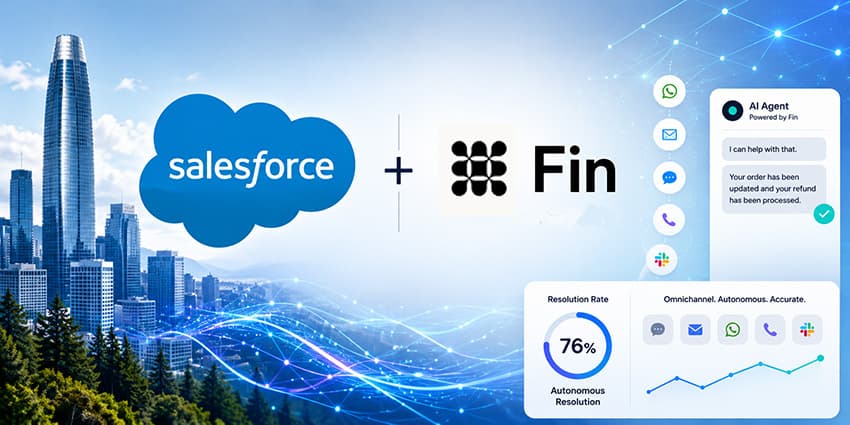
Salesforce is acquiring AI customer service company Fin, formerly Intercom, in a $3.6BN deal that indicates the CRM giant is aggressively focusing on autonomous service agents as a potential growth engine in customer experience technology.
The acquisition brings one of the biggest names in CX from the past decade into Salesforce’s portfolio. Founded in 2011, Intercom helped define modern conversational customer engagement, particularly among startups and digital-first businesses, through its messaging-first approach to customer support.
Recently rebranded as Fin, the company has reinvented itself around AI-native customer service automation, a transition that Salesforce appears to view as strategically important with the software industry shifting towards agentic AI systems.
The difference in scale between the two companies highlights the long-term nature of the bet. Fin reportedly generated roughly $100MN of Intercom’s $400MN annual recurring revenue (ARR) last year, compared with Salesforce’s more than $42BN in annual revenue. Salesforce clearly expects future growth from AI service automation to materially influence its revenue trajectory over time.
Salesforce CEO Marc Benioff said in a statement:
“We’re thrilled to welcome Fin to Salesforce as we enable every company to become an agentic enterprise.”
Salesforce Targets the Midmarket AI Customer Service Opportunity
The acquisition gives Salesforce access to a segment it has not always captured consistently: a faster-moving midmarket customer base seeking quicker deployment and lower operational complexity.
While Salesforce dominates enterprise CRM, many midsize organizations have tended to gravitate towards lighter-weight customer service platforms that require less customization and implementation effort.
That is where Fin comes in.
Fin’s AI customer service platform is designed for fast deployment, with pre-trained AI agents that companies can launch without extensive workflow engineering or large professional services engagements. Salesforce said the company serves more than 30,000 customers globally.
That positioning could prove valuable as businesses move from AI experimentation into production deployments and increasingly prioritise measurable outcomes over platform breadth.
Why Fin’s AI Agent Strategy Appeals to Salesforce
Intercom has positioned Fin as a broader customer-facing AI agent that can operate across the customer lifecycle, rather than simply as a customer service chatbot.
Paul Adams, the company's Chief Product Officer, pointed out in a recent CX Today interview that customers do not experience businesses through internal silos such as sales, service, onboarding or success.
“For a customer, it’s a company, it’s a brand, it’s a product, and they don’t care about your internal issues or whether one department talks to the other.”
It’s a view that aligns closely with Salesforce’s push to connect customer data, workflows and AI across the enterprise.
“Sales and service are very naturally aligned. In fact, they overlap. And when customers are dealing with businesses, they’ll move from sales to service very, very naturally,” Adams said.
Intercom’s answer to that overlap is a single AI agent that can be trained across multiple customer-facing roles, rather than a collection of disconnected bots sitting inside separate business functions.
“In the pre-AI world, you just can’t train a human to be brilliant at service and brilliant at sales. It’s a different set of skills. So you have these two departments, but you can train AI to do it,” Adams said. “With Fin, we have a very strong conviction in having a single customer agent for all customer communication, because you can train Fin to be good at all of these things.”
This approach could be particularly attractive to Salesforce because it directly addresses fragmented customer context, which is one of the biggest problems in enterprise CRM. Adams warned that deploying separate AI agents for different departments could recreate the same broken handoffs that have long frustrated customers.
“If you have multiple agents, one for sales, one for service, one for success, especially if these agents come from different companies… These agents have different context... They have different customer history, different memory, and it’ll end up being a big mess.”
Intercom has been taking Fin in the direction of unified customer records and shared memory across the complete customer relationship, launching Fin for sales after Fin for service, followed by Fin for e-commerce. Adams indicated that “we’ll have more roles for Fin. Fin will do onboarding and success and all sorts of things like that.”
The acquisition gives Salesforce an AI-native model for how customer communication may evolve away from department-specific tools and toward a single agentic layer sitting across the customer journey.
Salesforce Expands Its AI Contact Center Ambitions
The deal also strengthens Salesforce’s ambitions in the contact center market. Salesforce has been pushing into the contact center as a service (CCaaS) space, positioning Service Cloud, Service Cloud Voice, and more recently Agentforce as AI-driven alternatives to traditional contact center platforms. The company has increasingly emphasized unified digital and voice engagement, automation and agent augmentation as enterprises modernize customer service operations.
Unlike legacy CCaaS vendors that grew around telephony infrastructure, Salesforce has approached the market from the CRM and workflow layer outward, combining customer data, case management, automation and AI inside a single platform.
Unlike legacy CCaaS vendors that grew around telephony infrastructure, Salesforce has approached the market from the CRM and workflow layer outward, combining customer data, case management, automation and AI inside a single platform.
Fin could accelerate that strategy. Its AI agents operate across chat, email, WhatsApp, SMS, phone and Slack, giving Salesforce an established omnichannel autonomous support layer that can sit inside broader customer engagement workflows.
CEO and co-founder Eoghan McCabe wrote in a post on X: