
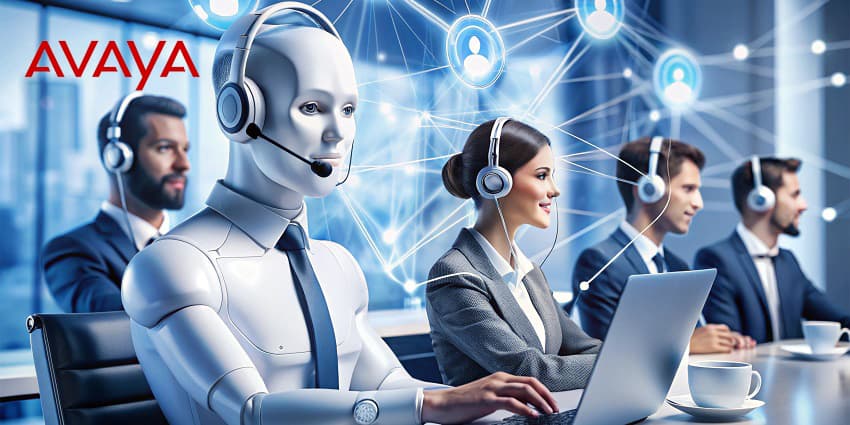
Artificial intelligence (AI) is reshaping the landscape of customer experience (CX) and employee experience (EX). Organizations are no longer just using AI to charge their self-service capabilities but are integrating it seamlessly into customer interactions and agent workflows. The resulting transformation offers enterprises significant opportunities to elevate customer satisfaction and employee engagement, ultimately delivering better business outcomes that can 'move the needle'.
AI’s Impact on Customer Experience (CX)
AI in Customer Experience has often been wielded on self-service solutions, with chatbots and virtual assistants handling common inquiries to free up human agents for those that are more nuanced. However, modern enterprises now need to leverage AI to orchestrate more of the complex, dynamic interactions. Rather than deflecting human interactions, AI facilitates a seamless transition between digital and human touchpoints, ensuring that customers receive the right level of support at the right time.
AI-powered orchestration allows businesses to tailor customer journeys based on real-time needs. For example, an AI-driven system can analyze a customer's query and determine whether self-service, an AI-powered virtual assistant, or a human agent is the best option.
David Funck, Avaya's Chief Architect, highlighted the importance of orchestration in modern CX strategies: "We see the orchestration of AI as key to weaving together a seamless customer experience. It’s not just about deflecting customers away from human agents; it’s about ensuring they get the right support through AI or a human touch."
Enhancing Employee Experience (EX) with AI
AI is not only transforming CX but also revolutionizing the employee experience. Contact center agents are often burdened with repetitive tasks and administrative work. By leveraging AI-driven automation, companies can eliminate low-level tasks and enable agents to focus on valuable interactions that require empathy, problem-solving skills, and other nuanced skills that are inherently human.
This shift for the agent enhances job satisfaction and reduces agent attrition, as employees feel more engaged and empowered. Additionally, AI-driven workforce engagement tools can predict agent fatigue, optimize break schedules, and provide real-time coaching, ultimately leading to a more motivated workforce.
As Funck explained: "If we can use AI to remove mundane tasks from an agent’s workload, leaving them with just the meaningful, human-to-human interactions, we create a richer, more fulfilling work experience. That, in turn, improves retention and engagement."
Addressing the Cost and Scalability Challenge
One of the biggest challenges for enterprises when integrating AI into CX and EX strategies is cost. While AI solutions promise efficiency gains, the cost of agentic AI experiences is often comparable to human labour. Enterprises must carefully assess ROI when deploying AI-powered CX solutions.
Funck noted: "One of the biggest hurdles can be cost. We are seeing industry data indicating that AI-driven solutions are often as expensive as employing a human agent. The expectation that enterprises will save money overnight is not always realistic, which means organizations must be strategic about implementation."
A strategic approach involves leveraging specialized AI models tailored to industry-specific use cases. Rather than relying on a one-size-fits-all AI solution, businesses can implement customized AI tools that address their unique operational needs. This approach not only improves AI effectiveness but also maximizes cost efficiency.
Orchestrating AI-Driven Customer Journeys
Successful AI-driven CX strategies require seamless orchestration across various digital and human touchpoints. Enterprises must ensure that AI tools integrate smoothly within their existing CX frameworks to allow dynamic, flexible interactions.
One key challenge in AI-driven journey orchestration is handling unpredictable customer behaviour. Unlike traditional IVR systems, AI-driven orchestration must be prepared for widely varying responses and outcomes. Organizations need sophisticated AI tools that can dynamically adapt to real-time customer needs, ensuring a personalized and seamless journey.
Avaya's recent acquisition of Edify has enabled them to power lightweight RPA capabilities during and after calls. The system can trigger workflows at different touchpoints (arrival, transfer, etc). The agent can also be given the option of triggering AI workflows to respond to the problem at hand.
"Finding the right balance between AI automation and human intervention is critical. We’re giving businesses the flexibility to choose the best AI solutions while ensuring a human connection when needed," Funck emphasized.
Predictive Analytics: Anticipating Customer Needs
Predictive analytics is another game-changer in the AI-CX-EX convergence. AI can anticipate customer needs before they arise by analyzing vast amounts of customer interaction data. This capability allows enterprises to proactively resolve issues, personalize customer interactions, and optimize resource allocation.