
CRM has traditionally been a place where employees go to update records, check account history, and find the information they need.
But is that still the case?
The biggest CRM announcements from the past seven days point to a model where data, business rules, and customer context are being pushed out of the conventional CRM interface and into AI agents, collaboration tools, data clouds, and service workflows.
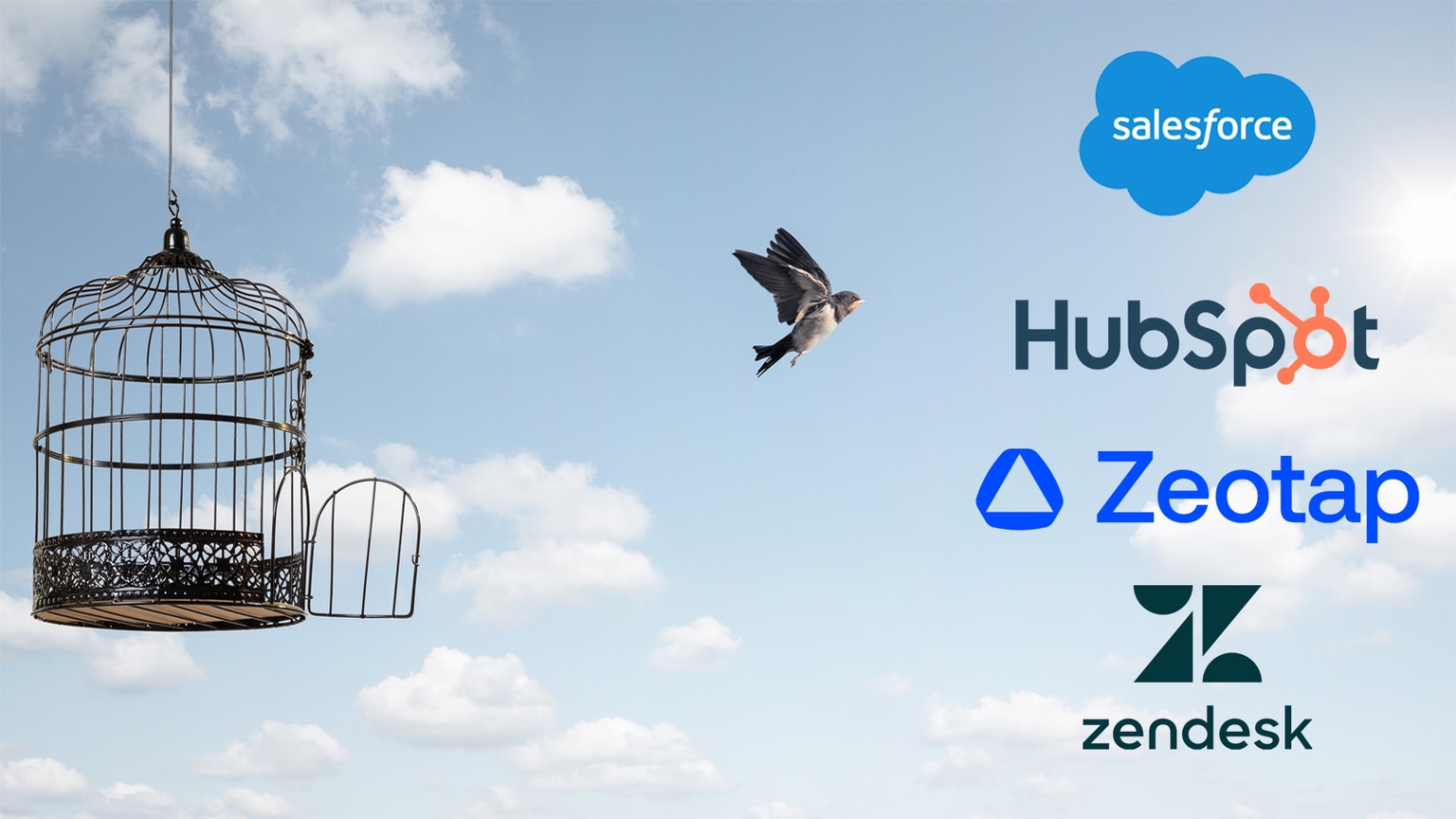
Salesforce chose Dreamforce to set out its new CRM vision... which involved spending less time in your CRM. HubSpot, on the other hand, wants to remove manual CRM upkeep altogether. Zeotap is challenging the idea that a CDP vendor should host customer data in the first place. Zendesk, meanwhile, is betting that specialized AI agents will need to work across the systems enterprises already use.
As Marc Benioff, Chair and CEO of Salesforce, put it: “AIforce is here to unlock trapped value from anywhere.”
Here’s what that means for CRM and customer data leaders.
Salesforce Wants CRM to Work Beyond Salesforce
Dreamforce 2026 was dominated by Salesforce’s effort to turn CRM into an invisible but tightly governed enterprise layer.
The vendor unveiled AIforce, its umbrella term for agentic experiences that bring Salesforce context, permissions, workflows, and actions into external interfaces such as Slack, Microsoft Teams, and Anthropic’s Claude.
At the center of the strategy is ClaudeForce, which allows employees to access Salesforce customer data and take authorized actions from within Claude Enterprise.
Salesforce also introduced Slackforce, alongside Slackforce Surfaces, which turns prompts into live reports, dashboards, and working views based on Salesforce and connected enterprise data.
Parker Harris, Co-Founder of Salesforce, summed up the company’s ambition when he said: “You may never log in to Salesforce again.”
The vendor was quick to point out that the new focus does not mean Salesforce is becoming less important.
Instead, Salesforce is positioning itself as the governed system underneath AI interactions. It wants customer records, metadata, business rules, and identity controls to travel with employees and AI agents wherever they work.
In practice, this means that if a service employee can check an entitlement, update a CRM record, or trigger a follow-up action without switching between systems, CRM becomes less of an administrative burden.
The tradeoff is that the governance burden gets heavier. As CRM actions move into new interfaces, leaders will need to know exactly which customer data an AI agent can see, what it can change, and how those changes are tracked.
HubSpot Makes a Case for the Self-Updating CRM
HubSpot has taken a more practical approach to the same underlying problem of CRM data often being incomplete because people do not keep it up to date.
At its Fall 2026 Spotlight, the company introduced a self-updating Smart CRM that automatically captures and synchronizes calls, emails, and meetings. HubSpot says the goal is to give sales, marketing, service teams, and AI agents a current view of the customer without relying on manual data entry.
It also launched Context Home, a centralized place for teams to view and manage the business context powering the platform. That includes a Context Score, intended to show where customer and business data is incomplete.