
Contentsquare has spent 2026 consolidating behavior, service conversations, design workflows, and enterprise data into one governed platform, and AI-referred traffic breaking the old “traffic by source” model is the clearest proof yet that this convergence bet, not any single AI feature, is the real story.
Digital leaders are in an odd place right now, particularly when it comes to data analytics.
The dashboard used to be a website analytics tool, a session-replay tool, a survey tool, and a separate contact-center reporting system, four logins, four owners, four versions of “what happened.”
CMSWire’s 2026 Digital Customer Experience research found that teams lacking orchestration name fragmented tools and operational complexity as their top CX inhibitors, exactly the problem this convergence bet is aimed at. Contentsquare’s bet is that AI discovery is simply the newest test of that same consolidation problem.
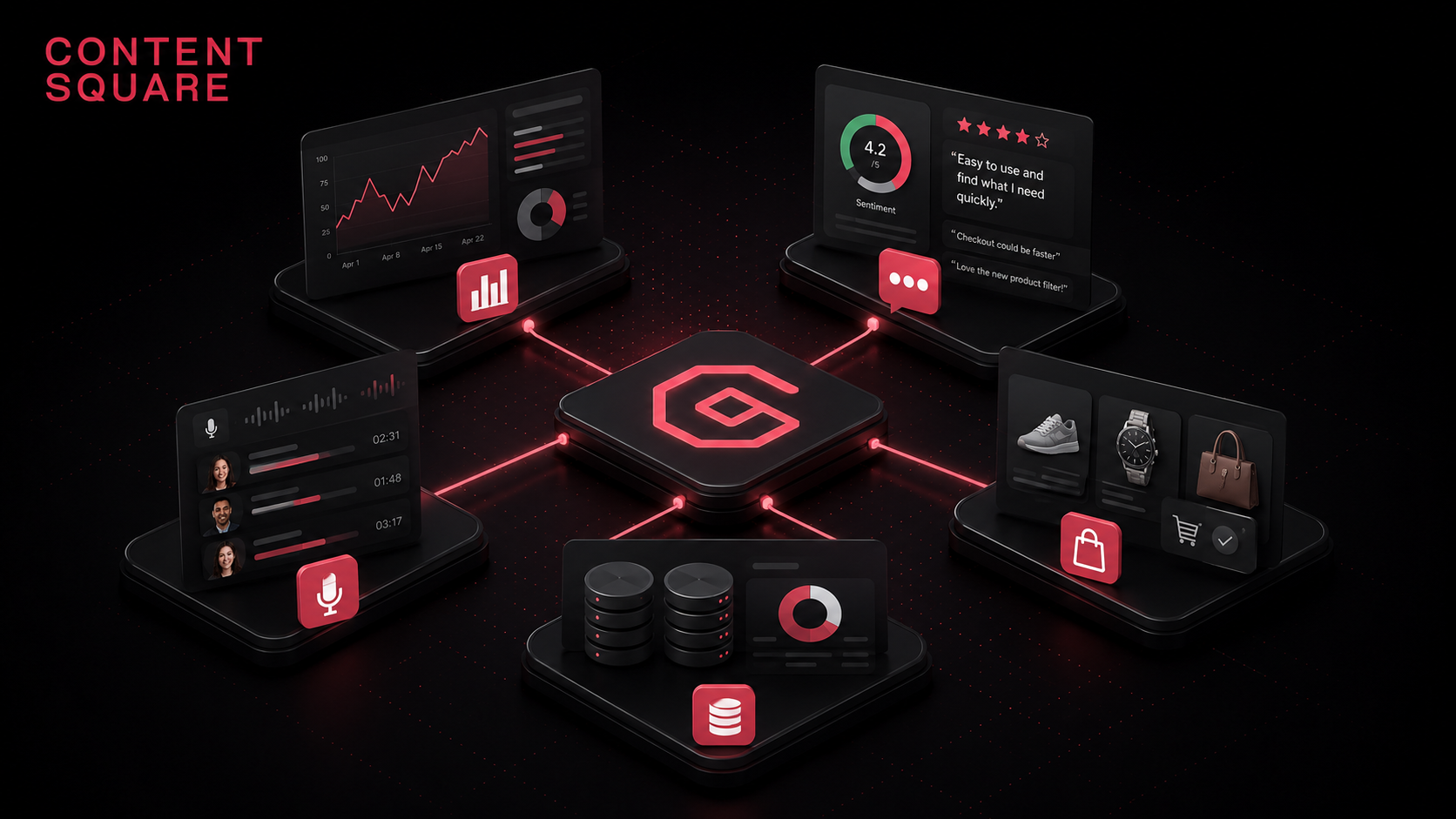
Hotjar and Heap are now fully merged into one platform, not sitting beside it. Sense Analyst turns detection into something that runs continuously instead of waiting for someone to open a dashboard. Conversation Intelligence pulls service conversations into the same system that already tracks behavior. Claude and Figma connectors put that data inside the tools teams already use. Snowflake and Shopify connect it to the enterprise data warehouse and the storefront itself.
Is this the full intelligence layer companies have been looking for?
TL;DR: Is Contentsquare’s Convergence Bet Actually Working?
- AI discovery is the latest test of Contentsquare’s wider platform bet. Referral traffic from AI tools climbed 632% year over year and converted 55% better, although it still made up only 0.2% of Q4 visits.
- People and AI agents are getting better results together. Contentsquare recorded a 57% resolution rate for combined support, compared with 29% when bots handled conversations alone.
- Customers are seeing results they can put a number on. Olaplex lifted conversion by 31%, while Optimum reduced a 23-hour checkout investigation to a few minutes.
How Did Hotjar, Heap, And Sense Analyst Create An AI-Native Analytics Platform?
Contentsquare acquired Hotjar in 2021 and Heap in 2023, and the two aren’t separate products anymore, just sitting next to Contentsquare’s enterprise tool. As of July 1, 2025, Hotjar and Contentsquare fully merged into one platform, nearly a year before AI-referred traffic became large enough for anyone outside Contentsquare to measure. Hotjar’s heatmaps and feedback tools folded directly into a full contextual customer intelligence solution.
Hotjar is the part that incorporates visual analytics into the customer experience story, with UX data, heatmaps, session replays, and surveys that show the why behind a customer’s action.
Heap is the part in Contentsquare’s mix that replaced manual event tagging by automatically capturing every digital interaction, allowing for cross-channel journey mapping that actually shows each stage of the journey.
Sense Analyst may be the slightly more interesting part for AI enthusiasts, even though it was originally introduced in 2025. It gives users a configurable AI analytics agent inside Contentsquare, built to look for experience problems and commercial opportunities based on the company’s own projects, KPIs, industry context, and priorities.
That’s the promise behind Sense Analyst. It includes personalized insights, a customizable Newsroom where agents keep analyzing experience data around the clock, and scheduled email delivery for teams that won’t live inside the platform all day.
For AI-native customer analytics, this is the more useful AI story. The win isn’t a chatbot sitting on top of analytics. The win is cutting the detection-to-action gap.
What Does Conversation Intelligence Add To Digital Experience Analytics?
Essentially, all the missing human context that gets left out of most traditional dashboards. Contentsquare’s tools automatically capture and analyze unstructured voice and text interactions, then merges that activity with what users actually do in a digital journey.
That’s surprisingly helpful. A basket abandonment chart can make a bad checkout look like a UX problem. Then the contact center hears the fuller version: “I couldn’t tell if my discount had applied.”
That’s the gap Contentsquare has been trying to close ever since its Loris AI acquisition. That purchase allowed Contentsquare to add a conversation layer to its digital analytics stack, covering chat, email, and voice interactions across human and AI-handled conversations. The useful bit is the connection between what the customer did and what they later complained about.
It’s giving companies a valuable way to examine one of the trickiest parts of the customer journey: the handoff. In fact, Contentsquare’s own data shared on January 29th, 2026, found that when humans and AI agents work together, 57% of customer inquiries get resolved, compared to just 29% with bot-only support.
Sentiment matters too: conversations that start negatively but successfully turn around resolve more than twice as often, 67% versus 28%.
Conversational intelligence helps you find out where the thread actually broke. For AI-powered customer analytics, this is the missing receipt. If the site breaks, service pays. If the bot fails, loyalty pays. Contentsquare is trying to put those costs in the same room.
Take a closer look at where customer analytics improves the experience and pays its way.
How Does Contentsquare Connect Customer Intelligence To The Wider Business Stack?
Contentsquare’s smartest 2026 move wasn’t adding more analytics. It was getting the evidence into the tools where people are already designing, investigating, debating, and sending campaigns.
The Claude connector lets teams question Contentsquare data in normal language. They can ask where checkout starts leaking customers, which errors are costing money, or why abandonment suddenly jumped without building another report first.
Figma solves a more everyday problem. A designer working on onboarding or checkout can see friction and conversion data inside the file instead of bouncing between tabs and trying to piece the story back together.
Snowflake adds the commercial detail that replay data can’t answer by itself. Contentsquare’s June 2026 Native App combines behavioral signals with product performance data, starting with an always-updated SKU dashboard for category and merchandising teams.
Shopify Plus covers the storefront and checkout journey. Retailers can see whether traffic from AI search or recommendation tools turns into a sale, stalls on a product page, or disappears at payment.
The July 20, 2026 Klaviyo partnership goes further. A behavioral segment in Contentsquare can trigger an email or SMS campaign in Klaviyo without waiting for a data team to connect the systems.
Chris Formosa, Contentsquare’s Global VP of Alliances and Ecosystem, said in a July 2026 statement announcing the Klaviyo partnership: “Understanding ‘why’ a customer hesitates or drops off is the holy grail of digital commerce.” That’s the same convergence logic as Claude and Figma, just aimed at marketing execution instead of analysis or design.
The buyer question is whether these connections remove handoffs. A larger integration map is no victory if teams still argue over different versions of the journey.
CX Awards 2026 Categories Announced
CX Today has announced all 25 categories for the CX Awards 2026, recognizing excellence across customer experience technology, AI, automation, data, and trust.
How Does Contentsquare Track AI Journeys?
Traditional analytics starts when someone reaches the site. AI-led discovery starts earlier, after a customer has already asked questions, compared options, or received a recommendation.
Contentsquare is covering both sides of that journey. Its LLM traffic visibility tracks visitors referred by AI platforms once they arrive. Its March 2026 ChatGPT app analytics launch looks further upstream, at discovery and interaction inside ChatGPT apps.
The early numbers are small but hard to dismiss. Contentsquare shared on April 3rd, 2026 that AI referrals represented just 0.2% of Q4 traffic, yet grew 632% year over year and converted 55% better than typical traffic.
Adobe Analytics, tracking more than a trillion US retail visits independently, found the same shift: AI-referred traffic grew 393% year over year in Q1 2026 and, for the first time, began converting better than non-AI traffic.
The more interesting questions begin inside the assistant. Which prompts send customers who later buy? Which AI-led journeys produce repeat visits? Where does a strong recommendation fall apart once the shopper reaches the site?
Accor is an early adopter, using Contentsquare to study guest behavior inside AI-led discovery as part of its ChatGPT strategy. The real test is whether brands can connect that activity with bookings, revenue, and specific journey fixes. Otherwise, prompt analytics risks becoming another clever report with no owner.
What Evidence Supports Contentsquare’s Outcomes Story?
Contentsquare is still gathering evidence to prove its position as a leader in AI-driven customer analytics, but the numbers are stacking up.
Opalex is a good example. They say Contentsquare’s AI, especially Session Replay Summaries, helped its team analyze behavior faster, explain friction across departments, and support a redesign that delivered a 31% improvement in conversion rates.
Contentsquare has published a few outcomes from other industries, too, in the customer story library on its website.
Audi got a 7% conversion lift, and Specsavers ended up with a 14% ecommerce purchase rate. EasyJet boosted its revenue by 3%, and Admiral improved its QA outcome score from 85 to 98%.
Jean-Christophe Pitié, Contentsquare’s Chief Marketing and Partnerships Officer, in a January 2026 statement accompanying the company’s 2026 Digital Experience Benchmarks report:
“Great customer experience isn’t loud. It’s precise. It’s relentless. And it’s built by removing small irritants until the experience simply works.”
One more data point worth having, since it’s the most recent: Optimum, a major US telecom provider, used Session Replay, Heatmaps, and Sense Analyst together to cut checkout-friction analysis from 23 hours down to minutes, surfacing a confusing “continue” button, an unvalidated birthday field, and error-prone checkboxes in a single working session. The fixes drove a 7.8% uplift in shopper-to-order conversion.
So yes, Contentsquare is showing proof.
Will Contentsquare Give Businesses the CX Insights They Need?
The market is heading toward journeys where customers compare inside ChatGPT, arrive through LLM referrals, hit a product page, ask a bot for help, abandon, complain, return later, and maybe buy through a completely different path. Buyers can’t manage what they can’t see across that whole arc.
Contentsquare’s 2026 roadmap has a clear pattern: ChatGPT app analytics for AI discovery, LLM traffic visibility for source quality, Sense Analyst for faster issue detection, Loris-powered Conversation Intelligence for service signals, and Snowflake plus Shopify for enterprise and ecommerce data depth.
| Journey Stage | What To Check | Contentsquare Capability |
|---|---|---|
| Discovery, inside the assistant | Which prompts lead to a sale | ChatGPT app analytics |
| Referral quality | How AI-sent visitors convert once they land | LLM traffic visibility |
| Detection speed | Time from issue to insight | Sense Analyst |
| Service handoff | Where complaints trace back to friction | Conversation Intelligence |
| Execution | How fast a signal becomes a campaign | Klaviyo integration |
The risk is sprawl. Contentsquare is connecting a lot of surfaces fast, and enterprise buyers should check whether the platform reduces confusion or simply gives more teams more places to look.
Adobe and Similarweb are tracking the same AI-referral surge industry-wide, so the fair test isn’t whether Contentsquare spotted the trend; it’s whether the platform was built before the trend arrived or is simply moving fast to catch up now. That’s the question worth putting to any vendor claiming to lead this shift.
Contentsquare is aiming at the right problem. Cleaner reporting won’t tell a company how a customer formed an opinion, where the journey broke, or who needs to repair it. AI-powered customer analytics earns its place when it connects those moments to the revenue at risk.
FINAL CTA
Explore the Best Analytics and Insight Platform Award
The CX Awards 2026 will recognize the platform that best turns AI discovery, behavioral data, and service signals into one usable customer intelligence layer.
Learn more about the Best Analytics and Insight Platform Award
FAQs
Who should own AI journey analytics inside the business?
The work will cross several departments, but accountability can’t. A named leader should decide which AI traffic signals, conversion problems, and service issues move to the top of the list. Without that person, every team reads the data through its own lens and the findings stall.
How should brands treat AI-originated visitors differently?
AI-originated visitors may arrive with more pre-shaped intent than search visitors. They've already asked questions, compared options, or received a recommendation. LLM traffic visibility helps teams see whether these users need clearer landing pages, stronger product proof, fewer checkout steps, or better post-click reassurance. Treating them identically to search traffic risks missing exactly where they get stuck.
Can prompt analytics change content strategy?
Yes, if teams treat prompts as demand signals. Contentsquare ChatGPT app analytics can show what people ask before they reach the brand. That can expose gaps in product copy, FAQs, comparison content, policy explanations, and category pages, giving content teams a sharper view of customer language. That's a genuinely new data source most content teams haven't had access to before.
Why should service teams care about digital experience analytics?
Service teams often inherit problems created elsewhere. A confusing checkout, missing delivery detail, broken promo code, or weak bot answer can become a contact driver. AI-native customer analytics helps connect digital friction with conversations, so service leaders can push fixes upstream instead of absorbing the cost. That link is exactly what Conversation Intelligence is built to surface.
How should enterprises pilot Contentsquare without overcomplicating it?
Start with one journey tied to revenue, such as checkout, booking, renewal, or quote completion. Use the platform to find one costly point of friction, make the change, and track what happens to conversion, service demand, or lost revenue. Expanding before that first result is clear will only make the pilot harder to judge.
What could make AI-era customer analytics fail?
The danger is treating AI signals as novelty data. If AI-powered customer analytics doesn't connect to ownership, workflow, and business impact, teams get another reporting layer. Buyers should make Contentsquare prove how an AI-originated journey becomes a prioritized fix with measurable value. A dashboard nobody is accountable for is worse than no dashboard at all.