
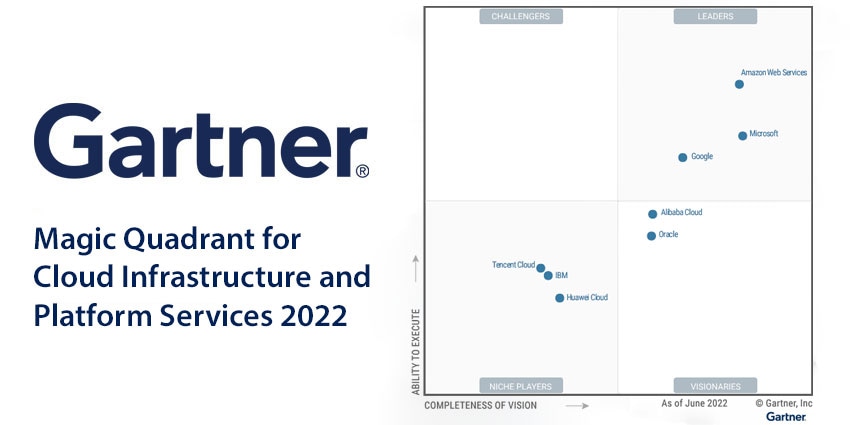
Gartner has released its 2022 Magic Quadrant for Cloud Infrastructure and Platform services.
According to the analyst, today’s infrastructure and operations (I&O) professionals are dealing with a environments growing in complexity, encompassing an array evolving cloud providers.
At the same time, these organizations are facing rising inflation, growing competition for cloud talent, and evolving regulatory mandates.
As such, this Magic Quadrant aims to assist companies in negating these issues by presenting and assessing the available cloud providers they can leverage for transformation support.
This year’s report features eight companies, with three market leaders.
Defining Cloud Infrastructure and Platform Services
Providers of Cloud Infrastructure and Platform Services (CIPS) offer access to infrastructure computing, networking, and storage resources – alongside various complementary services, such as managed applications, database, and as-a-service solutions.
For a vendor to be included in the CIPS Magic Quadrant, they must offer scalable, elastic resources, delivered in near real-time, with metered usage. Self-service interfaces like web-based UIs and API solutions should also be directly available to customers.
Gartner notes CIPS resources may be single or multi-tenant, and could be hosted by a service provider or in the customer’s data centre as an on-premises solution.
The scope of the Magic Quadrant for CIPS looks at integrated IaaS offerings and PaaS tools. The latter includes application PaaS, functions as a service, and database PaaS, alongside application developer PaaS and industrialized cloud offerings.
Gartner typically divides its list of notable vendors in the CIPS space into 4 segments: Leaders, Challengers, Visionaries, and Niche Player. However, in this year’s report, there are no Challengers listed.
Here, we’ll review each entrant on the 2022 Magic Quadrant.

Leaders
Leaders in the CIPS space distinguish themselves with a service that combines strategic adoption with an ambitious roadmap. These solutions serve a broad range of use cases, though they may not excel in all areas. Leaders in the market do, however, have a significant market share, and a sizeable base of reputable customers. This year’s leaders for the CIPS Magic Quadrant include:
- Amazon Web Services
- Microsoft
Amazon Web Services
AWS is considered to have the greatest breadth and depth of capabilities of any provider in the market, and has helped to set accepted standards in the space. The vendor also boasts the current market-share lead in the environment, exceeding both Microsoft by two times. The company’s prosperous and vibrant ecosystem is also a magnet for partners, which helps to generate greater market share. However, Gartner does note that AWS tends to optimize for the short-term when dealing with customers, which can lead to less brand loyalty.
Microsoft
According to Gartner, the solution is closing the gap in market share with AWS. Its solutions-oriented ecosystem seems a significant reasons for this, demonstrating broad range of cloud capabilities and ecosystem partners to address different use cases. Microsoft also benefits from a hybrid and multicloud environment, with the Azure Arc technology environment. Despite its excellent growth, however, Gartner suggests that Microsoft is still suffering from a handful of security issues, and lack of innovation.
Google’s GCP (Google Cloud Platform) has made significant progress in improving its edge abilities this year, and has achieved the highest percentage of revenue gains and improvements across the Critical Capabilities portfolio defined by Gartner. Google has also recently updated its sales execution strategy, to help boost revenue, and is willing to partner with in-country operators to create sovereign cloud alternatives. However, Gartner also notes that Google has suffered from some market confusion problems, and has struggled with financial losses.