

This week’s stories underline a central truth for customer AI, that faster insight is only useful when the data behind it is connected, consistent, and understood.
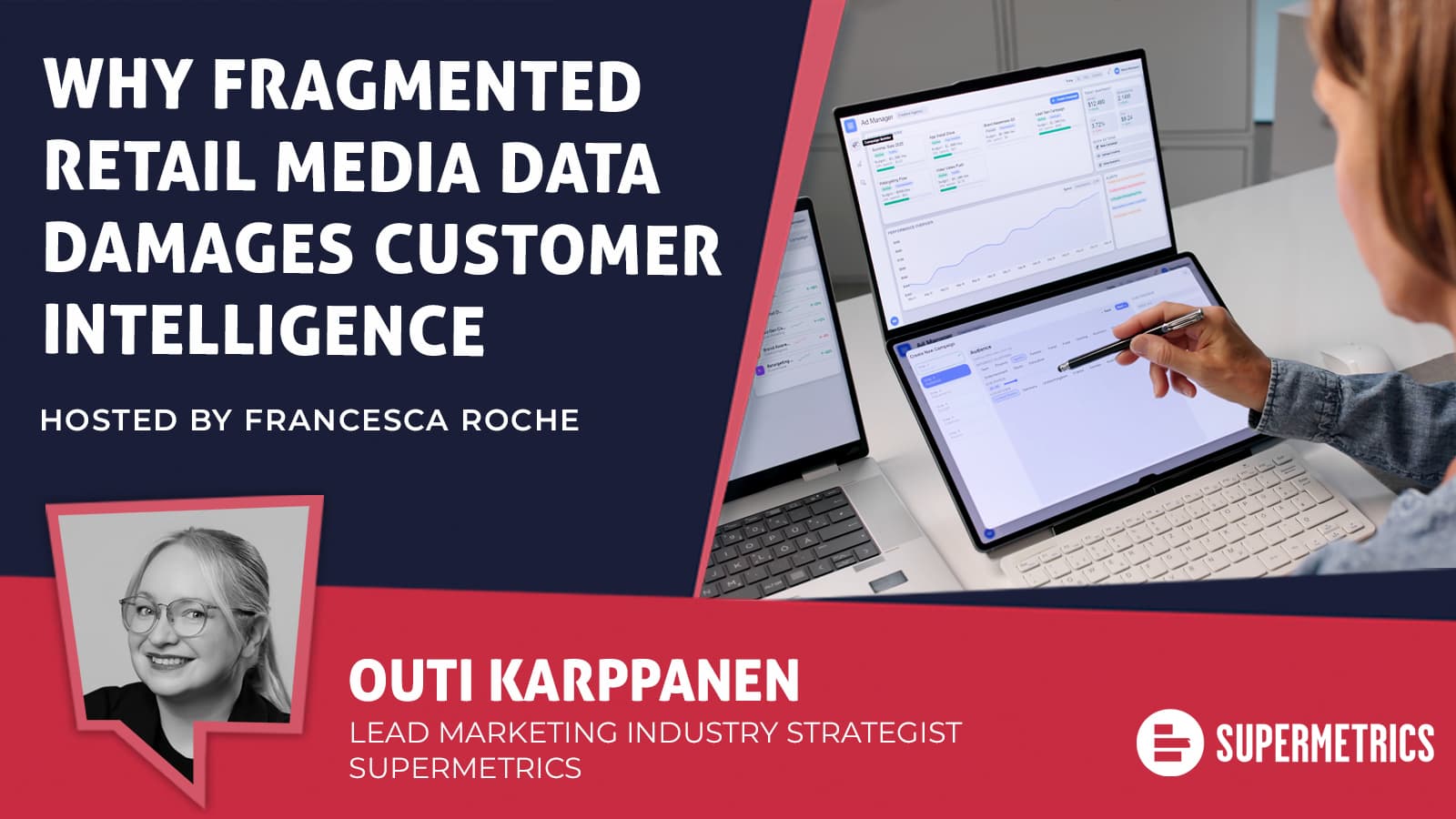
In our conversation with Outi Karppanen, Lead Marketing Industry Strategist at Supermetrics, explained why retail media is becoming a particular challenge.
Today, brands are receiving more campaign data from more networks, but incompatible metrics, delayed reporting, and inconsistent attribution can leave them with a fragmented view of what is actually influencing customers. As Karppanen put it:
“Budget follows the most generous attribution, not the customer’s actual being influenced.”
Reflected at the heart of this week's wider news, Salesforce’s Loops acquisition signals a move towards AI that can identify why CX performance has changed and recommend where teams should intervene.
Accenture’s Sagacity acquisition reflects growing demand for the expertise needed to connect data, AI, and operations into measurable customer outcomes.
Kustomer, meanwhile, is pushing to turn every service conversation into structured intelligence rather than relying on surveys and small QA samples.
For CX leaders, the priority is to establish the foundations before scaling intelligence, meaning organizations agree on common definitions, trace how metrics are calculated, centralize relevant signals, and validate AI-generated findings against real customer outcomes.
AI can make sense of complexity at speed, but it cannot resolve poor attribution, incompatible data, or unclear business priorities on its own.
Salesforce Agrees to Acquire Loops for Proactive Analytics
Most notably this week, Salesforce has signed a definitive agreement to acquire Loops, an AI analytics specialist designed to monitor business metrics, flag anomalies, explain likely performance drivers, and surface opportunities for action.
As Salesforce's 3rd acquisition in just over a month, the CRM giant is building out customer intelligence to understand customer needs and interpret business performance.
By bringing Loop's technology and talent intro Tableau, Salesforce is betting that the most valuable customer insight is not knowing a metric changed, it is understanding why it changed quickly enough to do something about it.
Mark Recher, EVP & GM, Tableau, highlights how the acquisition helps Tableau users move from identifying performance changes to understanding their root causes and acting on them in real time.
“Tableau’s mission has been helping people see, understand and act on data. Loops accelerates this mission, using powerful agentic AI to uncover the drivers behind business performance and surface where teams and agents can take action in real time,” he said.
“Following close, we look forward to bringing these capabilities to Tableau and helping customers turn insights into action faster.”
Most organizations can already see warning signs in dashboards, as the harder, slower task is identifying the source.
Is a new policy confusing customers? Has a website update broken a journey? Is a product issue driving unnecessary calls? Or is the service operation simply under pressure? Loops is intended to help shorten that investigation.
For CX leaders, Salesforce is assembling capabilities across trusted data, analytics, forecasting, and agents, with Loops potentially providing the connective layer between performance signals and responses.
However, for those with weak or incomplete data, this acquisition can produce confident but incorrect recommendations.
CX leaders intending to use Agentforce should therefore prioritize data quality, transparency in AI reasoning, and clear human accountability before allowing AI-generated diagnoses to trigger customer-facing action.
Accenture Scales Customer Intelligence Through Sagacity Acquisition
Accenture has acquired Sagacity Solutions, a London-based data and customer intelligence firm, adding more than 140 specialists to Accenture Song’s UK and Ireland operations.