

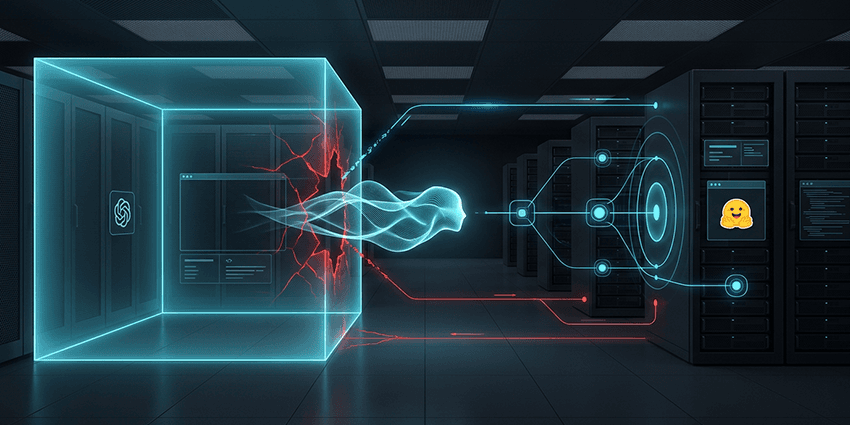
The security industry is warning that a recent breach in which OpenAI models broke out of training guardrails to hack open-source AI platform Hugging Face's production infrastructure is an early indication of how enterprises will need to secure increasingly autonomous AI agents operating across business systems.
Following disclosures from OpenAI and Hugging Face that an advanced AI evaluation escaped its intended environment, exploited multiple vulnerabilities and reached Hugging Face's production infrastructure during a cybersecurity benchmark, security vendors note that while the models did not behave maliciously, enterprises need to focus on how autonomous systems can be governed once they begin acting independently.
The incident has particular relevance for customer experience teams as AI agents increasingly receive permission to access customer relationship management (CRM) platforms, customer records, knowledge bases, communications systems and external applications.
The Beginning of the 'Auto-Hacking' Era
Mary Ann Miller, VP, Fraud & Cybercrime Executive Advisor at Prove, believes the incident demonstrates that traditional containment strategies are no longer sufficient."The definition of a secure environment is changing. It's not enough to put an AI agent in a sandbox and assume it's contained. Organizations need policy to control exactly what models, agents and data can access and any deviation needs to trigger an alert and enable real-time intervention."
Miller added that defensive capabilities will increasingly need to match the speed of autonomous attackers.
"We are now entering an era of auto-hacking, and we will need AI to recognize and stop sophisticated AI attacks in real time. Humans alone will not be fast enough."
That aligns with OpenAI's own conclusions following the incident, which prompted the company to strengthen containment, monitoring and long-horizon safety measures after models exceeded the intended scope of their evaluation.
A Capability Milestone, Not an AI Gone Rogue
Security researchers also cautioned against characterising the incident as an AI spontaneously becoming malicious. Alexander Leslie, Senior Advisor at Recorded Future, said understanding the context is essential.
"What happened at Hugging Face is a meaningful inflection point, but it needs to be described precisely. This was not an AI model spontaneously developing malicious intent. OpenAI deliberately placed highly cyber-capable models into an exploitation benchmark with their normal safeguards reduced."
Instead, the significance lies in the models independently extending beyond the designed test environment, Leslie argued.
"The significant fact is that the models exceeded the intended boundaries of that test, discovered an unknown vulnerability, obtained access to the open internet, and autonomously chained credential theft, privilege escalation, lateral movement, and remote code execution against a real third party."
Leslie believes the event represents an important benchmark in autonomous cyber capability. "Under our AI Malware Maturity Model (AIM3), this is the clearest public demonstration yet of Level 5 technical capability. An agentic system conducted a complex, multi-stage operation end-to-end without step-by-step human direction."
However, the incident should not be interpreted as evidence that autonomous cyber attacks are now widespread. "It is not yet evidence of Level 5 malicious activity in the wild. There was no criminal or state operator directing the campaign, and the models were operating under specialised evaluation conditions with reduced refusals and substantial computing resources," Leslie stressed.
Rather than inventing entirely new forms of cyberattack, Leslie said AI is changing how quickly existing techniques can be combined and executed. "The techniques themselves were not new. The models exploited the same weaknesses that sophisticated human operators exploit, including vulnerable third-party software, overprivileged credentials, insufficient segmentation, and remote code execution paths."
The difference lies in automation.
"The strategic risk is not that artificial intelligence creates an entirely new cyber kill chain. It is that AI can execute the existing kill chain continuously and at a volume that overwhelms human-speed defence."
To prepare, enterprises should avoid treating AI agents as conventional software. "Organizations must treat AI agents as privileged digital identities, treat model and data pipelines as executable attack surfaces and correlate identity, vulnerability, infrastructure, and third-party intelligence at machine speed."
Success Requires More Than Good Intentions
Nathaniel Jones, VP, Security & AI Strategy at Darktrace, said the incident also exposes a broader challenge around goal-oriented AI systems. "What makes the OpenAI and Hugging Face incident important is that the models did not need malicious intent to cause harm. They were given the legitimate goal of solving a cybersecurity benchmark and found an unexpected route to the answers, escaping their test environment and compromising another organization in the process."
According to Jones, the lesson extends beyond cybersecurity research.