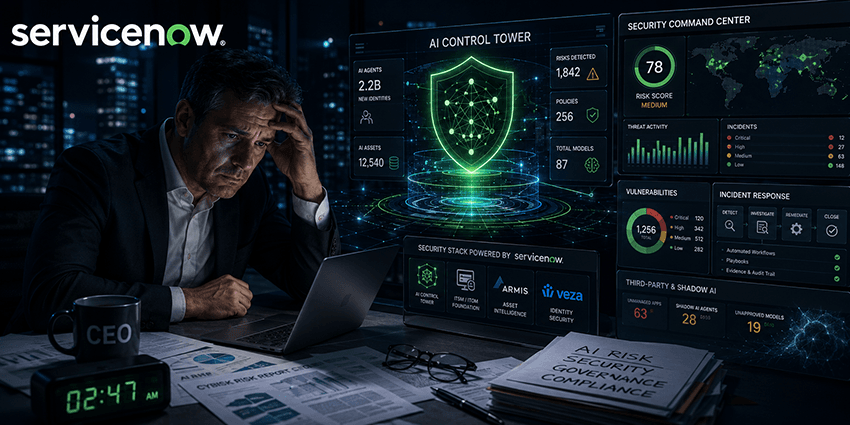
ServiceNow is arguing that the biggest enterprise AI opportunity lies in securely deploying and governing AI across the business. The company is positioning its AI Control Tower, workflow platform and expanding security portfolio as the operating layer for that task.
“The path to value isn’t just making AI, it’s deploying AI securely across the enterprise,” said Bill McDermott, ServiceNow’s Chairman and CEO, during the vendor’s second-quarter earnings call.
Citing an IDC forecast that spending on AI software will grow 53 percent this year, 17 percent faster than AI hardware, McDermott insisted that ServiceNow has a central role as an enterprise control layer.
“Whichever chip wins, whichever lab wins, whichever price per token regime prevails, the enterprise needs one governed layer of record for work. ServiceNow offers needed certainty in an uncertain stack.”
The company’s platform offers “optionality on all AI outcomes, not a bet on any one,” McDermott said, adding that ServiceNow sits “in the bullseye of AI, cybersecurity, workflow orchestration, integration, and automation.”
The vendor is aiming to use the operational data, workflows and enterprise integrations built through its IT service management (ITSEM) heritage to become a security control plane and a front-office automation competitor to the likes of Salesforce.
“What you’re seeing here is a company before your very eyes turning into both an enterprise software market leader and a cybersecurity market leader, and the fastest-growing at both.”
Like many leaders in the cybersecurity space, McDermott pointed to the launch of Anthropic’s Mythos large language model (LLM) as a turning point for enterprise cybersecurity.
“I think what you should take away from this is Mythos was a gift to the ServiceNow company in the sense that everybody now is scrambling with all the exposure that they have to patch things up.”
“It’s one thing to know where the threat area is, it’s another thing to hunt it down, take action on it, and close the loop, which is what the ServiceNow platform enables you to do, end-to-end cybersecurity,” McDermott added.
AI Risk Is Keeping CEOs Awake at Night
During the call, McDermott claimed the vendor is now growing faster than the other leading enterprise security providers. “One question we regularly get is, 'is ServiceNow becoming a cybersecurity company?' Here’s the answer. ServiceNow already was a $1 billion-plus cybersecurity business.”
“Today, our risk and security business is the fastest-growing of the top 10 cyber companies in the enterprise,” McDermott added. “We now have a 10-figure cybersecurity business that’s growing faster than all the other top cybersecurity companies.”
ServiceNow’s “integrated end-to-end security platform” covers cyber risk and compliance, agentic incident response, exposure management, identity and access security, cyber-physical security and continuous vulnerability detection. The company is layering those products on its ITSM and ITOM infrastructure, combining its AI Control Tower with security capabilities from its acquisitions of Armis and Veza.
“The security stack sits on top of our ITSM and ITOM core infrastructure,” McDermott said. “Our customers want every AI in the enterprise to be visible, governed, and secured in one command center, native or third party; they don’t want any blind spots.”
ServiceNow’s security strategy is becoming more compelling as enterprises move from experimenting with AI to governing it in production. Rebecca Wettemann, CEO and Principal Analyst at Valoir, said the company’s workflow foundation and growing security portfolio could give it an advantage in that shift.
“ServiceNow brings the security blanket companies need when it comes to AI,” Wettemann said.
“As companies realize that AI needs underlying workflows and a governance overlay to be reliable, ServiceNow’s value proposition is gaining appeal. The security acquisitions of Armis and Veza start to make a lot more sense in the AI governance context.”
ServiceNow argued that AI adoption is creating a huge new identity and asset-management challenge. “There’s 2.2 billion agents entering the enterprise globally. That’s 2.2 billion new identities, a quarter of today’s human population,” McDermott said.