As of 2023, 50 percent of organizations have received a mandate to acquire composable digital experience platform (DXP) technology, according to Gartner.
But, by 2026, the research firm estimates this will increase to 70 percent, so more brands can compose unique digital experiences for customers, employees, and partners.
That 20 percent hike could represent a significant growth opportunity for the many players in the DXP market.
Yet, it’s a broad market, as DXP suites unify many technologies, from content management and journey mapping solutions to analytics and reporting tools.
Thankfully, Gartner has evaluated the offerings of 14 prominent DXP providers, isolating three market leaders in the process.
The Definition of Customer Digital Experience Platforms
A digital experience platform combines solutions that help compose, test, optimize, implement, and manage digital customer journeys.
Core fixtures of the platform include content management, journey orchestration, and cloud-based solutions that fit within a composable architecture.
However, as DXPs gain traction, more features become standard. For example, these likely include account services for customer profile management, hyper-personalization functionality, and analytics for continuous optimization.
Customer journey mapping, customer data management, knowledge management, security, and applied AI are further examples of solutions buyers now expect from the platform.
Finally, it's critical to note that DXPs also support business-to-employee (B2E) applications – alongside B2B and B2C use cases.
However, this is just a whistle-stop tour of the DXP market – as the sector is continually expanding, giving buyers lots to consider.
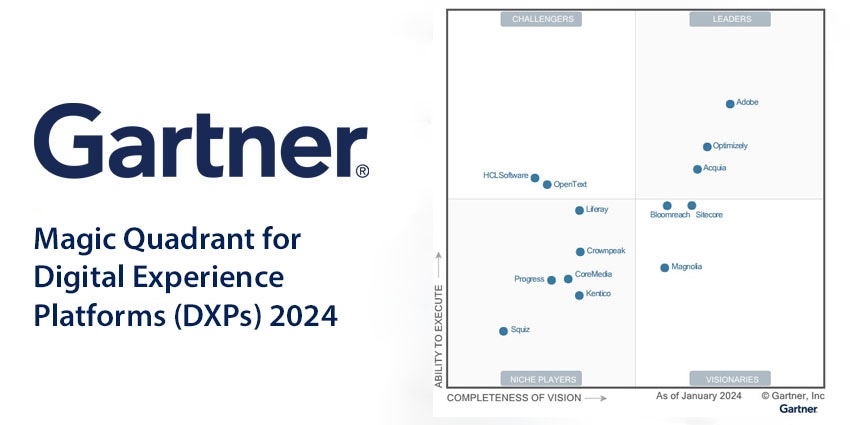
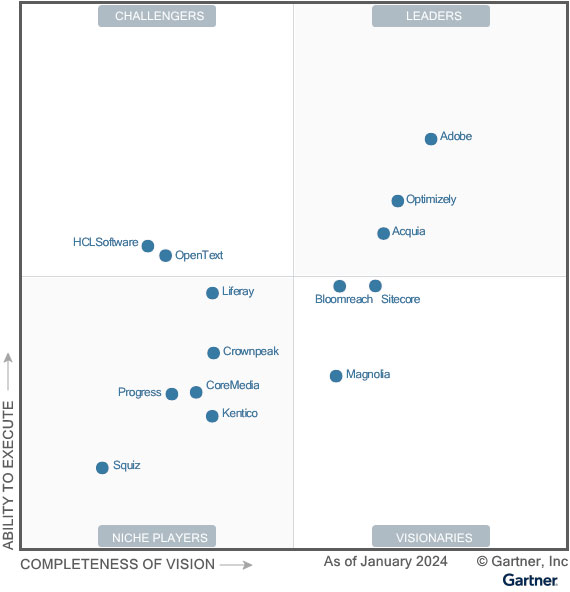
The Magic Quadrant strives to help, splitting 14 DXP vendors into four groups: Leaders, Challengers, Visionaries, and Niche Players – as shared below.
Gartner Magic Quadrant Leaders
Leaders in the Magic Quadrant support numerous DXP use cases, providing a track record for meeting customer requirements and expectations across each. In addition, they deliver cutting-edge product innovation that resonates with customers across various sectors. This year's leaders are:
- Adobe
- Optimizely
- Acquia
Adobe
The Adobe Experience Cloud often appears on shortlists due to a widespread perception of the DXP being a "proven and mature" offering. Adobe backs this up with deep, innovative product features -especially for external-facing digital experiences – and its extended partner ecosystem. Those partnerships span creative, design, and advertising agencies alongside system integrators. As a result, Adobe's customers have many partner options when implementing and leveraging its DXP.
Optimizely
Lots of large enterprises have implemented Optimizely One as their DXP of choice. Many may leverage a GraphQL API to unify data across the platform, bolstering its AI applications and organizational data strategies. Gartner highlights this API as a core strength, alongside the DXP's "simple, scalable, [and] modular" pricing and packaging strategy. Finally, the analyst lauded how Optimizely has integrated its acquisitions, taking capabilities and spreading them across its platform.
Acquia
The Acquia Open DXP offers advanced, AI-driven journey mapping, personalization, and segmentation features, each embedded into an intuitive interface. That UI often appeals to less technical business users. Gartner isolates this as a plus point alongside the bustling open-source Drupal community and Aquia Exchange. The Exchange is its marketplace, which brims with connectors, modules, and pre-built integrations that extend across the vendor's robust product portfolio.
Gartner Magic Quadrant Challengers
Challengers in the Magic Quadrant excel in their ability to execute with a portfolio that aligns well with many companies' current demands. However, they lag leaders in their vision, as Gartner suggests they may "struggle" to satisfy the future demands many DXP customers. This year's challengers are:
- HCLSoftware
- OpenText
HCLSoftware
The HCL Digital Experience (DX) platform is highly extensible, providing sector-specific use cases, integrations, and connectors for complex scenarios. Gartner recognizes this as a significant strength, in addition to its large global presence and user session licensing. The latter is a new platform feature that enables a more predictable and simplified consumption-based pricing structure. However, HCLSoftware’s DXP remains a “complicated proposition” for some customers – as per the analyst.
OpenText
Available on AWS, Azure, and Google, OpenText Experience Cloud offers robust security, governance, and account management credentials. As such, it can appeal to businesses in highly regulated sectors. Gartner pinpoints this as a plus for OpenText, along with its platform's extensibility and broader information management capabilities. The latter include communications and content management tools. Nevertheless, OpenText struggles from perceptions of its tech as "legacy and outdated".
