

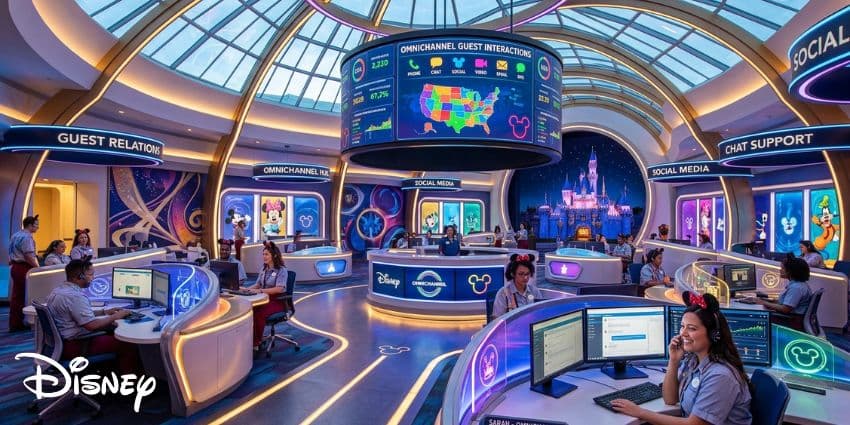
The Walt Disney Company’s parks ecosystem offers one of the clearest examples of experience-led retail at enterprise scale. Disney is not simply selling tickets, hotel rooms, meals, merchandise, or media IP. It is building a connected guest journey where the mobile app, wearable band, hotel stay, park entry, food order, queue access, photo capture, payment layer, frontline service model, and support operation all reinforce one another.
For CX Today readers, that makes Disney useful beyond the theme park sector. It shows what happens when retail stops being a channel and becomes an orchestrated environment — and when digital self-service, human escalation, identity resolution, and physical service recovery have to work together in real time.
“Disney is uniquely positioned in the entertainment industry — no other company reaches consumers to the same degree across both digital and physical environments.”
That comment from Josh D’Amaro, Chairman of Disney Experiences, in Disney’s Q2 FY2026 earnings commentary, captures the strategic point. Disney’s advantage is not just that it owns powerful brands. It can move customers between screen, app, store, hotel, attraction, restaurant, queue, payment, support interaction, and memory-making in a single experience loop.
The harder question is whether Disney’s model represents the future of experience-led retail — or a warning about how easily connected CX can become over-engineered, app-dependent, and cognitively demanding when service journeys are pushed too heavily into digital tools.
TL;DR - Disney Experience-Led Retail Analysis
- Disney Parks show how experience-led retail can connect app, wearable, payment, ticketing, hotel access, food ordering, merchandise, photography, queue access, and human service.
- MagicBand+ remains a physical wearable, while Disney MagicMobile provides a phone-based alternative for key access, PhotoPass, queue, Lightning Lane, and room-folio purchase functions.
- The My Disney Experience and Disneyland apps act as live journey dashboards for planning, wait times, maps, mobile ordering, PhotoPass, Direct-to-Room, and Cast Member chat.
- Disney Experiences generated $9.487 billion in Q2 FY2026 revenue, up 7% year over year, while My Disney Experience holds a 4.5-star Google Play rating from 164,000 reviews.
- The main scrutiny point is that Disney’s connected retail model can reduce friction, but it can also increase planning pressure, app reliance, service complexity, and digital fatigue.
Related CX Today Coverage
Why Disney Belongs in Experience-Led Retail
Direct answer: Disney’s parks ecosystem is experience-led retail because the commercial journey is inseparable from the physical, digital, emotional, and service experience.
Most retailers still think of connected CX as app plus ecommerce plus store. Disney’s model is more ambitious. At Walt Disney World, My Disney Experience helps guests manage plans, use Disney Genie, access MagicMobile, order food, make dining reservations, check in to restaurants, join waitlists, view maps, monitor wait times, access virtual queues, use in-app chat, manage PhotoPass, and unlock hotel-room services.
At Disneyland Resort, the Disneyland app similarly supports Disney Genie recommendations, mobile food ordering, dining reservations, GPS-enabled maps, attraction wait times, in-app Cast Member chat, Lightning Lane access, PhotoPass, virtual queues, MagicBand+, merchandise mobile checkout, and Direct-to-Room services.
That makes the app less like a digital storefront and more like an operating system for a live retail environment. For contact center and omnichannel leaders, the useful point is not that Disney has an app. It is that the app becomes the first service layer before escalation moves to Cast Members, help centers, phone support, or in-person Guest Relations.
The Guest Identity Layer: MagicBand+, MagicMobile and the App
The most important part of Disney’s model is identity. A guest is not just a ticket holder or app user. They are a hotel guest, restaurant customer, merchandise buyer, ride participant, PhotoPass subject, queue participant, family-group planner, support contact, and media fan — often all in the same day.
MagicBand+ is the physical interface for that identity layer. Disney says guests can use it to enter parks with valid admission and reservation where required, unlock Disney Resort hotel rooms, check in at Lightning Lane and virtual queue entrances, charge food and merchandise purchases to the payment card on file at a Disney Resort hotel room, and link Disney PhotoPass photos.
“Unlock moments of magic on your vacation with just a tap.”
That phrase from Disney’s MagicBand+ material is marketing language, but it accurately describes the CX mechanism: the band collapses multiple retail and service interactions into a tap.
Disney MagicMobile then extends many of those functions into the phone. Disney describes Disney MagicMobile as a My Disney Experience app feature that enables access to select theme park and resort amenities through eligible iPhone, Apple Watch, or Android devices. It supports theme park entry, PhotoPass linking, virtual queue and Lightning Lane check-in, and room-folio purchases for eligible Disney Resort hotel guests.
Importantly, MagicMobile does not replace MagicBand+ outright. The stronger interpretation is that Disney has built a layered identity system: wristband for hands-free, experiential interaction; app and phone wallet for flexible digital access; Cast Members for human support when the system needs judgment. Disney does not publicly expose the full enterprise technology stack behind that identity layer in the sources reviewed, but the buyer lesson is clear: experience-led retail depends on identity resolution across digital, physical, transactional, and service touchpoints.
Commerce Without the Checkout
Direct answer: Disney’s retail innovation is not just mobile payment. It is the removal of checkout friction from food, merchandise, photos, hotel services, and attraction access.
Mobile food ordering is one of the clearest examples. Disney’s mobile food and beverage ordering lets guests order, pay for, and pick up food, snacks, and desserts through the My Disney Experience app at participating Walt Disney World locations.
That matters because food in a theme park is not merely hospitality. It is queue management, revenue capture, dietary information, customer convenience, and crowd control. When done well, mobile ordering allows guests to use otherwise unproductive time — for example, while waiting elsewhere — to complete a purchase before arriving at the restaurant.
Disneyland takes the retail logic further by explicitly listing merchandise mobile checkout as an app feature, allowing guests to make simple, contactless purchases. Meanwhile, PhotoPass and Memory Maker turn memories into a digital product: photos, videos, attraction captures, professional images, and Magic Shots delivered through the app.
This is the retail lesson. Disney sells physical goods, food, access, and memories, but the transaction is embedded inside the experience rather than sitting apart from it. For enterprise CX teams, that also creates a service implication: when commerce, access, and itinerary management are embedded in the same digital journey, support teams need context across all of them.
The Service Operation Behind the App
Direct answer: Disney’s model depends on digital self-service, but it still needs human escalation through Cast Members, in-app chat, phone support, help centers, and in-person Guest Services.
This is the part of the story that matters most for contact center and omnichannel readers. Disney’s parks ecosystem is not a pure self-service model. The apps may handle planning, ordering, access, wait times, photos, hotel services, and maps, but exceptions still need people.
Both the My Disney Experience app and the Disneyland app list in-app chat as a support feature. Walt Disney World also publishes phone support for new or existing Disney Resort hotel reservations and tickets, plus dining reservations, technical support, and other enquiries through its phone help page. Disneyland similarly points guests to a phone directory, email support, help center resources, and in-park Guest Services.
That gives Disney a multi-layer escalation model: app guidance first, digital chat for support, phone or email for more complex pre-visit issues, and Cast Members or Guest Relations for in-the-moment service recovery inside the parks and hotels.
The limits are also important. Disney does not publicly provide detailed call volumes, chat volumes, IVR design, average speed of answer, containment rates, resolution times, or the extent to which automation supports guest service escalation. That absence matters for enterprise buyers because the visible customer journey is only half the operating model. The other half is how exceptions are triaged, staffed, routed, resolved, and learned from at scale.