
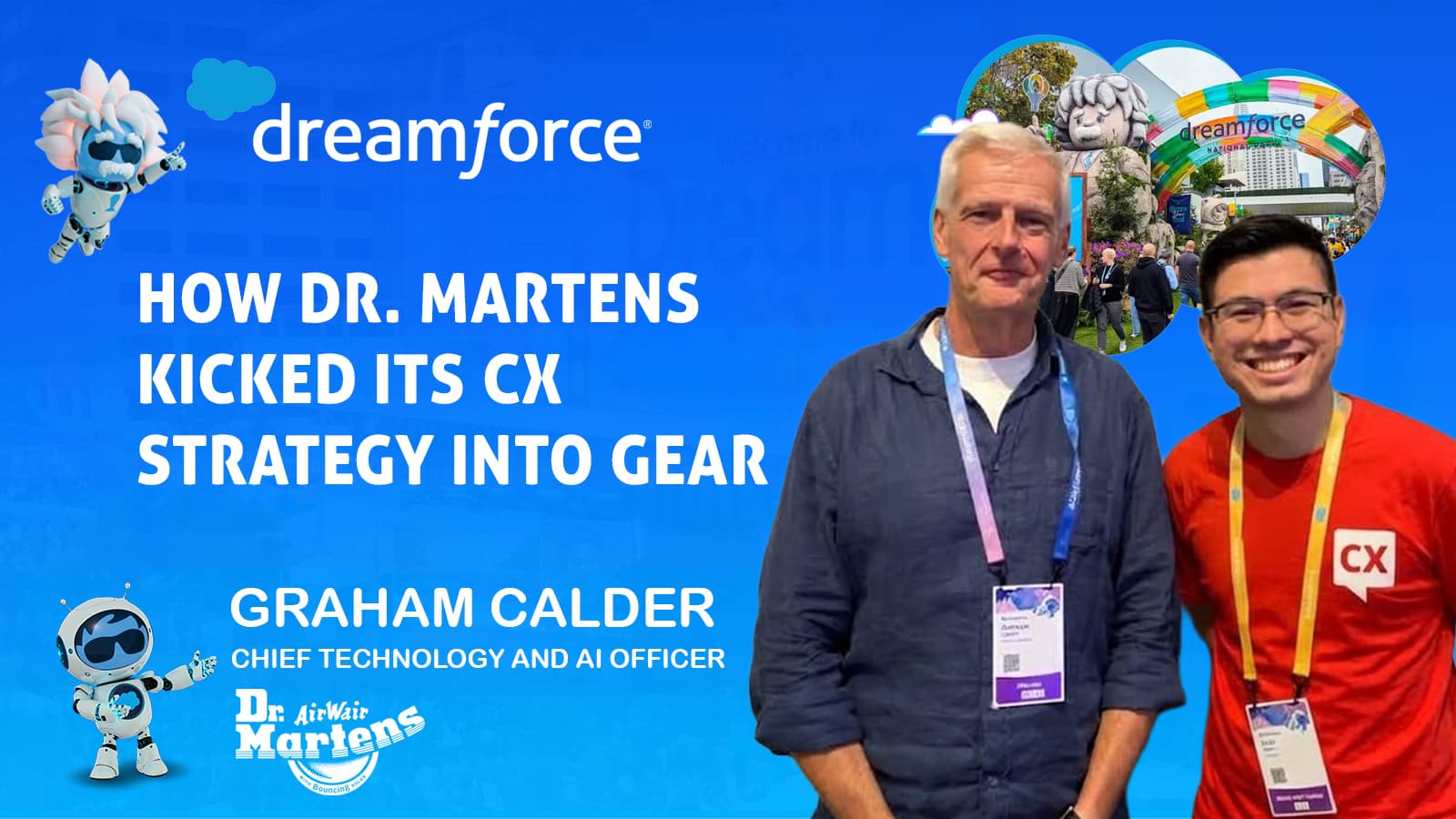
Dr. Martens has spent the best part of a decade transforming from a wholesale-first manufacturer into a direct-to-consumer powerhouse, but its customer care hadn't kept pace. At an exclusive media roundtable at Dreamforce 2026, Graham Calder, Chief Technology and AI Officer at Dr. Martens, told CX Today's Sean Nolan how the brand rebuilt its entire customer care operation from the ground up.
Calder started by explaining how the company had grown its direct-to-consumer business to roughly two-thirds of total revenue, operating across 20-plus e-commerce markets and around 280 stores globally. But growth had outpaced the infrastructure meant to support it.
"Our products are timeless, but customer expectations and experiences move on and evolve"
Check out more insights from Dreamforce 2026:
- Dreamforce 2026 Roundup with Constellation Research’s Liz Miller
- Interview with John Kucera, Chief Product Officer for Agentforce on Prebuilt Agents & Vibe Coding
- Exploring the Dreamforce 2026 Keynote: Salesforce Takes CRM Out of Salesforce?
Why Did Dr. Martens Need to Overhaul Its Customer Care?
The problem wasn't hidden. It was showing up publicly, in the form of declining customer sentiment that the brand could no longer ignore, as Calder said:
"If you looked at the negative commentary around the brand, more often than not it would be some sort of problem with customer care"
That translated into a steady three-year decline in Trustpilot scores and customer satisfaction, dragging the brand toward what Calder bluntly called "the red zone."
The root cause was fragmentation, not just across markets, but across nearly every layer of the operation. Different regions ran different platforms, Zendesk in the US, Salesforce in the UK and Europe, and neither was being used anywhere near its potential. Even the metrics teams used to measure success weren't standardized.
He explained: "We had regional solutions. We had no consistency of policy, no consistency of data, no consistency of journeys, experience, it was all kind of different"
Looking back at just how disconnected things had become, Calder didn't hold back:
"We were as fragmented as you could get."
Underneath the platform gaps sat a more painful reality for agents. Systems didn't talk to each other, forcing staff into constant manual workarounds.
"The telephony platform didn't connect to the CRM. The order management systems didn't connect to the CRM. Nothing was connected. So the whole integration was that classic human swivel chair integration, which made it really difficult for the agent and really hard for the customer"
How Dr. Martens Rebuilt Its CX Strategy
Rather than untangle years of fragmented systems piece by piece, Dr. Martens made the call to start over, as Calder explained:
"I could try and fix this, or I could just assume that that is not where you would start, and just get rid of it"
That decision led the brand to Salesforce and AWS. Dr. Martens consolidated its Salesforce Service Cloud operations into a single global instance, covering its US and Canada operations alongside the UK and European markets, unifying the business on one data model, one version of the truth, and one set of processes. For voice, the brand runs two instances of Amazon Connect, split specifically to manage latency across regions, but both plugged into that same central Salesforce environment.
The logic behind leaning on established platforms rather than custom-building integration was pragmatic, as Calder put it: "We didn't really want to spend any time on time to plumbing. What we wanted to do was get the platform in quickly, use someone else's integration and someone else's hard work. Our job was to leverage that and to get value"
That approach let the team move from design to launch in around seven months, starting design work in December and going live the following June. The rebuild extended into the wider Salesforce stack, including Data 360 to centralize customer information, and Marketing Cloud to handle post-purchase and service messaging on the same underlying data model, so a courier update or order change is instantly visible to whoever is helping that customer next.
What This Means For Customers
The clearest signal of progress came from the metric Dr. Martens had deliberately chosen not to control internally, as Calder noted: "Objective number one, which was turn around the trend in CSAT, Trustpilot, has happened. I think it's been quite surprising to people that it's happened so quickly"
Having sat in what Calder called "the red zone," around a 2 out of 5 on Trustpilot, the brand has since climbed back into what he termed "the amber zone," within roughly three months of going live, against a medium-term target of 4.5 out of 5.
Containment rates tell a similarly sharp story. Dr. Martens has moved from around 10% of contacts being resolved without human intervention to roughly 50%, against an internal target of 75%, achieved without letting automation compromise the CSAT and Trustpilot scores the brand set.
Real-time data has also surfaced a pattern the brand hadn't previously been able to see. Customer demand was coming in steadily over about 17 hours a day, seven days a week.