

To suggest that CPaaS is a growing market would be something of an understatement.
According to Gartner, by 2028, 90% of global enterprises will utilize CPaaS for customer experience and engagement, up from 50% in 2023.
While the sheer number of communications channels currently available would have been unfathomable even a decade ago, now they are commonplace.
Moreover, given the explosion of generative AI (GenAI) within the customer service and experience space, these channels are likely to continue to mutate and become even more sophisticated.
If companies want to use this multitude of channels to maximize the potential of their CX offerings, a CPaaS platform is a non-negotiable.
Unfortunately, the growing importance of CPaaS has led to a crowded market – complicating the process for buyers to identify and choose the best solution for their business.
That’s where Gartner steps in.
By analyzing and evaluating the credentials of the leading CPaaS providers in the sector, Gartner has whittled it down to the following 11 vendors.
The Definition of Communications Platform as a Service (CPaaS)
A CPaaS is a cloud-based solution that enables developers, IT teams, and nontechnical business roles to create various communications features using APIs, SDKs, documentation, and no-code/low-code builders.
For Gartner, the role of a CPaaS is to help enterprises enhance their communication workflows by offering easy access to various communication features and channels.
These channels are paramount to Gartner’s Magic Quadrant criteria, which is evident in some of its standard capabilities. These include APIs to:
- Make and receive voice calls
- Contact and are contactable via SMS and email
- Capacity to perform local and global direct inward dialing (DIDs)
- Identity confirmation such as 2FA/MFA and flash calling
The use of rich communication messaging platforms such as Apple Messages for Business, RCS, Google Business Messages, MMS, WhatsApp, and WeChat, is also expected.
In addition, Gartner considers the level of customer service and support for CPaaS capabilities when considering a company’s credentials.
While the above are examples of standard capabilities, optional capabilities include conversational bots; and APIs for voice, network, messaging channels, programmable video, and programmable wireless.
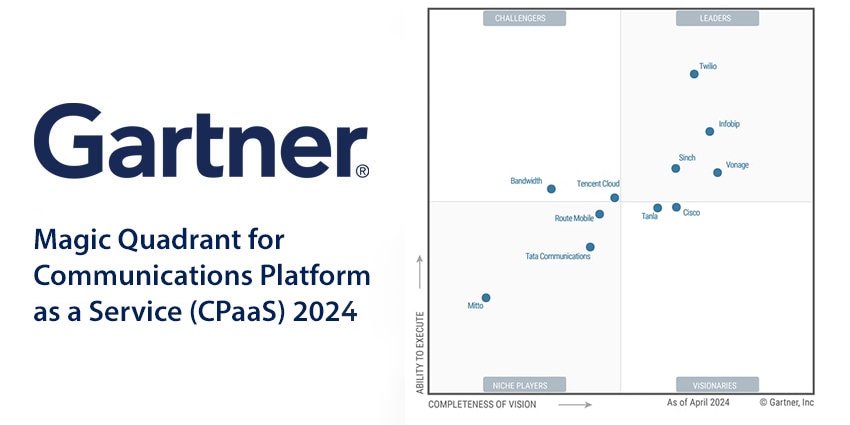
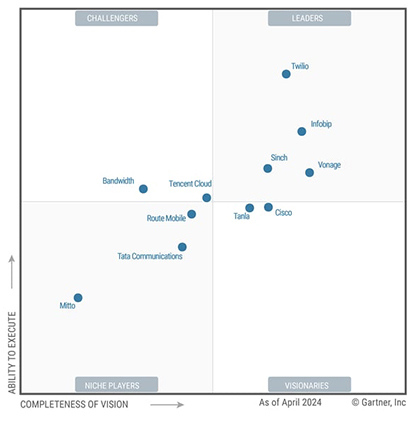
This is just a snapshot of the multitude of capabilities that Gartner evaluates before categorizing the 11 CPaaS providers into the following four groups: Leaders, Challengers, Visionaries, and Niche Players.
Here’s how each performed:
Gartner Magic Quadrant Leaders
Gartner considers its Magic Quadrant leaders to be the companies that possess the most influence over the market's direction. In order to achieve this status, these organizations must showcase a clear vision for CPaaS deployment and be able to effectively execute this vision through their organizational capabilities, business model, and platform. This year’s Leaders are:
- Twilio
- Infobip
- Vonage
- Sinch
These are the same four companies that were named Leaders in the 2023 CPaaS Magic Quadrant. However, while Infobip, Vonage, and Sinch have returned similar results, Twilio has made a notable improvement in its ability to execute.
Twilio
As something of a CPaaS pioneer, Twilio continues to be one of the most substantial vendors in the sector. Gartner believes that the company is ideally situated for global enterprises looking to expand their operations, due to its “extensive” carrier network and “highly scalable” platform. Gartner also praised the company’s use of predictive and generative AI (GenAI) in its Segment CDP. This solution allows users to enhance targeting, boost campaign accuracy, and deliver superior business outcomes.