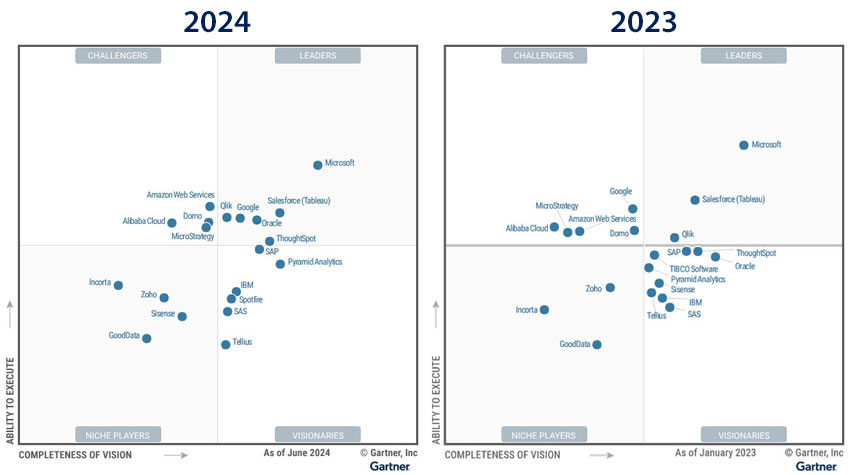
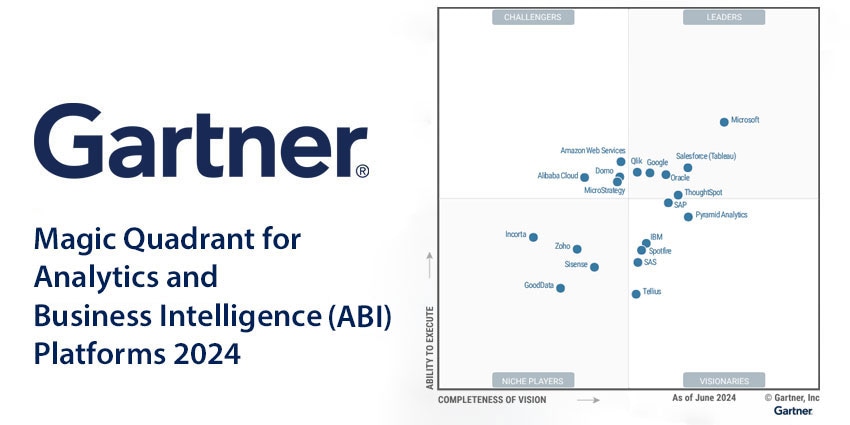
The Gartner Magic Quadrant for Analytics and Business Intelligence Platforms 2024 is here.
On its release, the report sheds light on a space undergoing significant change.
After all, with trends ranging from data storytelling and governance to advanced analytics and augmented AI, there’s a lot happening in the analytics and business intelligence (ABI) market.
Thankfully, Gartner offers a comprehensive overview of that market and its most prominent global players.
Below is a quick-fire review of each provider’s performance after an essential outline of how Gartner defines analytics and business intelligence platforms.
→ THE 2025 Edition: Check out CX Today’s coverage of the latest Gartner Magic Quadrant for ABI Platforms.
The Definition of Analytics and Business Intelligence Platforms
According to Gartner, an analytics and business intelligence platform enables brands to “model, analyze, and share data”.
As organizations do so, they may interact with their data, create custom measures from it, and visualize insights.
Increasingly, these platforms are becoming available to non-technical users, who can pull insights relevant to their objectives and workflows.
Yet, to support such use cases, the solution must blend modeled and non-modeled data to ensure the necessary insight generation.
However, that’s only a fraction of what an analytics and business intelligence – or ABI – platform provides brands.
Recognizing this, Gartner names 12 mandatory and common features of such a platform. These are:
- Data visualization
- Governance
- Reporting
- Analytics Catalog
- Data preparation
- Data science integration
- Automated insights
- Metrics layer
- Data storytelling
- Natural language query (NLQ)
- Collaboration
- Composability
The 20 ABI platform providers below innovate around these areas to differentiate.
In doing so, they’ve established a significant market presence and popular offerings.
After evaluating each, Gartner separated them into four categories: Leaders, Challengers, Visionaries, and Niche Players. Here’s how they performed.

The 2024 Analytics and Business Intelligence Platforms Magic Quadrant Leaders
Leaders in the Magic Quadrant understand their core product capabilities, make them easily comprehensible, and offer an "attractive" pricing model. Moreover, they demonstrate a commitment to customer success, a fast innovation cycle, and a robust roadmap. This year’s Leaders are:
- Microsoft
- Salesforce (Tableau)
- Oracle
- ThoughtSpot
- Qlik
Microsoft
Microsoft "dominates" the business intelligence space in its user adoption, according to Gartner. Over the past four years, its success has accelerated, with the analyst crediting Microsoft’s "strong" grouping of ecosystem, functionality, and price. Alongside this, Microsoft benefits from its product ambition and broader Power portfolio, which helps automate customer flows, so insight triggers actions. Finally, Gartner highlights the addition of Copilot for Power BI as a strength, enthused by how GenAI may transform the report creation process.
Salesforce (Tableau)
Salesforce has pulled Tableau into its core Einstein 1 Platform, enabling a robust growth rate of 16 percent, which is much higher than many of the other vendors included in the study. According to Gartner, that demonstrates its "strong" corporate viability and is one of Salesforce’s core strengths. Others include its dedicated leadership teams and composable analytics. The latter catches the eye, as Salesforce has re-engineered the architecture to be more agile, facilitating a quicker release cycle and innovations like Tableau Pulse, which enables a generative analytics experience.
Oracle
The Oracle Analytics Cloud benefits from the vendor’s suite-first approach. That structure allows Oracle-centric customers to embed decision workflows within various business applications and workflows. These empower employees with data-driven recommendations when and where they make the most impact. That flexibility to enable decision-centric business apps is a significant plus, alongside its enterprise cloud ecosystem, data management, and data integration capabilities. Oracle’s pre-built data pipelines and AI models exemplify the latter.
ThoughtSpot
ThoughtSpot impressed Gartner with its "visionary" GenAI product strategy. That strategy embeds in its automated insights, data storytelling, and new reasoning capabilities. The latter enables personalized user Q&A suggestions. In highlighting this strength, Gartner notes how ThoughtSpot’s AI is "self-learning" and enabled by GPT-4 and Gemini. Other strengths include its modularity for the modern data stack and track record for delivering successful customer deployments, experiences, and support – with the analyst citing verified customers on its Peer Insights platform.
Like Salesforce, Google is gaining market momentum. Indeed, Gartner has received many queries regarding its Looker platform over the past year. Looker’s large social network following is one potential driver. Yet, after integrating Looker Studio with LookML, Google now also attracts buyers with a unified offering for centrally governed analytics and self-service. Market momentum aside, the tech giant excels in its "strong" data and analytics stack and "excellent" composability. Such composability enables headless BI integration with other open-source data technologies.
Qlik
Qlik has made numerous acquisitions over the last five years to bolster its Qlik Cloud Analytics platform. One of the most significant is its Talend roll-up to advance its data foundation. That – alongside its evolving data science and LLM approach - enabled end-to-end analytics. Gartner spotlights that analytics capability as a core strength, alongside its cloud-/application-agnostic design and renewed market recognition. Again, its M&A strategy has helped, spurring Qlik on to become a "top five" vendor for business intelligence and data integration solutions.
The 2024 Analytics and Business Intelligence Platforms Magic Quadrant Challengers
Challengers in the Magic Quadrant are well-positioned to succeed within the market, with a record of successful - albeit sometimes "limited" - deployments. However, they may lag Leaders in product co-ordination, sector-specific innovation, and overall vision. This year’s Challengers are:
- Amazon Web Services (AWS)
- Domo
- MicroStrategy
- Alibaba Cloud
Amazon Web Services (AWS)
Amazon QuickSight is often leveraged by broader AWS ecosystem buyers. In part, that’s perhaps due to convenience, but also its competitive pricing. Indeed, a license starts at $3 per user per month, with guardrails to prevent overprovisioning. Gartner highlights this pricing model as a central strength of the platform, alongside its integrated global cloud service and serverless architecture. That architecture supports high scalability and performance. Yet, Gartner cautions that the offering is limited to the AWS cloud and – for governance - relies on separately licensed tools.