
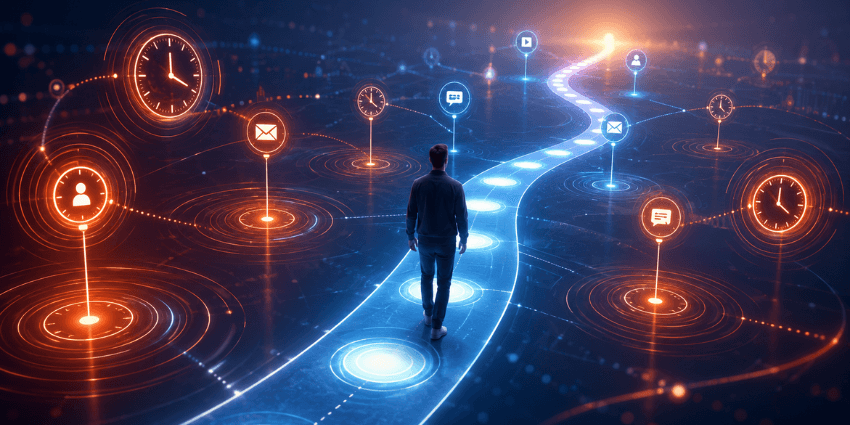
Customer journey timing is the difference between “helpful” and “creepy.” CX orchestration strategy often underperforms because the brand shows up a beat too late, or a week too early. Real time engagement in CX is not a channel problem. It is a moment problem.
Customer interaction timing breaks when journeys are scheduled like email calendars instead of triggered by live intent. Journey optimisation in CX is really timing optimization: using real signals to decide when to act, when to wait, and when to hand off.
Related Articles
- Decision-Driven CX Orchestration: Build an Adaptive Engine
- Customer Journey Modeling Flaws: Why Maps Miss Reality
- AI in Customer Engagement: 2026 Insights
Why Does Timing Determine Customer Journey Success?
Timing determines success because customers do not experience “journeys.” They experience moments. A refund moment. A renewal moment. A confused moment. A high-intent buying moment.
CX Today’s orchestration explainer draws a clean line: mapping helps you plan, orchestration helps you perform in real time using live signals to trigger actions. When timing is wrong, even great content becomes noise.
Salesforce has also emphasized that experience now matters as much as products and services. That raises the bar. If your response is late, customers feel ignored. If it is early, they feel stalked.
What Happens When Engagement Is Triggered Too Late?
Late engagement is the classic “we showed up after the decision.”
Examples:
- A cart-abandon message arrives after the customer already bought elsewhere.
- A proactive service update arrives after the customer has already posted a complaint.
- A retention offer arrives after the cancellation has been processed.
Real-time orchestration content on CX Today points to the core issue: latency between customer behavior and business response weakens relevance and performance.
How Do Organisations Mistime Customer Interactions?
Most organizations mistime interactions for boring, fixable reasons:
They trigger off schedules, not signals. Journeys run on “Day 3” logic, not “customer intent changed” logic.
They rely on delayed data. Dashboards arrive after the moment has passed. That is the measurement trap: data shows up too late and rarely turns into a decision someone can make in the moment.
They confuse journey maps with real behavior. Maps are simplified. Reality is messy. That mismatch is why modeling flaws matter.
They over-automate broken paths. If customers keep escalating to humans, the journey is failing. Automating that failure just scales pain.
Where Does Journey Timing Break Down?
Timing usually breaks at the “connective tissue” layer: