
Currently, a lot of business leaders think they’re already orchestrating customer journeys, particularly when it comes to marketing. What they usually mean is this: a welcome email, a nurture sequence, a reminder text, maybe a chatbot if budgets allow. They’re not actually thinking about how decisions are made from one step to the next.
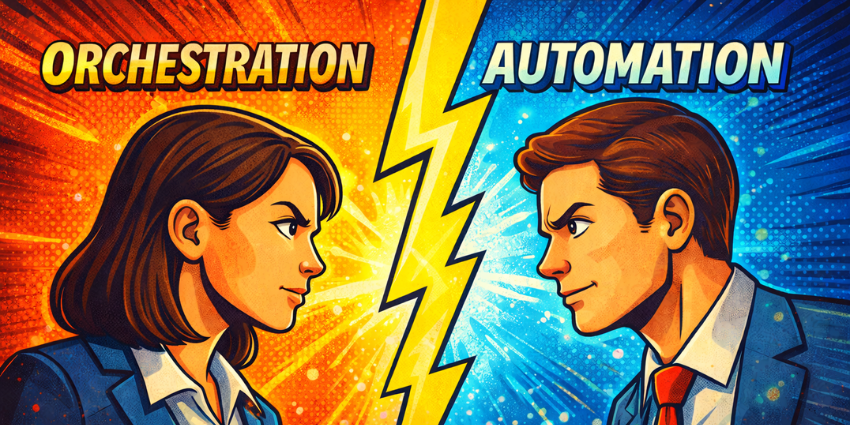
That’s the gap behind the journey orchestration vs marketing automation debate. Automation is great at following a specific path. It’s bad at understanding what else is happening around the customer at the same time. That’s how brands end up talking over themselves.
“The pressure is higher now because journeys don’t move in straight lines anymore.”
People jump from ads to product pages, disappear, come back through chat, escalate to voice, then resurface weeks later through email. That means journeys have to be tracked across channels and adjusted in real time, not “fixed” later in a dashboard review.
Without a single decision layer, every channel optimizes locally and breaks the experience globally. The result is familiar: duplicated messages, awkward timing, and growing frustration.
Further Reading:
- Martech Tools Explained
- Real-Time Customer Journey Orchestration Explained
- Journey Orchestration Governance and Design
Journey Orchestration vs Marketing Automation: What is Marketing Automation?
Marketing automation isn’t a bad thing; it’s still incredibly valuable, particularly with AI now helping CMOs achieve their KPIs faster than ever. For teams trying to scale predictable communication, it’s still one of the most reliable tools in the stack. Nurture streams, onboarding drips, lead scoring, renewal reminders: automation tools can do it all. They bring order to repetition.
The trouble starts when automation is asked to think. Traditional platforms operate on fixed logic: if someone clicks, wait three days, then send the next message. That works when journeys behave like we think they will. They rarely do.
This is the boundary in journey orchestration vs marketing automation. Automation runs what’s been designed. It doesn’t decide whether the design still makes sense.
Why Do Traditional Marketing Automation Platforms Fall Short?
The cracks show up once automation leaves its comfort zone. Scheduled workflows don’t struggle because they’re poorly built; they struggle because customers don’t behave on schedules.
One of the loudest warning signs sits in the personalization gap. Twilio’s research puts it bluntly: 75% of companies think they’re doing personalization well, but only 48% of customers agree. That’s not a rounding error. That’s a disconnect customers feel every day. Automation keeps sending what it was told to send, even when the moment has passed, or the message no longer fits.
This is where marketing automation limitations become hard to ignore:
- Journeys stay linear while customers zigzag
- Messages fire without awareness of service issues or sales conversations
- Identity fractures across channels, so the “same” customer looks like five different people
- Timing optimizes for campaigns, not for reality
Plus, marketing automation only focuses on one part of the customer journey. That naturally leads to a disconnect, and the familiar issue of “over-messaging”. People end up getting “personalized promos” for a product they’ve already bought, or offers when they’re in the middle of resolving an issue.
Journey Orchestration vs Marketing Automation: What is Journey Orchestration?
Journey orchestration tools do overlap with automation tools, but their primary purpose is to act as a real-time decisioning layer. They connect identity, behavioral signals, history, and context, then decide the next best action across channels and teams.
Sometimes that action is a message. Sometimes it’s routing a case, suppressing outreach, or waiting. “Do nothing” is still a decision, and often the right one.
That distinction matters. Automation follows instructions. Orchestration evaluates the situation.
Gartner’s 2025 framing pairs journey analytics with orchestration for a reason. Understanding paths without the ability to act in the moment doesn’t fix much. Orchestration closes that loop. Signals come in, decisions happen immediately, and actions adjust while the customer is still in motion, not days later in a post-campaign review.
This is also why orchestration naturally stretches beyond marketing. Service interactions, sales conversations, product usage, and even unresolved issues all become inputs. The system isn’t asking, “Which workflow comes next?” It’s asking, “What helps this relationship right now?”
Cross-Channel Orchestration: Where the Real Value Emerges
This is where the journey orchestration vs marketing automation debate really livens up.
“Customers don’t move in neat sequences. They bounce around a lot.”
Without cross-channel orchestration, each channel does its own thing. Marketing optimizes engagement. Service optimizes resolution. Sales optimizes the pipeline. None of them is wrong. Together, they still create friction. One team pushes, another pauses, a third has no idea either thing happened.
Cross-channel orchestration changes the mechanics. Instead of every channel deciding in isolation, decisions happen once, upstream. Timing, priority, and relevance get resolved before anything is sent or routed. That’s how duplicate messages disappear, and how a support issue can automatically quiet a campaign without someone manually flipping switches.
Take a look at this case study from TSB for an example. They used Adobe’s Experience Orchestration tool to deliver personalized experiences at every stage of the customer experience. Not only did they increase loan sales by 300%, but they also avoided a host of compliance and overcommunication issues that can drag down marketing strategies in regulated industries.
How Does Journey Orchestration Differ From Marketing Automation?
The simplest way to untangle journey orchestration vs marketing automation is to ask a fundamental question: where are decisions actually being made?
Automation lives inside workflows. It follows rules that were agreed on weeks or months earlier. When conditions change, someone has to notice, open the tool, and adjust the logic. Until then, the system keeps going.
Orchestration sits above that. It evaluates signals in real time and decides what should happen next, across channels and teams. Automation might still send the message or route the task, but it’s acting on a decision that was just made, not one that aged quietly in a workflow diagram.
That difference shows up fast at scale. As journeys multiply, conflicts become unavoidable. Two campaigns want attention at the same time. A service issue collides with a renewal push. A sales follow-up interrupts onboarding. Automation doesn’t resolve those conflicts. Orchestration does.
It’s how companies go from just scaling messaging and personalization tactics to making sure the right information lands with the correct person, at the most appropriate time.
Another example, IC24 used journey orchestration to not just personalize experiences, but reduce unnecessary messaging by 27% and cut average handling times by 16 seconds. That shows you how journey orchestration improves the whole customer journey.
How Can Journey Orchestration Improve Customer Experiences?
Marketing automation definitely still has a place in the customer experience stack. Without it, we’d have no chance of scaling one of the most important parts of customer communication. But without orchestration, there’s too much noise without relevance.
Unified journey orchestration platforms give you a decisioning layer that improves:
Conversion rates:
When decisions happen in context, relevance improves, and relevance converts. Look at HSBC, the company used Genesys Cloud and orchestration tools to create end-to-end, personalized journeys for customers. Over three years, they say the initiative reduced abandonment by 48% and delivered $60 million in projected value.
Sales went up because the company wasn’t just flooding customers with messages; it was sending the right nudges at the best possible moments. That’s orchestration doing what automation can’t, deciding whether to engage, not just how.
Customer experience:
CX gains show up fastest when orchestration crosses into service. A Genesys customer story reports a 34% reduction in routing time and a 43% drop in escalations after introducing real-time decisioning across channels.
The win wasn’t speed for its own sake; it was fewer dead ends and fewer handoffs. Customers reached the correct outcome sooner because the system understood what had already happened.
Efficiency:
Efficiency follows when noise goes down. NICE’s work with the Open Network Exchange case showed what happens when containment and prioritization are coordinated centrally. With AI-driven orchestration in place, the company saw a 30% reduction in call volume, 20% fewer escalations, and 76% of routine instalment payment calls handled automatically, while revenue per call increased by 15%.
Less effort. Better outcomes. The pattern isn’t about AI or shiny new channels. It’s about having one place where decisions get made. When relevance, priority, and suppression are sorted once, everything downstream starts behaving more intelligently.
If you’re looking for your own journey orchestration solution, start with our guide to comparing journey orchestration platforms.
How Journey Orchestration and Marketing Automation Work Together
If you’re still mainly relying on marketing automation, don’t panic. The answer isn’t “rip everything out.” Journey orchestration vs marketing automation isn’t a zero-sum fight. They do different jobs.
Automation is still the hands. It sends the email, triggers the SMS, creates the task, and updates the record. None of that disappears. What changes is who’s in charge. Orchestration becomes the brain, deciding if something should happen, when, and in what order, based on what the customer is actually experiencing right now.
That shift matters across the lifecycle. Marketing automation can’t see churn risk forming unless someone hard-codes it. Orchestration can ingest health signals as they emerge, product usage drops, sentiment turns, and tickets pile up, and adapt before renewal conversations even start. The system stops reacting late and starts adjusting early.
This is where retention analytics becomes one of orchestration’s most valuable inputs. When engagement, service history, and behavioral signals roll into a single view, decisions get smarter without getting louder. Fewer “check-in” emails. Fewer tone-deaf offers. More restraint.
When Should Companies Upgrade from Automation to Orchestration?
An upgrade from automation to orchestration usually becomes obvious when you start noticing friction. Watch for the patterns:
- Messaging conflicts across channels, even when teams swear they’re “aligned”
- Opt-outs creeping up, not because content is bad, but because timing is off
- Sales and service operating blind to what marketing just triggered
- Workflows growing so complex that no one wants to touch them
- A growing need for real-time next-best-action decisions, not another scheduled sequence
This is the point where marketing automation limitations stop being manageable annoyances and start becoming structural problems. Adding more rules only adds more edge cases. Adding more tools just multiplies them.
What’s often misunderstood is the scope of change. Orchestration doesn’t require ripping out existing platforms. Most organizations already own the execution tools they need. The gap sits above them, in how decisions are made and coordinated.
This is also where buying discipline matters. Jumping straight to feature checklists or AI promises usually backfires. The better move is stepping back and asking whether outcomes, data readiness, and operating models are actually clear. This guide can help with that.
From Sending Messages to Steering Journeys
Most marketing tech stacks are very good at sending things. Emails go out on time. Tasks get created. Notifications fire exactly as designed.
“The trouble is, when you just have automation on its own, you still end up with disjointed, noisy journeys.”
Automation scales execution. Orchestration scales judgment. One moves faster. The other chooses better. As journeys stretch across more channels, teams, and moments, that difference becomes more crucial. It shows up in retention curves, service costs, and brand trust. It shows up when restraint matters more than reach, and when timing beats volume.
Orchestration isn’t about adding intelligence everywhere. It’s about deciding once, upstream, so every downstream action makes sense in context. That’s how brands stop talking over themselves and start behaving like a single organization again.
If you’re ready to start building journeys that make sense, rather than just communicating at scale, start with our ultimate guide to sales and marketing technology, and discover how you can align the different stages of the customer experience properly.
FAQs
Why are CX leaders moving beyond traditional marketing automation?
Automation works perfectly when the journey behaves exactly the way the diagram says it should. The problem is that real customers don’t behave that way anymore. They jump channels, stop responding, come back weeks later through a completely different entry point. A fixed sequence keeps running regardless, today’s teams need orchestration.
What technologies enable real-time journey orchestration?
It’s less about one product and more about a stack working together. Something has to recognize the customer across channels. Something else collects signals as they happen. Then a decision layer sits above it all and decides what the next step should be. Message, routing, or sometimes nothing at all.
How do organizations unify data across customer touchpoints?
Most companies discover they’ve been talking to the same person through five different records. One in marketing, another in support, another in billing. Unifying the journey usually starts by linking those identities together. Once that happens, the timeline finally makes sense.
What role does AI play in journey orchestration platforms?
AI tends to help with the decision moment. The system watches signals coming in: behavior changes, support activity, engagement patterns, and adjusts the next step. Sometimes the best outcome is actually suppressing a message rather than sending one.
What mistakes do companies make when implementing journey orchestration?
Treating it like a marketing project is a common one. Journeys rarely live in marketing alone. Service, product usage, and sales conversations all shape what the customer needs next. Another mistake is ignoring messy data. If the inputs are fragmented, the decisions will be too.