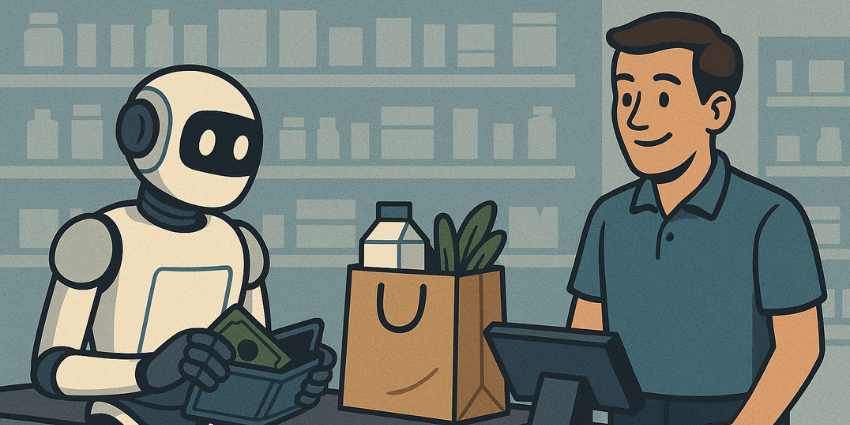

Sales never really stays the same for long, but we rarely experience a change as big as the one we’re encountering right now. Across industries, revenue leaders are discovering their customers don’t fit the carefully-designed profiles they built out for them anymore. In fact, a good percentage of them aren’t even human; they’re bots.
Machine customers and sales are officially colliding, and honestly, a good portion of businesses have no idea what to do. They’re used to human emotion being the biggest driver of buying decisions. So, what happens when one of the biggest opportunities of the next decade rests on connecting with machines? About 50% of CEOs are already sketching strategies for this new buyer persona, but they’re already behind.
“AI assistants are already shopping, making decisions, and skipping the traditional ‘funnel’ altogether.”
Selling is starting to feel a lot less like persuasion and more like infrastructure management.
Further Reading:
- The 5 Superpowers of Copilots for Sales
- Sales Automation Without Sales Alienation
- Sales Team Upskilling for Enterprise AI Adoption
What are Machine Customers?
Our guide to machine customers covers all the essentials you need to know, but basically, machine customers are the new buyer every sales team needs to prepare for.
You might assume consumer bots are just nuisance traffic or scraping tools, but really, they’re actually systems that research, compare, and make decisions on behalf of real buyers. They’re not noise; they’re potential revenue wearing a very untraditional face.
That “potential revenue” is enormous. Gartner says machine customers will have direct influence over about $30 trillion in purchases over the next decade. That’s not a small number.
Right now, these tools come in a few different “species”. You’ve got personal shopping assistants, like Alexa, Siri, ChatGPT, and even Amazon’s assistant with the “Buy for Me” feature. Then there are IoT devices that shop for themselves, like printers that automatically order toners, or industrial machines that schedule maintenance as needed.
Plus, you’ve got the B2B “agents” that do all the work of comparing suppliers on price, SLA stability, ESG data, and delivery reliability, so actual humans can skip calls with sales teams entirely.
For now, most of these tools are still “human-led”, responding to directions given by real people. Soon, they’ll be as autonomous as your new AI coworkers, setting goals, adapting, and making real choices without a person’s input.
How Will Machine Customers Change the Sales Process?
Most sales leaders still believe the “buyer journey” starts when a human lands on their homepage. Unfortunately, the real journey now begins inside an AI tool that’s already sorted through ten vendors before your analytics even register a blip.
This is the part of machine customers and sales that feels genuinely disorienting: we spent decades fine-tuning messaging for humans, and suddenly, the first entity judging you might be a model that doesn’t care about brand voice at all.
From emotional selling to logic-driven buying
Humans can be talked into things by a good story, good rep, and good timing. Machines are immune to charm. They’re basically spreadsheets with spending power. They weigh your prices against your competitors’, watch your delivery performance like hawks, and keep score when your stock levels wobble. Miss too many beats, and you get buried in their ranking logic. No warm relationship will save you.
This isn’t a complaint; it’s a wake-up call. AI in sales isn’t just your internal tooling anymore. It’s the thing that evaluates you.
Gatekeeper bots: the new inbound channel
We’ve been talking about this for a while: your first touchpoint is increasingly a bot rummaging through structured data, API endpoints, FAQs, and product feeds. Humans show up later, if they show up at all. With AI assistants eating into discovery, traditional search is losing its gatekeeper status. Gartner and BCG are essentially predicting a collapse in organic search visibility as buyers lean into AI-recommended shortlists.
So the “inbound lead” isn’t your ad click; it’s whether an agent thinks your catalog is consistent enough to include.
Sales shifts from people to programming
Despite all this, reps aren’t disappearing. They’re just sharing the stage. Sales AI now has two audiences: your team and the buyer’s AI. Internally, tools keep shaving hours off admin. Externally, assistant-driven buyers are doing the early qualification. Since these agents care more about SLAs, uptime, and pricing logic than webinars or charm, sales teams have to team up with product, ops, and data folks to influence the signals that agents actually read.
Humans still close complex deals, navigate politics, and handle nuance. The machines just run the opening act, and sometimes, honestly, most of the middle too.
How Will Machine Customers Reshape Revenue Strategies?
The funniest part of this whole machine customers and sales shift is watching perfectly competent revenue teams wrestle with tech that hasn’t caught up. CRMs still capture data about “people”, which is important, particularly since most machine customers are still trained by humans.
But it’s naive to think that every lead is a person with a pulse.
Traditional scoring models treat every form fill, trial signup, and demo request as a warm human hand waving in your direction. Except now AI agents do all of those things because they’re benchmarking vendors. They just want clean data for their decision engine. Plus, since no one ever calls them back (because, you know, they’re not people), the funnel starts looking like it’s full of ghost buyers.
Then we have the issue of systems misreading AI behavior. Bots behave weirdly. They test pricing endpoints several times in a row, complete a “journey” in seconds, and repeat an order pattern with unnerving consistency. Some security tools treat this like hostile scraping; marketing automation often treats it like a VIP bingeing content.
Also, without a machine flag, routing goes wild, a procurement agent lands in a rep’s queue, the rep calls and emails into the void, and everyone wastes time. Worse: a high-value machine signal, like a new supplier test, gets lumped in with bot noise and ignored. Companies that don’t distinguish human from machine traffic end up reporting nonsense funnel performance.
On top of all that, attribution is becoming harder and harder. The “first touch” might’ve been an AI assistant scraping your API for consistency. The “last touch” might’ve been a machine submitting the order at 3:07 a.m. None of that reality appears in a typical CRM.
How Should Cros Prepare For Machine-Driven Purchasing Decisions?
The most important thing to learn right now is that you can’t treat machine customers like “odd humans”. They’re programs doing exactly what they were designed to do. Unless you build a funnel that acknowledges their existence, your reports will keep lying to you.
Step 1: Add “machine identity” to your data model
First you need to admit that machine customers exist, and make sure both your employees and tech knows that. Your CRM needs a way to tell humans from machines, so add simple fields: customer_type, machine_type, parent_account, and some version of a confidence score. Once you see the patterns, everything else gets easier.
For authentication, treat machines with the same seriousness you’d give a human login. API keys, OAuth, mutual TLS, it depends on your maturity, but the point is control. A lot of leaders forget that machine identity is identity. Especially now that AI in sales workflows depends on clean, predictable signals.
Step 2: Expose machine-specific surfaces (APIs > forms)
Most websites are still built like every visitor is a human with a mouse. You still need to design for people, but remember that agents don’t care about your beautifully designed CTA. They want:
- Clean pricing,
- Stock data,
- Shipping rules,
- SLAs,
- And anything else that helps them rank suppliers.
If that information is hard to find or inconsistent, machines treat you like an unreliable narrator. A buyer’s assistant will happily skip right over you.
Step 3: Build machine-aware intent & lead scoring
The old scoring frameworks don’t apply to bots. A human reading three whitepapers in one night looks interested. A machine doing the same thing looks normal.
So break the scoring into two tracks:
Human scoring: opens, clicks, recency, multi-touch engagement.
Machine scoring:
- Error-free API calls
- How consistently the bot completes tasks
- Order cadence
- Whether the agent reacts to price or SLA adjustments
- Stability of machine-originated revenue
Step 4: Route tasks based on who’s actually “speaking”
If a replenishment bot fires off a standard repeat order? Leave it alone. Machines understand routine better than we do.
But if an assistant suddenly starts poking around new product categories, increases volume, or shows signs of negotiation? That’s when a rep should step in. Create “machine-originated opportunities” automatically. Don’t force reps to guess.
Journey orchestration matters here, so check out our guide on making orchestration systems work for your business. Modern routing engines can decide whether a handoff goes to a human, another bot, or a parallel workflow.
Step 5: Bot hygiene: frequency controls, anomaly protection, fraud
Machines don’t really “misbehave” as much as they don’t behave like humans. They loop and retry the same request 40 times. They hit the wrong endpoint when someone upstream updates a schema. Sometimes, monitoring tools start screaming like your site’s under attack.
Set hard frequency caps per machine ID. Suppress duplicate retries. Build anomaly detection specifically for agents, not humans and give yourself a kill switch. A pricing glitch can trigger a bot swarm and drain inventory fast.
Step 6: Design journeys that work for both machines and humans
The collision of machine customers and sales doesn’t mean human customers will cease to exist. You still need to design for people, using AI and a bit of creativity to predict and personalize experiences for people who care about emotion. We’ve got a guide on how to do that here.
Just remember the other buyer journey too. Machines need structure, speed, and consistency.
When you design for both at once, your whole experience becomes sturdier. Nike and Sephora figured this out early. Their AI experiences are powered by deep product metadata, consistent imagery, disciplined catalog management, and real orchestration in the background. It’s the kind of foundation that both people and bots can trust.
What Are the Risks of Machine Customers for Sales?
On the one hand, machine customers do have the potential to make things feel more efficient. Less emotion and more logic means more streamlined buyer journeys, in theory. But right now? We’re in the awkward teenage years, where half the automation is brilliant, and the other half is actively trying to light your forecasting model on fire. Make sure you’re prepared for:
- Fake demand and inflated funnels: Machine-led noise gets mistaken for momentum all the time. It screws up your pipeline math. It feeds reps bad signals. It tricks leadership into thinking marketing finally cracked the code. It’s all nonsense until you build filters to separate real buyers from automated behavior.
- Misrouting and broken experiences (for bots and humans): The Assi experiment still haunts CEOs. A researcher built a custom GPT, pointed it at 42 major brands, and let it run support tasks. It got stuck constantly because the digital journeys assumed a human with a browser and a full attention span. Sales has the exact same problem. A procurement bot tests your sign-up flow → hits some outdated Javascript → gives up → chooses a competitor, and you never even knew it came.
- Security, fraud, and control: Machine identity is a whole new attack surface. If someone hijacks a bot with legitimate credentials, they can place “real” orders at scale. Imagine 600 fraudulent replenishment cycles hitting your OMS at once. Then there’s the turf war. Amazon blocking Perplexity’s Comet browser wasn’t about “security.” It was about control, who owns the interface between the buyer and the purchase. If you think that conflict won’t spill into B2B ecosystems, you’re kidding yourself.
Also, don’t underestimate the negative impact of focusing too much on machines and neglecting humans. You’re still going to be selling to people, too. Humans still configure the assistants they use. Don’t cut the “people” part out of the equation.
Are you prepared for machine customers? Find out here.
Why This Matters Now: The Machine Customer and Sales Opportunity
Honestly, this is probably the largest shift in how demand forms since e-commerce itself, and maybe bigger. The difference is that e-commerce took a decade to reshape buying. Machine customers are reshaping it way faster. Still, that also means there’s a chance for businesses to get an edge, if they act just as fast. Look at some of the biggest businesses in the world right now.
Amazon is rolling out agents inside its shopping app and blocking agents it can’t control. Walmart built Sparky and is designing for a world where external AIs browse on behalf of customers. Perplexity has basically turned itself into an AI-powered shopping concierge. Nike and Sephora rebuilt their product data foundations, so their recommendations work for humans and machines.
They’re all following the same playbook: Own the interface, own the data, and make it stupidly easy for agents to execute a full purchase. Take the same approach and you’ll survive in the new market. Do nothing, and:
- Your products won’t surface inside AI assistants because your data is inconsistent.
- Your competitors will appear “more reliable” simply because they cleaned their catalogs and exposed better APIs.
- Your inbound pipeline will shrink as assistants steer buyers toward whoever machines can understand fastest.
Preparing for the Dual-Buyer Era (Humans + Machines)
The funnel you’re running today was built for a world that doesn’t exist anymore. By 2026, machine customers and sales will be tangled together in ways that make your old lead definitions feel pointless.
The human side isn’t disappearing. Humans handle fear, frustration, edge cases, politics, and all the things software hates. But machines will handle the routine.
So the job now isn’t “choose a side.” It’s run a business that can speak fluently to both.
Here’s the short version of what leaders should actually do:
- Map every place a machine might already be in your funnel.
- Add machine identity to your CRM and clean the data you’ve been ignoring for years.
- Build bot-aware scoring and routing so machines don’t clog queues meant for humans.
- Update KPIs so you’re measuring AI-mediated influence, not hallucinating over vanity metrics.
- Train your teams to work with AI colleagues and AI buyers, because the crossover is only getting tighter.
If you need help getting the foundations right for an aligned sales, marketing, and customer service strategy that appeals to humans and machines, we’re here to help. Check out our ultimate guide to sales and marketing technology for the next generation of customer experience.
FAQs
Why are machine customers considered a major economic opportunity?
Because they buy differently. A person might compare a handful of vendors and call it a day. A software agent can check dozens in seconds, sometimes hundreds. That scale changes the math. Once machines start doing routine supplier checks or replenishment purchases, a lot more transactions happen without a salesperson ever being involved.
What technologies enable machine-to-machine commerce?
Most of it comes down to systems talking to each other. APIs expose pricing and product data. Identity tools confirm which machine is making the request. AI models sit on top of that stack and compare suppliers. Put those pieces together and software can move surprisingly far through the buying process on its own.
How will AI agents influence B2B purchasing decisions?
They’re already filtering options before humans see them. Procurement agents can scan documentation, test product feeds, and compare reliability signals faster than any analyst could. By the time a human buyer gets involved, the system may already have eliminated half the vendors.
What changes are needed in pricing and product information for machine buyers?
Machines need information that behaves predictably. Pricing tables should be easy to interpret. Product specs should match everywhere they appear. When details shift depending on the page or document, automated systems struggle to compare options and often move on.
How can companies ensure their offerings are discoverable by AI purchasing agents?
In practice it comes down to clean data. Product catalogs need consistent naming, pricing should be structured, and documentation has to be easy for software to parse. When those basics are in place, AI agents can evaluate the offering without guessing what anything means.