
In 2026, community-led and social engagement is becoming a core layer in Customer Experience infrastructure.
What Is Community-Led CX?
Community-led customer experience is the practice of using customer communities and social engagement as a core layer of CX, where trust, validation, and peer support complement AI-driven self-service.
Why Does Community-Led CX Matter In 2026?
In 2026, it matters because buying is more self-guided, AI answers require human proof, and influence increasingly happens in private, peer-led spaces.
When done well, community-led CX drives faster time-to-value, reduces support friction, improves retention, and turns customer insight into a measurable competitive advantage.
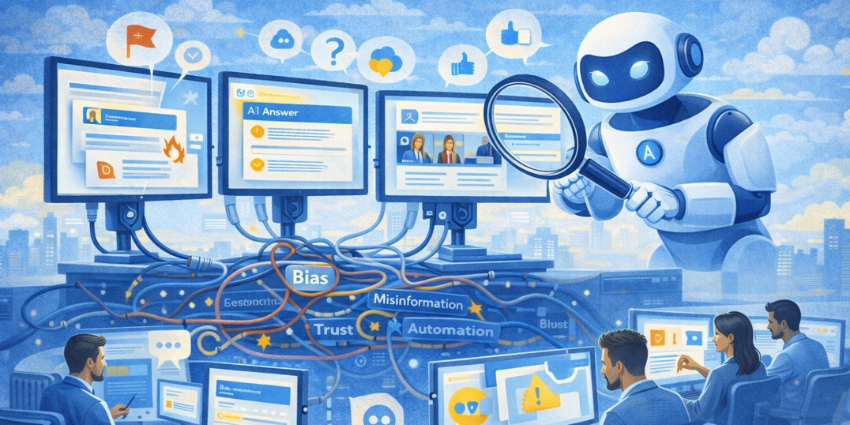
1) Communities Become The Trust Layer in AI-driven CX
AI is accelerating self-service and scaling responses – but speed doesn’t equal confidence.
When customers receive an AI-generated answer, they still want validation: edge cases, real-world context, and confirmation from people who’ve actually done it.
That’s where community becomes essential. Higher Logic notes that communities deliver value beyond quick answers by providing trusted expertise and real relationships.
What to watch in 2026: high-performing teams will build community as the human assurance layer behind automation – AI for speed, community for credibility.
2) Dark Social Remains Dominant – And Younger Buyers Amplify Private Influence
Dark social has long shaped B2B influence. This term refers to the private sharing and mentioning of brands and their products via channels like email and instant messaging. Research from RadiumOne suggests that up to 84% of content sharing now happens through private channels rather than public feeds.
But what makes this more urgent in 2026 is who is buying. Forrester reports Millennials and Gen Z have become the majority of B2B buyers, climbing from 64% to 71% in its annual survey tracking. These buyers favour self-guided research and authentic peer-led interaction over sales pitches – accelerating the shift toward private channels and community-based engagement.
What to watch in 2026: Influence moves further into private, peer-led spaces – and communities become the bridge between untrackable conversations and measurable CX. So, learning how to track and analyze these spaces most efficiently will be key. After all, dark social is the channel for private, high-trust exchanges – the kind of peer-to-peer influence that drives decisions without ever showing up in measurable feeds.
3) Community Shifts From “Engagement” To Retention Infrastructure
Churn rarely begins with a dramatic cancellation moment. It starts with disengagement: stalled adoption, repeated friction, unresolved blockers, and value that feels invisible.
That’s why CX teams are repositioning community as renewal protection. Harvard Business Review notes that acquiring a new customer can be anywhere from five to 25 times more expensive than retaining an existing one. Bain & Company has argued that “by increasing retention by as little as 5 per cent, profits can be boosted by as much as 95 per cent.”
Communities create measurable customer advocacy impact, turning customers into proof – not just users.
What to watch in 2026: Community ROI is increasingly tracked through retention-linked outcomes: time-to-value, support deflection, renewal risk signals, and advocacy participation.
4) Workflow-Embedded Community Becomes The Default
Standalone communities often fail because they require customers to build a new habit. In 2026, community is moving into workflows: onboarding, help centres, product education, and integrated environments like Slack and Teams.
This matters because engagement rises when community is integrated into the broader experience. Higher Logic benchmarking shows systems like automation and gamification can drive more than 2x logins in its dataset. (Forrester)
What to watch in 2026: the communities that win are embedded into moments of need — learning, problem-solving, and peer proof surfaced in-context.
5) Influencer Partnerships Become More Important than ever
In 2026, influencer partnerships stop being a marketing experiment and become a trust + distribution strategy.
This is visible in investment trends. The Interactive Advertising Bureau’s 2025 Creator Economy Ad Spend & Strategy Report projects U.S. creator ad spend will reach $37 billion in 2025, up 26% year-over-year and growing nearly 4x faster than the media industry’s overall growth.
For B2B, the logic is simple: buyers trust practitioners more than polished brand narratives, especially in crowded categories where product claims blur together.
What to watch in 2026: influencer partnerships mature into always-on credibility systems – with measurement shifting from impressions to pipeline influence, activation, and retention impact.
6) B2B Social Continues To Look Like B2C – And The Corporate Voice Finally Dies
B2B social has been evolving toward creator-led formats for years, but 2026 is the tipping point. The corporate voice – safe, vague, consensus-driven – performs worse in a social environment that rewards clarity, personality, and point-of-view.
Using B2C-style elements in B2B campaigns can make brands feel more human, more engaging, more relatable, and easier to trust.
Christa Chavez, À La Carte Media Consulting says:
This additional layer of personalization will foster stronger connections with the audience, which often leads to increased trust and loyalty.
Gartner’s rep-free preference data also supports the direction: buyers increasingly want to educate themselves through digital channels rather than engage with sellers early.
What to watch in 2026:
B2B brands will win by building “media-like” social strategies: opinionated POV content, human faces, practitioner creators, and community-driven proof – because that’s what earns attention and trust.
The Takeaway
In 2026, community and social engagement matters because it solves three modern CX problems at once:
- AI needs trust (community provides proof and nuance)
- Buying happens privately (dark social and peer influence dominate)
- Retention pressure is rising (community reduces friction and makes value visible)
Community isn’t just a channel anymore. It’s the layer that makes customer experience scalable — and in 2026, it’s one of the clearest competitive advantages available.
For a full breakdown of how to build a community-led CX approach, read our Ultimate Guide to B2B Community Engagement.