
It’s obvious something has seriously changed in CX lately. Most customer experiences don’t start on a brand’s website anymore. They start in comment threads, Slack groups, Reddit posts, WhatsApp chats, and half-forgotten review sites someone bookmarked years ago.
Experience is being shaped in pieces, by other customers, long before a brand ever gets involved. That’s the reality behind communities and customer experience today.
When things go wrong in those places, the fallout is huge. When those spaces are managed intentionally, on the other hand, over 67% of customers end up feeling more connected to your brand.
This is why owned customer communities are creeping back to the center of CX strategy. Not as engagement tools, but as places to stabilize experience, capture real insight, and protect trust. Discovery can be rented. Experience continuity can’t.
What’s happening now isn’t a trend. It’s a re-centralization. And brands that miss it are already paying for it.
Rented Reach vs Owned Customer Communities
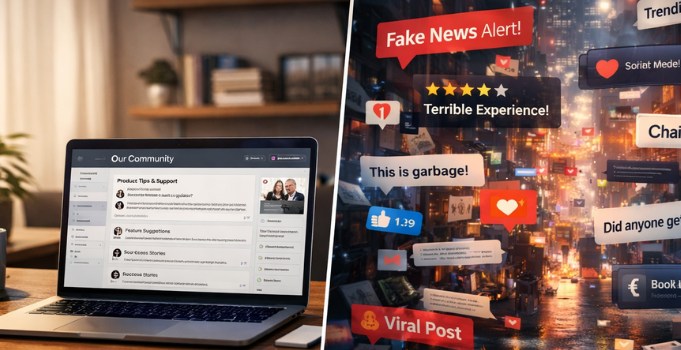
When people say “reach,” they usually mean visibility earned at the beginning of the customer journey. Impressions. Likes. Views that spike and vanish. That’s rented reach. On social platforms and review sites, algorithms decide who sees what, not you, and data shows up late and stripped of detail. If a customer has a bad experience in those spaces, you often hear about it after the damage is done, if you hear about it at all.
Customer Communities work differently. They’re not about grabbing attention in passing. They’re about staying in the room. An owned community gives customers a place where conversations don’t disappear after 24 hours and where history matters. You can see the same names come back, notice patterns, and recognize who’s struggling, who’s helping, who’s quietly drifting away.
What these places give you is first-party community data. You’re not guessing what people care about; you’re watching it unfold over time with repeated questions, long-running frustrations, and unexpected workarounds customers invent on their own.
That’s why communities and customer experience are so tightly linked now. Experience doesn’t live in campaigns or touchpoints. It lives in conversations. If you don’t own the space where those conversations happen, you’re always reacting instead of learning.
The Problems With Rented Reach Platforms
Rented platforms, like social media sites, are great at one thing: momentum. They move fast, amplify emotion, and reward whatever triggers a reaction. None of that is inherently bad. The problem is that customer experience doesn’t behave that way. CX is slow, cumulative, and fragile. Rented reach has a habit of breaking it in small ways.
Algorithm shocks & disappearing access
If you’ve ever watched a reliable channel suddenly go quiet, you know the feeling. Same content. Same audience. Different outcome. Algorithms shift, feeds reorder themselves, and the audience you thought you had slips out of view. That’s a CX risk.
Discovery still happens there. In fact, 40% of digital shoppers say they discover products through social platforms. But discovery without continuity doesn’t give you much. Customers might find you in a feed, then miss the update that explains a delay, a policy change, or a fix. That’s how experience fractures and fragments.
Data limits create blind spots
Rented analytics tell you what happened, not why. You see spikes and drops, but you don’t see the throughline. There’s no sense of how today’s complaint connects to last month’s friction.
That gap is becoming more dangerous as companies rush into AI-led CX. Modern CX efforts stall when data foundations are shaky. AI can’t fix experience problems it can’t see clearly, and it often amplifies the mess instead.
Brand safety and trust risks scale faster than teams
Peer advice spreads quickly. Sometimes it’s brilliant. Sometimes it’s wrong. Once misinformation settles in, it becomes the default answer. Brands step in late, outnumbered, and out of context.
It’s getting worse. News outlets like The Guardian have documented the rise of fake reviews and AI-generated content polluting public platforms. When customers can’t tell what’s real, trust erodes, and CX takes the hit.
Why Owned Customer Communities Improve CX
A lot of companies still think customer communities are spaces for engagement. What they actually become, when done properly, is a core part of the end-to-end customer experience, something people rely on throughout the entire journey. Customer communities power:
Evergreen self-service that actually holds up under pressure
Support teams often collapse under the weight of the same questions that keep coming back, slightly reworded, day after day. Customer communities interrupt that cycle.
A well-run community turns help into something that compounds. Answers don’t disappear into inboxes, workarounds get refined in public, and edge cases get documented by the people who hit them first. Over time, the community becomes a living reference, not a static FAQ.
Customers clearly want this. 81% say they want more self-service options, especially ones that don’t feel like they’re talking to a wall. Community-based self-service works because it feels human. You’re learning from someone who’s already wrestled with the problem.
First-party community data improves insights
First-party community data is cleaner and richer than rented data. You’re not tracking isolated clicks. You’re seeing patterns form. Who asks questions early in onboarding, who’s constantly complaining, and who answers everyone else’s questions.
That kind of longitudinal insight is ideal for customer experience work. It gives teams context instead of snapshots, and shows how needs evolve, not just when something spikes.
Personalization depends on that depth. McKinsey found that 71% of consumers expect personalized interactions, while 76% get frustrated when that doesn’t happen. You don’t get there with anonymous impressions. You get there by understanding people over time, something owned communities can really help with.
Communities as always-on VoC, without the survey fatigue
Surveys have their place. They just arrive late.
Customer communities don’t ask customers to reflect after the fact. They capture experience while it’s happening. People talk through friction in real time. They explain what broke, what confused them, and what finally worked. That context is what surveys miss.
Microsoft’s research showed 90% of customers want to give feedback, but only 24% feel they consistently can. Communities close that gap without forcing anyone to fill out another form.
This is why Customer Communities outperform traditional Voice of the Customer programs. Companies acting on VoC in near real time see a 21% increase in customer retention compared to teams reviewing feedback quarterly. Communities make that speed possible because the signal never stops flowing.
Credibility and belonging do the heavy lifting
When customers see real people using a product, solving problems, and sometimes disagreeing openly, credibility goes up. That’s why 67.4% of consumers say they feel more connected through community than through social media. There’s less performance, more reality.
Belonging matters too. People who feel recognized stick around. They answer questions. They defend the brand when things get rough. That emotional glue doesn’t show up in dashboards, but it shows up in churn numbers later.
Operational leverage without burning out teams
Communities scale better than people.
Research found that 86% of community builders believe branded communities positively impact core operations, and 85% say they improve the customer journey and increase trust. That’s because communities spread the load. They reduce repeat contacts, shorten resolution time, and surface issues earlier.
Just look at Adobe. It runs one of the largest branded communities in the world, with tens of millions of members. It functions as a knowledge engine, a feedback loop, and a peer network all at once.
Verizon’s community, with millions of members and hundreds of thousands of discussions, acts as a massive self-service layer, absorbing demand that would otherwise hit support queues.
The Hybrid Strategy: Social for Discovery, Owned for Depth
Embracing customer communities doesn’t have to mean giving up on “rented reach” entirely.
Social platforms are where curiosity tends to hang out. People scroll when they’re sort of interested, sort of killing time. They spot things wedged between a friend’s update or a clip they never planned to watch in the first place. That kind of exposure still matters, especially now that earning customer trust feels harder than ever.
More than 70% of people trust recommendations from friends over brand messaging, which explains why so many buying decisions start with a screenshot, a link, or a “has anyone tried this?” post. That’s discovery doing its job.
The problem starts when brands expect those spaces to carry the weight of experience. Feeds move on, context gets lost, questions repeat, and customers show up again with the same confusion because nothing sticks.
That’s where customer communities stand out as places where conversations don’t evaporate. Where someone can say, “I asked this last month,” and the answer is still there. Where identity matters. Where history exists.
Social lights the match. Communities keep the fire from burning out.
How to Build a Customer Community Strategy That Improves CX
A lot of companies launch customer communities with energy, branding, and the hope that “engagement” will sort itself out. It rarely does. Communities that actually improve customer experience are built with restraint. Fewer goals. Clear ownership. A willingness to sit with messy feedback instead of polishing it away.
Step one: decide what problem you’re solving
Pick one or two issues to address: support deflection, faster onboarding, or continuous VoC. Maybe even trust repair after a rocky product cycle. Just don’t go over the top. If everything’s a goal, nothing gets done. The strongest owned communities have a narrow reason to exist, and they stick to it longer than feels comfortable.
Step two: treat the community like a shared CX asset
Moderation is important, and escalation paths matter. Someone needs to own what happens when a question reveals a product flaw or a broken process. Feedback has to go somewhere real. When it doesn’t, customers notice fast, and participation drops even faster. Get every customer-facing team aligned around your strategy early.
Step three: give people a reason to come back
That doesn’t have to mean giving people discount vouchers or points every time they contribute. Clear answers and honest discussions can be enough to keep people coming back. You might even set up office hours with people who can actually respond, or regularly recognize your top contributors with public “thank you” messages.
Step four: close the loop publicly
Communities behave like early warning systems. Small issues show up there first. The same questions popping up again and again usually mean something’s off. Silence matters too. When teams share clear “here’s what you said and here’s what we did” updates, people relax. When nothing comes back, customers assume no one’s paying attention and they check out.
Step five: measure outcomes, not noise
Define your metrics. Time-to-resolution. Repeat issue drop-off. Adoption milestones. Sentiment shifts around known pain points. If the numbers don’t move, the community isn’t helping CX yet. That’s fine. Fix it before scaling it.
Unlocking the Power of Customer Communities
For years, brands chased reach and mistook visibility for experience. That worked when journeys were shorter, and customers stayed inside the lines. They don’t anymore. Experience now unfolds in fragments, shaped by peers, algorithms, and private conversations brands rarely control.
That’s why owned customer communities are pulling CX back toward something sturdier. They steady experience, give feedback somewhere to land and turn scattered conversations into first-party community data that teams can actually learn from. Most importantly, they give customers a place where being heard doesn’t feel accidental.
Rented reach will always have a role. It’s how people find you. But communities and customer experience live in the spaces that remember what happened last time.
If you’re ready to learn more, start with our guide to communities, and the future of customer experience.