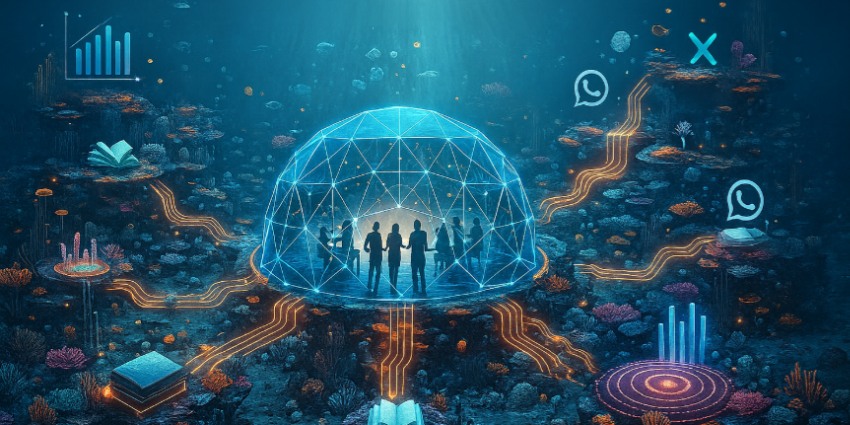

If you’re evaluating tools and asking how customer community platforms work, here’s the honest answer: they work best when they stop acting like “just a forum” and start acting like a connected system. The community becomes a self-service channel, a listening post, and a growth engine. But only if your social engagement tech stack is wired into the rest of your customer world.
That means integrations with CRM, CDP, marketing automation, customer support, analytics, and increasingly, AI moderation and gamification.
Read More
- How Community Engagement Impacts The Customer Experience
- Why B2B Customer Communities Improve Retention
- Why LinkedIn Is Becoming A B2B Customer Hub
What Is The “Core” Of a Customer Community Platform?
At the center is your community experience. Think discussions, Q&A, groups, events, and knowledge. Many platforms also include branding tools, roles, permissions, and content workflows.
But evaluation-stage buyers should zoom out. The core experience is only one layer. The real value shows up when the community connects to your service team, your data, and your go-to-market motions.
Some community products sit inside bigger ecosystems. For example, Salesforce positions Experience Cloud as a CRM-connected digital experience, and it can expose service features like knowledge and case-related experiences.
How Does Community Platform CRM Integration Actually Work?
A CRM integration answers one question: “Who is this person, and what do we know about the relationship?”
In practice, CRM integration usually powers:
- Identity and access: SSO, verified customers, partner tiers, and entitlements.
- Context: showing account details, product ownership, or case status.
- Routing: sending key posts or escalations to the right teams.
- Closed-loop outcomes: linking community activity to retention, expansion, or reduced support load.
Some vendors also push community activity back into CRM. Gainsight, for example, describes syncing community member and activity data into Salesforce for deeper insights.
Evaluation tip: Ask whether the integration is “surface-level” (basic user sync) or “workflow-level” (cases, tasks, and reporting that teams actually use).
Where Does A CDP Fit In A Community Stack?
A CDP exists to unify customer data from many sources. That creates a usable customer profile.
So what does that mean for communities?
- Better segmentation: invite the right people into the right spaces.
- Personalized experiences: show content based on lifecycle stage or product usage.
- Cleaner measurement: connect community participation to downstream actions.
If your CDP holds identity and behavioral data, your community can become a first-class touchpoint. But only if you can share identifiers safely and consistently.
Evaluation tip: Ask how the platform handles identity resolution. Also ask what data gets stored where.
How Do Marketing Automation Tools Connect To Communities?
Marketing automation turns behavior into campaigns. It automates repetitive marketing tasks.
In community terms, that often looks like:
- Onboarding journeys: welcome series, “first post” nudges, and activation prompts.
- Event-driven messaging: “someone replied,” “your idea was accepted,” “new release notes posted.”
- Advocacy motions: recruit superusers, reviewers, and speakers.
Evaluation tip: Make sure you can trigger campaigns from community events. Also confirm you can suppress messages when they will feel spammy.
How Does Customer Support Integration Turn Community Into A Service Channel?
Support integration is where communities stop being “nice to have.”
A good pattern looks like this:
- A customer asks a question.
- Similar answers and knowledge are suggested.
- If needed, the issue becomes a ticket.
- Agents can respond, and the best resolution becomes reusable content.
Zendesk, for example, describes Gather as a community forum that’s part of its self-service Help Center, complementing the knowledge base.
Salesforce also describes enabling service features like knowledge for Experience Cloud sites.
Evaluation tip: Ask how “accepted solutions” become knowledge. Also ask how your agents will work day to day.
What Do Community Analytics Tools Track, And Why Do They Matter?
Community analytics tools tell you whether you’re building a thriving ecosystem or just hosting unanswered posts.
At minimum, you want:
- Health metrics: active users, time to first response, solved rate.
- Content metrics: top topics, deflection candidates, search gaps.
- Business metrics: impact on support volume, renewals, and expansion.
Khoros positions community analytics around dashboards, reports, and benchmarking for understanding what resonates.
Evaluation tip: Ask if analytics answers business questions, not just community questions. Also ask if you can export event data to your BI stack.
How Does AI In Community Management Show Up In The Real World?
AI in community management is not only about chatbots. It’s often about safety, speed, and scale.
Common uses include:
- AI moderation: flagging toxic or unsafe content for review.
- Triage: routing questions to the right product experts.
- Summaries: turning long threads into quick takeaways.
- Search relevance: helping members find answers faster.
Some moderation systems use toxicity detection tooling like Google’s Perspective API in research and implementations.
Evaluation tip: Ask what is automated vs. what is assisted. Also ask for your audit trail.
What Is A Gamification Engine, And When Does It Help?
Gamification is the “motivation layer.” It rewards helpful actions.
Typical mechanics include:
- Points, badges, and ranks
- Quests or challenges
- Leaderboards
- Status perks like early access
It can work well for peer support and advocacy. But it can also create noise. If you reward volume, you may get volume.
Evaluation tip: Ask if rewards can be tied to quality. For example, “solution accepted” matters more than “posted a lot.”
What Should Evaluation-Stage Buyers Validate Before Choosing A Platform?
Here’s a short checklist for late-stage evaluation:
- Integration depth: CRM, support, and data exports are proven in your environment.
- Security model: roles, permissions, and SSO match your reality.
- Data governance: you can control retention, access, and exports.
- Analytics: you can report impact in terms executives recognize.
- Moderation tooling: policy controls are clear, with human oversight.
One more practical note: integrations add value, but they also add risk. Recent reporting has highlighted how third-party app connections can become part of security incidents, which makes vendor due diligence and access controls even more important.
Conclusion: What “Works” Is A Connected Community, Not A Standalone Forum
Modern communities work when they are connected to the systems your business already runs on. That means community platform CRM integration, a clean data layer, service workflows, analytics, and smart automation. If you evaluate the full stack, you won’t just launch a community. You’ll launch a customer engine.
FAQs
What Is A Customer Community Platform?
A customer community platform is software that hosts discussions, Q&A, and self-service experiences for customers. It helps customers support each other and helps companies scale support and engagement.
How Customer Community Platforms Work With CRM Systems?
They connect community identities to CRM records. That enables segmentation, personalized experiences, and workflows. It also helps link community activity to customer outcomes.
What Are Community Analytics Tools Used For?
They track engagement and performance. They can also measure impact, like solved rates and support deflection. Some tools provide dashboards and exportable event data.
How Does AI In Community Management Improve Moderation?
AI can flag harmful content for review and help enforce policies at scale. Some approaches use toxicity detection models and APIs to detect risky language.
What Integrations Matter Most In A Social Engagement Tech Stack?
For most teams, the top three are CRM, customer support, and analytics exports. CDP and marketing automation become critical when personalization and lifecycle journeys matter.
Want the bigger picture on where communities are heading next? Dive into The Future of Customer Experience.