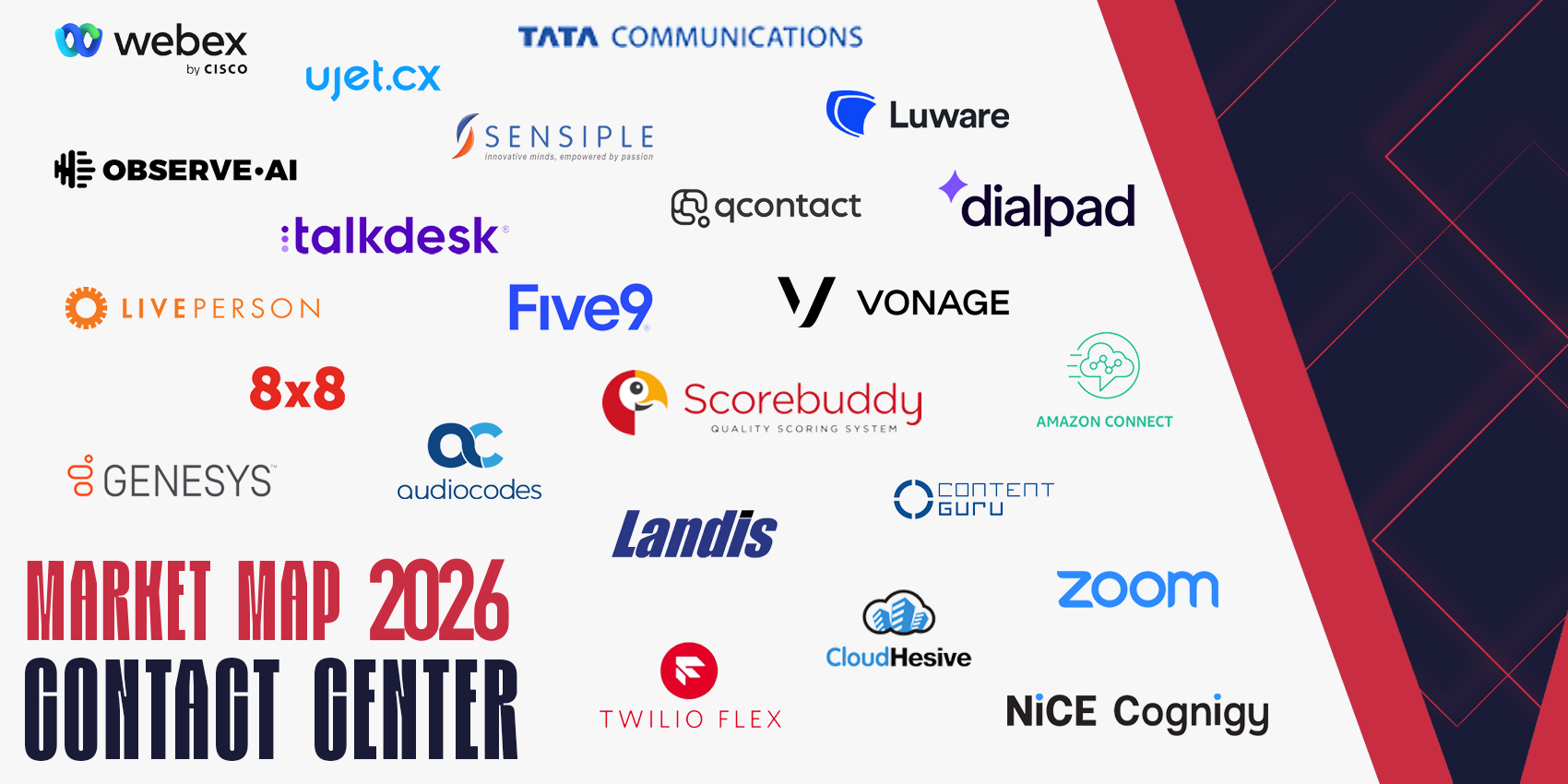

Understanding today’s contact center vendors takes more than comparing features. Instead, the modern CCaaS market is shaped by very different approaches to cloud design, AI use, and platform ownership. As a result, these differences now play a major role in long-term success.
The market also reflects a broad mix of global cloud providers, AI specialists, regional innovators, integration partners, and workforce optimisation vendors. From enterprise platforms such as 8×8, Zoom, Vonage, Dialpad, and Tata Communications, to specialist providers like Ujet, Luware, QContact, Landis Technologies, and AudioCodes, buyers now face a wider ecosystem than ever before.
Related Stories
- Contact Center Platform Reviews: CCaaS and AI Maturity Assessed for Real Buyers
- Genesys vs NiCE vs Five9: Which Tier-1 CCaaS Platform Is Right for Enterprise Cloud and AI Strategy?
At the same time, as enterprises move faster into the cloud and push AI beyond pilot stages, the gap between vendor types has grown. Cloud-native CCaaS platforms, AI-led vendors, and composable architectures all solve different problems. However, they also introduce very different risks.
Because of this, understanding these models early is critical. Without clarity, organisations risk stalled modernisation, rising cost-per-contact, and repeated platform changes.
What Types of Contact Center Platforms Exist Today?
At a high level, today’s contact center market falls into three main platform models:
- Cloud-native CCaaS platforms
- AI- and automation-led contact center vendors
- Composable and API-driven CCaaS stacks
Importantly, each model reflects a different view on control, speed, and ownership.
Cloud-Native CCaaS Platforms: Built for Scale and AI
Examples include: Content Guru, Five9, Talkdesk, Zoom, Vonage, Dialpad
(with enterprise-scale platforms such as Cisco Webex Contact Center, 8×8 and Genesys Cloud also operating in this space – although not exclusively)
Cloud-native CCaaS platforms were built for the cloud from day one. Unlike older systems adapted later, these platforms avoid on-prem limits. As a result, they are designed for scale, resilience, and constant updates.
Enterprise-scale platforms such as Content Guru, 8×8, Genesys Cloud, and Cisco Webex Contact Center also sit in this cloud-native CCaaS category, but not exclusively. In practice, they serve a wider mix of enterprise needs—often supporting more complex deployments, broader portfolios, and phased migration paths alongside modern cloud delivery. As a result, they can look more “platform suite” than “pure-play cloud-native,” even when their contact center products are fundamentally cloud-first and AI-ready.
This design choice matters. In practice, organisations using cloud-native CCaaS find it easier to roll out analytics, automation, and AI. That’s because data models, routing, and workflows were built to support them from the start.
In other words, the benefits are structural, not cosmetic. Faster launches, less technical debt, and global scale come from the core design—not from add-ons. At the same time, cleaner data makes AI training and governance easier over time.
Other providers such as Ujet and Luware also align closely with cloud-native design principles, emphasising API-driven integration, digital-first routing, and flexible scaling models suited to distributed workforces.
However, there are trade-offs. For example, deep customisation is often more limited than in heavily modified legacy systems. In addition, governance options vary by vendor, especially in regulated or sovereign setups.
Best fit:
Therefore, cloud-native CCaaS suits organisations making a clear move to the cloud, or those replacing early “lift-and-shift” deployments with a more AI-ready base.
AI- and Automation-Led Vendors: Faster Gains on Top of CCaaS
Examples include: Observe.AI, NiCE Cognigy, LivePerson, Scorebuddy, Shyftoff
AI contact center vendors do not replace CCaaS platforms. Instead, they sit on top of them. Their focus is narrow but high-impact: automation, agent assist, quality checks, and deep analytics.
Vendors such as Scorebuddy focus heavily on quality management and performance insight, while emerging AI specialists like Shyftoff concentrate on targeted automation use cases. These tools sit alongside core CCaaS platforms to enhance decision support, QA calibration, and compliance visibility.
As a result, this group often delivers the fastest short-term ROI. Teams can improve agent output, compliance, and insight without changing core telephony or routing.
That said, these gains depend heavily on integration quality. If data flows are weak or ownership is unclear, value drops quickly. Moreover, explainability, trust, and model control become shared duties—not things the vendor fully owns.
Best fit:
Therefore, AI-led vendors work best for contact centres that already have a solid CCaaS platform and want faster AI results without major disruption.
Composable and API-Driven CCaaS: Full Control, Full Ownership
Examples include: Amazon Connect, Twilio Flex, Vonage APIs, Tata Communications
Composable CCaaS platforms take a very different path. Rather than offering a full suite, they provide building blocks that teams assemble themselves. In composable environments, integration and managed service partners such as CloudHesive and Sensiple often play a critical role, helping enterprises connect routing, AI services, CRM, identity layers, and analytics into a coherent operating model.
Not all modernisation journeys require full-suite enterprise replacement. Regional or hybrid-focused vendors such as QContact, Landis Technologies, and AudioCodes often serve organisations seeking phased migration, voice modernisation, or enhanced SBC and voice-layer resilience without immediate platform overhaul.
These providers frequently support coexistence models, bridging legacy telephony with cloud CCaaS or AI overlays.
On the plus side, this brings unmatched flexibility. For example, enterprises can tightly link contact center workflows to business systems, data platforms, and cloud AI tools. As a result, digitally mature teams can create highly tailored agent and customer experiences.
However, flexibility comes at a cost. Integration, security, uptime, and long-term upkeep all sit with the buyer. Without strong engineering teams and clear ownership, these stacks can become brittle and expensive.
Best fit:
In contrast to suite platforms, composable models suit organisations with mature engineering skills, clear governance, and a long-term platform plan.
How CCaaS Vendors Differ in Their AI Approach
Across the market, the key difference is where intelligence lives:
- Legacy-leaning platforms add AI slowly to existing flows
- Cloud-native CCaaS builds AI into routing and orchestration
- AI-led vendors focus on specific, high-value use cases
- Composable platforms expose AI through APIs and cloud services
Importantly, real-world deployments show a clear pattern: AI works best when it is built into core workflows and governed properly. Whether embedded natively within platforms like Dialpad AI, layered through optimisation vendors such as Scorebuddy, or orchestrated via composable APIs from providers like Vonage, the differentiator remains governance and integration discipline. By contrast, bolt-on tools struggle to scale.
When Should Organisations Re-Evaluate Contact Center Vendors?
In practice, four signals often trigger a successful review:
- Cost-per-contact is rising without more volume
- AI pilots stall and never reach production
- Security, compliance, or fraud risks increase
- Agent churn grows due to poor tools and friction
Crucially, waiting until contracts end or systems fail raises risk. Instead, early reviews allow phased change, better timelines, and stronger buy-in.
Why Market Understanding Matters Before Shortlisting
Too often, teams shortlist vendors without understanding the wider market. As a result, they run into common failures:
- Cloud goals blocked by legacy platforms
- Regulated teams underestimating governance needs
- AI plans moving faster than the architecture can support
Therefore, market analysis should come first. It removes mismatch early—before feature lists hide deeper issues.
The Buyer Takeaway
The modern contact center ecosystem now includes full-suite platforms, AI overlays, CPaaS providers, managed cloud partners, and specialised optimisation vendors. From Zoom, 8×8, and Dialpad to CloudHesive, Sensiple, and Tata Communications, buyer success depends less on brand recognition and more on architectural alignment.
There is no single “best” contact center platform. Instead, success comes from fit.
- Legacy platforms enable controlled transition
- Cloud-native CCaaS supports scalable change
- AI vendors speed up focused outcomes
- Composable stacks reward strong engineering
Ultimately, understanding how CCaaS vendors differ across cloud, AI, and architecture is what separates modernising once—from modernising again and again.
Find out how CCaaS is used in each industry here.