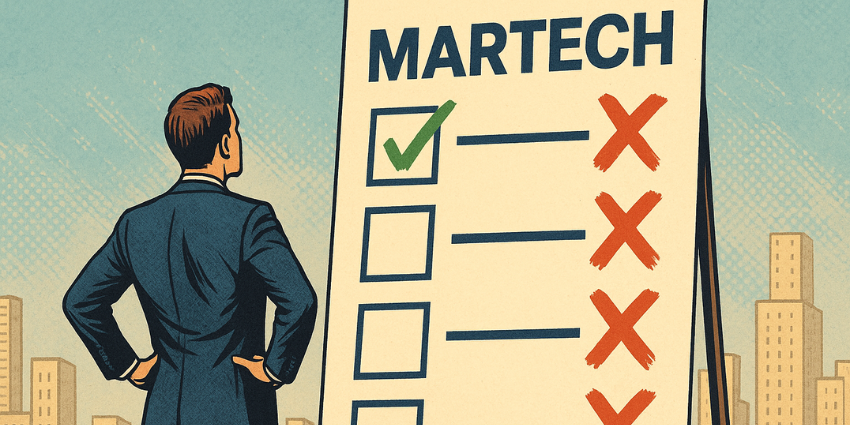

Signing a new marketing technology contract can feel like progress. Whether it is a HubSpot subscription for a small business or a specialised healthcare martech tool, the real work starts long before the ink is dry.
Across enterprises and regulated industries, the same pattern repeats. Teams discover the hard problems only after go live. Data is messier than expected, workflows are not aligned, and the business case is suddenly harder to defend.
“Treat buying the martech tool as the simple part.”
The hard part is getting ready to adopt and integrate it.
1. Start With Outcomes, Not Features
Most martech failures are outcome failures, not technology failures. Buyers fall in love with features, then struggle to show what has actually changed in the business.
Small businesses often overbuy. They pay for advanced capabilities they will not use for years. Healthcare organizations tend to underestimate compliance and workflow complexity. Both end up with the same problem. The tool does not clearly move the numbers that matter.
Before you shortlist vendors, do three things:
- Document three to five primary use cases, not a feature wishlist.
- Translate each use case into measurable outcomes, such as conversion uplift or reduced no show rates.
- Create a short list of non negotiables, covering integrations, security and compliance, channels, and reporting.
Use these objectives as the backbone of your vendor scoring. They should drive the demo agenda and the final decision. If a vendor cannot show exactly how their martech tool supports those use cases and metrics, that is a red flag.
2. Map Your Data And Integration Reality
Martech adoption often fails because data is scattered, dirty, or locked in legacy systems. For a small business, that might mean spreadsheets and an ageing CRM. In healthcare, it means EMRs or EHRs, patient portals, and strict data governance.
Integrations can turn an affordable subscription into a surprisingly expensive project.
Before you buy, map your data and integration landscape:
- Inventory every system that will send to or receive data from the new tool.
- Classify each as a system of record or system of engagement so you know where truth lives.
- Ask vendors for reference architectures and integration patterns for your industry.
- Estimate the data hygiene work, including deduplication, consent flags, and contact limits for platforms that price per contact.
That integration and data cleaning effort should feed directly into your timeline, budget, and vendor comparison.
3. Align Stakeholders And Governance Early
In small businesses, a single decision maker often buys martech. In larger or regulated organizations, buying without IT, security, and compliance at the table is a reliable way to trigger delays and rework.
Before you purchase:
- Clarify who owns what: marketing, IT, data and privacy, sales or service.
- Involve compliance and security early to confirm regulatory requirements, data residency, and audit logs.
- Decide which data must never flow into the martech platform.
- Define who can create segments, workflows, and templates, and who approves campaigns in regulated environments.
Capture this in a short operating model, ideally one to two pages. Share it with shortlisted vendors and expect their implementation proposals to align with it. If they cannot work within your governance model, you have just avoided a much larger problem later.
4. Model Total Cost, Not Just the Subscription
Subscription martech often looks affordable on the surface. Costs climb through contact tiers, add ons, extra environments, and professional services.
A three-year total cost of ownership view brings these issues into the light:
- Licenses and subscriptions, including hidden add-ons.
- Implementation and integration, both internal effort and external partners.
- Training, change management, and ongoing admin or operations.
Scrutinize pricing levers such as contact or record tiers, email volume, workflow limits, additional IPs, sandboxes, and support levels.
For suites such as HubSpot, be explicit about what you truly need on day one and what can wait. Make sure your business case includes time to value assumptions that align directly with the outcomes you defined earlier.
5. Design Adoption Before You Sign
The biggest gap many buyers face is a mindset problem. They treat the contract as the finish line instead of the starting gun. There is no concrete plan for how teams will change the way they work with the new martech tool at their disposal.
Before you sign, design the adoption plan:
- Define a phased rollout, starting with a small set of high impact, low risk use cases.
- Agree roles and skills, including admin, campaign builder, analyst, and approvers.
- Ask vendors and partners for concrete enablement assets and make them part of the contract.
- Set up 30, 60, and 90 day success reviews tied to the metrics in your outcomes definition.
If a vendor cannot show how they will support adoption, not just configuration, then the risk of shelfware and underuse increases sharply.
Turn Your Checklist Into A Vendor Test
If you treat adoption as the hard work and buying as the easy bit, you will make far stronger martech decisions. Use these five steps as a pre purchase checklist. Then flip it around and use it as a vendor test during sales conversations.
Ask each shortlisted provider to show how their platform and services support your outcomes, your data reality, your governance model, your cost constraints, and your adoption plan. The vendors that lean into that conversation are the ones most likely to be there when the real work begins.
To find out more about the process of finding, purchasing, and adopting Sales & Marketing technology, check out our Ultimate Guide on the subject here.