

Google has secured a series of impressive CCaaS wins, rubberstamping its credentials as a cloud contact center provider for the largest and most complex enterprises.
In an exclusive interview with CX Today, Amit Kumar, CCaaS Product Manager at Google, rattled off a long list of enterprise megadeals, including a 10,000-seat win in North America.
Yet, this is only one eye-catching example, with Google leveraging CCAI-P to displace legacy systems within many household name brands.
Those include the largest online retailer in Mexico, a prominent pharmaceutical vendor in Brazil, and a global insurance firm – each with several thousands of agents on Google’s platform.
Kumar promises much more, too, with a healthy pipeline brimming with businesses looking to expand their positive relationships with Google.
"We have lots of existing Google Cloud Platform (GCP) customers, looking to advance the relationship by adding CCAI-P in their environment," he said.
If they use the CCAI suite – the platform’s predecessor - and are looking to replace their legacy vendor, we have consistently been automatically added to those evaluations and requests for proposals (RFPs).
Interestingly, Kumar also notes that the CCaaS solution has become a “door opener” for the tech juggernaut, highlighting three core business drivers:
- Its reliable, scalable, secure foundation
- Cloud-native, AI, and user-first design
- A focus on driving customer success
One look at the CCAI platform’s architecture underscores the first two drivers, with the underlying Google Kubernetes Engine (GKE) providing a powerful, cloud-native base.
First, that allows Google to innovate quickly, as it did so throughout 2023, releasing 100+ new CCaaS features in 16 release waves. The graphic below includes many of these capabilities.
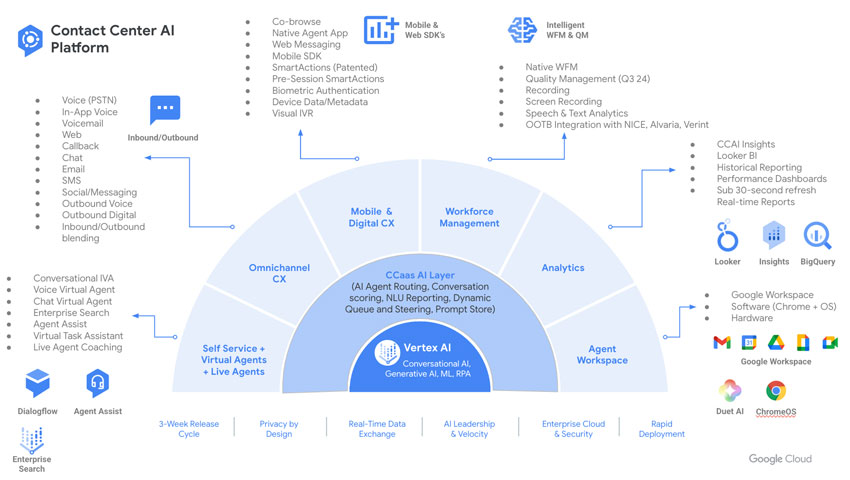
However, the GKE groundwork also enables that all-important scalability, with Kumar sharing an example of a global enterprise scaling the solution – across various locations - for 3,000 agents in less than five months.
Such successful implementations are also thanks to Google’s multi-region capability, which powers the platform to run automatically and reliably in multiple locations around the world and across various clouds.
Its security-focused foundation is critical, too. After all, Google doesn’t store any data within the platform. Instead, it encrypts everything – at rest or in transit - and funnels it into the business’s system of record.
With concerns over reliability, security, and scale, most large enterprises have not yet switched to the cloud – sticking with their legacy premise-based platforms.
Typically, those platforms are Avaya, Cisco, and Genesys. Each has a CCaaS offering, yet Google has displaced each vendor in the enterprise – thanks primarily to these factors, suggests Kumar.
Yet, he also noted that its AI-friendly design is becoming another significant business driver as Google aspires to move the needle with AI in the enterprise.