
Once an AI sales solution has been chosen, most enterprises assume the hard work of sales team upskilling is done. In reality, the risk simply shifts: the technology may largely perform as promised, but sales behavior may not change enough to unlock value. That’s where structured sales training and AI sales training become the decisive factors in whether you see a return in the first 6–12 months.
From my vantage point, the quickest path to ROI is clear: treat AI sales training as an integral part of your go-live plan, not a parallel initiative. The aim is simple – help sellers sell more, faster, using the tools you have already paid for and truly supporting salespeople with tech instead of adding extra admin.
Make AI Part of the Sales Workflow, Not a Side Project in Your Sales Training
Generic sales training on “what AI is” has limited value. Reps need to see exactly how the new tools help them do their jobs today – not in theory, and how supporting salespeople with tech makes their daily work easier, not harder.
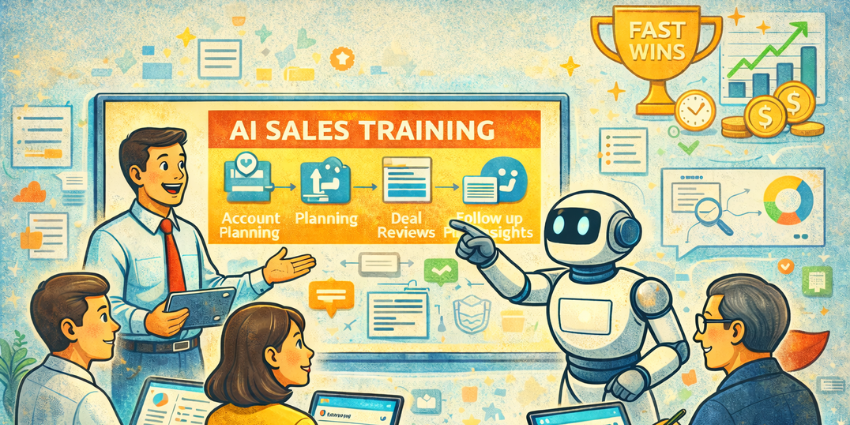
Anchor AI enablement in real sales motions:
- Account planning and territory coverage
- Opportunity management and deal reviews
- Prospecting, outreach, and follow-up
- Renewals and expansion motions
Every session should answer one question:
“How does this AI capability help me win this type of deal faster?”
Frontline managers are critical here. Equip them with simple coaching prompts (for example, “Show me where you used the AI assistant on this opportunity”) so AI usage becomes part of regular pipeline and 1:1 conversations.
Design Role-Specific Sales Team Upskilling and B2B Sales Team Skills
AI will be used very differently by SDRs, account executives and sales leaders, so B2B sales team skills need to be developed in different ways. A single, generic sales training path will slow adoption.
- SDRs: focus on prospecting efficiency, list building and AI-assisted outreach.
- AEs: emphasize stakeholder mapping, summarizing customer interactions and next-best actions in complex deals.
- Managers: train on pipeline insights, risk signals and coaching opportunities surfaced by AI.
Keep modules short, scenario-driven and immediately applicable. The most successful programs I see blend classic sales training principles with AI-specific workflows, rather than treating AI as a separate “tech” topic – they make sales team upskilling part of everyday selling.
Build Fast Wins and Measure Behavioral Change
If you want quick ROI, you need visible wins in the first 60–90 days from your AI sales training. Firstly, select two or three high-impact use cases. For example, AI-generated call summaries, automated follow-up drafting, or AI-assisted account plans – and instrument them from day one.
Measure:
- Time saved on admin tasks
- Adoption of AI features in core opportunities
- Impact on conversion rates or cycle times
Importantly, track behavior, not just logins: how often AI insights change a next step, a forecast, or a coaching conversation.
Turning Training into Revenue
AI will not fix a sales organization that is unwilling to change. But with focused AI sales training and role-based sales upskilling, you can turn your investment into tangible revenue impact much faster.
My recommendation: for every pound or dollar you spend on sales technology, ringfence time, ownership and budget for sales training, B2B sales team skills, and ongoing enablement.
Bring sales leadership, operations and enablement together to design a unified adoption plan before you go live. That’s how you move AI from “interesting feature” to indispensable part of how your enterprise sells, genuinely supporting salespeople with tech instead of overwhelming them.
Bring sales leadership, operations and enablement together to design a unified adoption plan before you go live. That’s how you move AI from “interesting feature” to indispensable part of how your enterprise sells.
FAQs
What is AI sales training?
- AI sales training teaches your sales team how to use AI tools in their everyday work, like prospecting, writing emails, and updating deals. Instead of just talking about what AI is, it shows reps exactly how to use AI features inside the systems they already use.
Why do sales teams need upskilling when we adopt AI tools?
- New AI tools only help if people know how to use them. Sales team upskilling makes sure reps understand how AI can save them time, help them find better opportunities, and close deals faster, instead of feeling like “just another system.”
How can I train my sales team to use AI?
- Start by showing them how AI supports the tasks they already do: finding prospects, planning accounts, running meetings, and sending follow-ups. Use short, practical sessions where they click through real examples, not long theory-based trainings.
What are some ways AI can help salespeople?
- AI can summarize sales calls, suggest next steps, draft emails, and highlight which accounts are most likely to buy. These small time-savers add up, giving salespeople more time to talk to customers instead of doing admin.
How should I upskill different sales roles like SDRs, AEs, and managers?
- Give each role its own path. For SDRs, focus on using AI for prospect lists and outreach. For account executives, focus on using AI for deal strategy and follow-ups. For managers, show how AI surfaces pipeline risks and coaching opportunities they can act on.
How do I know if my AI sales training is actually working?
- Look for simple, visible changes. This means less time spent on admin, more use of AI features in live deals, and higher conversion rates. If reps are talking about how AI helped them move a deal forward, your training is doing its job.
Interested in AI and sales? We’ve got the perfect read for you, our ultimate buyer’s guide to Sales & Marketing technology.