
This week, over 40,000 people gathered for one of retail’s largest annual events, the National Retail Federation (NRF) conference.
At the event a theme that became evident is that retailers are being asked to deliver more “human” service in physical locations, at the exact moment when labor is harder to hire, train, and retain.
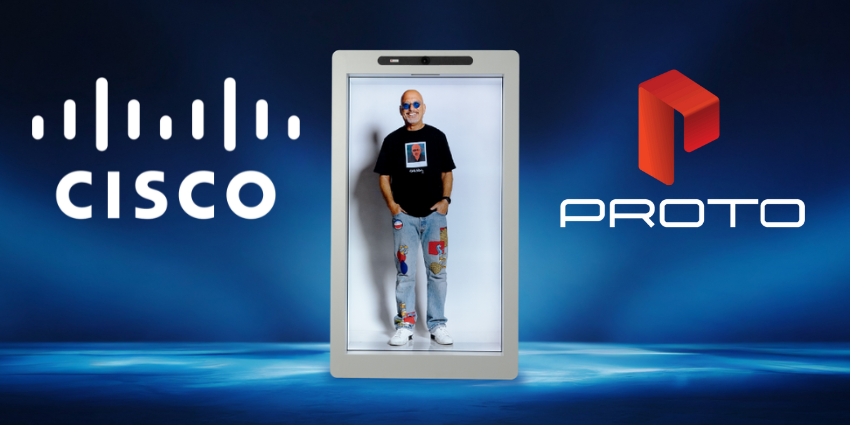
That tension is why a recent demo from Cisco and Proto Hologram at the event is worth a closer look. At Cisco’s booth, the companies showcased an AI-powered hologram chatbot called Kailey, positioned as a step beyond holograms as theatre, and toward holograms as a practical front line for retail customer experience.
David Nussbaum, Founder at Proto Hologram explained how Kailey works:
“Kailey runs on a small language model deployed at the edge using Cisco’s Unified Edge platform, enabling natural, voice-based conversations without relying on the cloud.”
Nussbaum went on to describe Kailey as a real person scanned live at the conference, then “brought to life” as an interactive hologram using Proto technology.
The experience is designed for natural, voice-based conversations. In the demo, customers could ask questions conversationally, get product and platform support instantly, and interact with a more human-style interface than a screen-based chatbot.
Critically, Proto Hologram frames the underlying architecture as edge-first, with the small language model deployed locally using Cisco’s Unified Edge platform, rather than relying on cloud connectivity.
Why Edge AI Matters for Retail CX, Beyond the Wow Factor
Retailers have experimented with kiosks, digital signage, QR journeys, and chatbots for years. The failure mode is familiar. Customers either do not notice them, or they notice them once and then abandon them when the answers are slow, irrelevant, or inconsistent with reality in the store.
An edge-deployed model changes a few practical considerations. Latency is the obvious one. If a customer is standing in an aisle asking a question, the interaction needs to feel immediate.
Resilience is another. Stores do not always have perfect connectivity. An experience that “does not rely on the cloud” can reduce the impact of network instability on customer service moments.
There is also governance. CX leaders will want clarity on how product and support knowledge is curated, updated, and controlled across locations. A compelling interface amplifies both accuracy and inaccuracy, so the operating model matters as much as the demo.
Proto Hologram also confirmed it is SOC 2 certified, a relevant trust marker for retailers that need clearer assurance around security controls when deploying customer-facing technology.
Retail Use Cases Where a Holographic Assistant Could Be Tested First
Proto Hologram positions this as “a glimpse into the future of retail and customer support.” With an emphasis on AI that feels personal, runs locally, and shows up as a human presence.
In practical retail terms, the most logical early pilots are the interactions that are high-volume and repeatable. That includes wayfinding, store policy FAQs, basic product comparison questions, and first-line troubleshooting for products and platforms where retailers see frequent returns or service escalations.
If the experience reduces repeat questions, shortens time-to-assist, and improves confidence in purchase decisions, it earns its place in the store. If it only creates a moment of spectacle, it will struggle to scale past the flagship.
Nussbaum pointed out the importance of the language capabilities:
“Kailey has been used by attendees speaking multiple languages, a useful signal for retailers operating across regions or serving multilingual communities in a single store footprint.”
What CX Leaders Should Measure Before They Scale It
If we treat this as a CX capability, not a gimmick, the scorecard should be grounded in outcomes. That means conversion lift in the pilot zone, reduced wait time for assistance, containment of common support queries, and customer satisfaction signals tied to specific journeys.
Store team feedback matters too. Any in-store digital service layer has to fit real operating conditions, including peak traffic, noise, and the need for fast escalation to a human when the query goes off-script.
Edge AI, real-time interaction, and holographic presence is a powerful combination. It also raises the bar for CX execution, because a more human interface makes expectations higher, not lower.
In a world where AI and personalization keep moving closer to the point of service, retailers that win will be the ones that pair innovation with discipline: clear use cases, tight content governance, and measurement that proves the experience is improving the customer journey.
Join our community on LinkedIn: https://www.linkedin.com/groups/1951190/ to continue the conversation with 40,000+ members, and subscribe to our newsletter: http://cxtoday.com/sign-up for our weekly rundown of the most crucial CX industry news.