
Right now, a lot of executives are telling themselves the same comforting lie: “Even if automation doesn’t help, it won’t hurt.” The pressure to automate everything has convinced leaders that experimenting endlessly is better than falling behind. It isn’t.
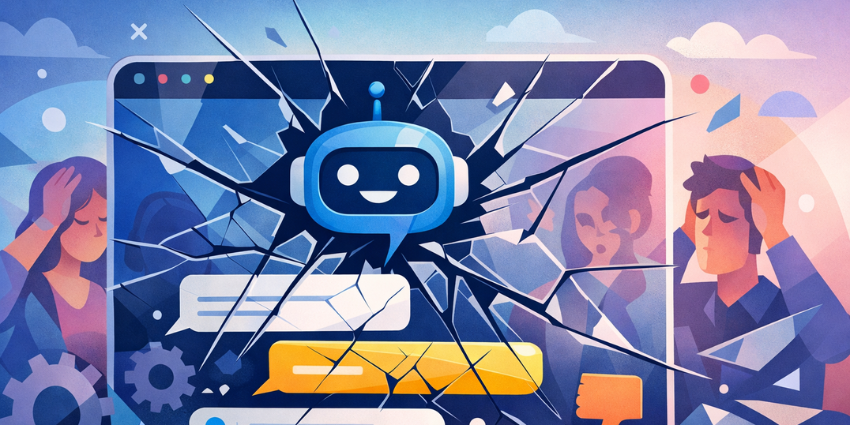
Bad CX automation is more of a liability than companies realize. You’re not just putting your reputation at risk (we’ve all seen the stories about major AI failures), you’re rewiring customer behavior. Over time, people stop complaining, stop trusting self-service, and stop giving brands a second chance, whether they realize it or not.
What makes this dangerous is the time lag. The automation fails today, but the churn shows up next quarter. By then, leaders are already funding the next wave of automation, unaware they’re scaling the same risks. There’s evidence behind this.
Qualtrics found nearly one in five consumers saw no benefit from AI in customer service, that’s almost four times the failure rate of AI use in general. Gartner reports 64% of customers would rather companies didn’t use AI for service at all, and over half would consider switching if they knew AI was being introduced.
AI isn’t the problem. Treating automation like a harmless experiment is…
Related Stories:
- AI Knows When Your Customers Will Leave – Do You?
- The Best Predictive CX AI Providers 2026
- The Predictive CX Playbook: Using AI to Stay One Step Ahead of Your Customers
What Bad CX Automation Looks Like, and the Hidden Costs
Most conversations about automation failure get stuck at the surface level. The bot was confusing, the flow was clunky, or the answers weren’t great. These things seem annoying, but manageable.
Really, though, bad CX automation doesn’t just create momentary friction. It changes how customers behave, how agents work, and how costs stack up across the business. And the damage rarely shows up where leaders expect it. It doesn’t always hit CSAT immediately. It doesn’t always trigger complaints. What it does is leak value, across churn, repeat contacts, abandoned self-service, and agent burnout.
This is where CX automation risks become financial risks.
Poorly designed automation creates patterns: customers learn which channels to avoid, agents inherit frustration they didn’t cause, and self-service becomes something people work around instead of rely on. Here’s where bad CX automation is really costing you.
Over-deflection = higher churn and repeat contacts
Over-deflection is where bad CX automation gets expensive quickly.
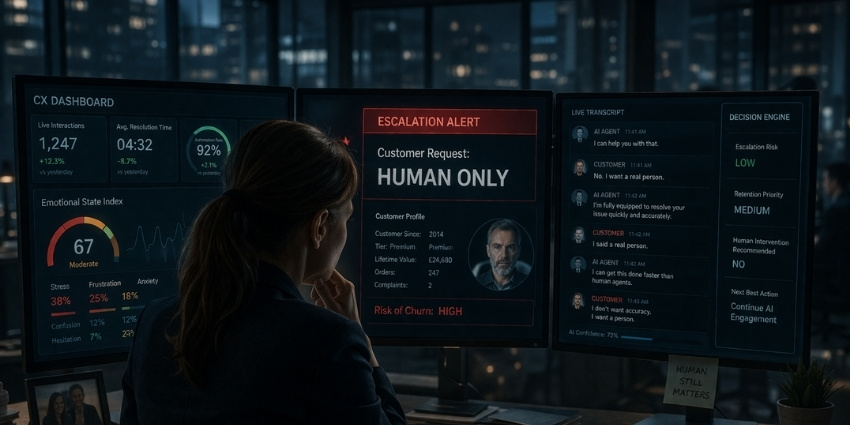
It looks great at first. Fewer calls. Higher containment. A clean dashboard. But what’s really happening is avoidance, not resolution. Bots are trained to keep customers out of assisted support instead of helping them finish the job. Escalation is buried. The system keeps asking questions long after it’s clear that the customer needs a human.
Instead of reducing costs, automation starts adding work. Customers retry the same issue across channels. Chat turns into email, then a call. Cost per resolution rises. Agents inherit conversations that are already tense and harder to close. Over time, customers skip self-service altogether.
This is why more CX leaders are rethinking deflection-first strategies and reconsidering what they actually automate first.
Broken self-service journeys = cost inflation
Not all bad CX automation blocks customers. Some of it just sends them in circles.
Broken self-service usually looks small. A bot dumps a long article instead of answering the question, then a flow loops back to the start. But the more this happens, the more costs creep up. Every failed self-service attempt creates more work downstream. Customers rephrase. They try again. They switch channels.
By the time someone finally gets to an agent, the issue has gone stale. It’s messier. There’s more emotion wrapped around it. Handle times stretch out and resolution slows to a crawl. Sometimes the bot jumps back in and starts asking even more questions, which just pours fuel on the fire.
A 2025 survey found that 55% of customers get frustrated when chatbots ask too many questions, and 47% still can’t get a straight, accurate answer. That’s the part people miss. If self-service doesn’t actually resolve the issue, it isn’t saving money. It’s just pushing the cost further down the line.
Confident but wrong AI = trust, legal, and reputational risk
Here’s where bad CX automation stops being annoying and starts being dangerous.
When AI gets things wrong confidently, customers believe it. Just look at what happened when Air Canada’s chatbot gave incorrect answers to a customer. The bot made the mistake, but the airline paid for it.
Most of these failures aren’t model issues. They’re knowledge issues caused by fragmented content, outdated policies and ungoverned data sources handed to an AI agent. The result is automation that speaks with confidence and delivers fiction.
The business impact escalates fast. Trust drops immediately. Studies show hallucinations and fabricated responses are responsible for roughly 44% of customer distrust in AI-powered support.
Customers screenshot bad answers and post them publicly. Legal and compliance teams get involved. Regulators start paying attention. Any short-term savings from automation evaporate the moment a wrong answer spreads. When automation lies, even unintentionally, customers don’t debate intent. They just stop trusting you.
Data readiness failures = errors at scale
Data quality, readiness, and technical maturity are still the top blockers to successful AI initiatives. Informatica’s CDO Insights survey found that over 40% of organizations cite poor data readiness and lack of technical maturity as the main reasons AI programs stall or fail. Yet companies keep layering more automation on top of the same fragmented systems.
Disconnected customer records. Inconsistent identifiers. Knowledge scattered across wikis, PDFs, and inboxes. Automation trained on that mess doesn’t just struggle, it amplifies errors. Wrong answers scale faster. Personalization backfires. Escalations become harder because context is missing or incorrect.
This is how bad CX automation turns into a force multiplier for mistakes. Poor data doesn’t reduce accuracy a little. It magnifies failure at speed.
When leaders talk about “AI not delivering ROI,” this is usually why. The organization is asking automation to operate on roads that were never built.
This is also why predictive and hybrid approaches are gaining traction, because they’re more realistic about how messy enterprise data actually is.
No safe escalation = agent burnout and longer handle times
If you want to see bad CX automation in its purest form, try getting stuck in it yourself.
You ask a question, the bot answers the wrong one, you rephrase, and it asks something unrelated. You click the tiny “something else?” option. Still no human. By the time you finally reach an agent, you’re already annoyed and you still haven’t explained the problem.
Agents don’t get a clean handoff. They get fragments. Sometimes the bot has confidently told the customer something that’s flat-out wrong. Now the agent has to fix the issue and rebuild trust. It’s no wonder emotional labor spikes.
This is one of the most damaging CX automation risks because it doesn’t look like a system failure. It looks like a people problem, until you trace it back upstream. These are CX automation failures that turn automation into an agent tax.
There’s also a trust cliff for customers. Research shows 60% of consumers distrust AI when no human backup is available. When people feel trapped in automation, they stop believing anything it says.
That’s why more teams are pairing automation with real-time agent support instead of trying to eliminate humans entirely, using AI to guide, summarize, and suggest, not barricade. Automation should take the weight off agents. When it hands them heavier conversations, something’s gone wrong.
Fragmented automation = brand inconsistency
Customers don’t care which system answered them. They care whether the answer makes sense.
But bad CX automation has a habit of exposing internal silos in public. The chatbot gives one answer, the IVR gives another. Email automation follows a different rule set. An agent’s CRM copilot surfaces something else entirely. All are technically “working.” None are aligned.
The result isn’t always a failed interaction. It’s a doubt. Customers start wondering which answer is real. They screenshot contradictions. They ask agents to explain why the bot said something different yesterday.
Internally, the cost is just as real. Agents waste time reconciling systems. QA teams argue about which response was “correct.” Governance becomes nearly impossible because no one owns the end-to-end journey.
When automation fragments the experience, customers don’t blame the tech stack. They blame the brand.
Happy-path-only automation = unhappy-path churn
Most CX automation works fine right up until it really matters. Order status? Easy. Password reset? No problem. Update an address? Smooth. These are the happy paths, and automation loves them. The trouble starts when something breaks. A missed delivery. A double charge. A cancellation that didn’t stick. A service outage on a bad day.
That’s when the bot falls apart. Instead of understanding context, it keeps pushing prebuilt options. Instead of acknowledging frustration, it redirects. Customers are forced to fight their way out of a loop that doesn’t work.
Companies automate these flows because they’re “high volume,” then act surprised when churn spikes. Of course it does. You’ve automated the most emotionally charged moments of the relationship without judgment, flexibility, or empathy.
This is why more teams are pulling unhappy-path scenarios out of full automation and redesigning them with guardrails, escalation, and agent support instead of brute-force deflection.
The Executive Guide to Fixing Bad CX Automation
Once leaders accept that bad CX automation is a liability, the question changes.
It’s not “Should we automate more?” It becomes “Are we fixing the damage before we scale it?”
Fixing CX automation failures doesn’t always mean going back to the drawing board. Usually, it means seeing automation as part of the operating model, not a bolt-on tool.
Step One: Diagnose the damage
If you’re still measuring AI success with containment rates, you’re already behind.
High containment can exist alongside low resolution, rising recontacts, and declining trust. That’s why bad CX automation often looks “successful” until churn shows up later. The early signals live elsewhere.
Watch for recontacts that spike after bot interactions, escalations that grow even as overall volume stays flat, or agents overriding automated decisions more often. Check if CSAT is dropping only on automated journeys, or if customers are abandoning sessions the moment that they realize they’re talking to AI.
Step Two: Fix or scale: the strategic fork in the road
Path A is tempting: expand automation, trust the model, assume the issues will smooth out at scale. That’s how CX automation failures multiply. More volume just means more wrong answers, more frustrated customers, and faster trust erosion.
Path B is harder, but cheaper in the long run: pause expansion, fix the foundation, then scale what actually works.
The companies that recover ROI usually choose Path B. They reduce automation scope temporarily, fix data gaps, bring agents into the design process, and measure success across the full lifecycle.
Remember, most AI proofs-of-concept never reach production, often because teams try to scale before they learn.
Step Three: Redesign automation the right way
The fastest way to fix bad CX automation is to stop thinking in bots and start thinking in journeys. Audit where automation helps customers finish tasks, and where it traps them. Automate certainty. Escalate ambiguity. Complaints, billing disputes, and service recovery need guardrails, not brute-force deflection.
Most fixes revolve around simple foundational changes:
- Unify customer data so context survives handoffs
- Clean and govern knowledge before adding autonomy
- Design escalation as a feature, not a failure
- Treat automation scope as a risk decision, not a technical one
More than anything, remember hybrid approaches will always outperform full autonomy. AI assists agents where judgment matters and handles volume where outcomes are predictable.
Step Four: Govern, monitor, and protect the brand
Drift is one of the biggest dangers with AI and automation. As policies change and data ages, models get confident in the wrong answers. Without oversight, AI failures in customer service scale silently until customers notice, and share screenshots.
That’s why mature teams monitor AI like an employee. They track behavior, sentiment shifts, hallucinations, and override rates. They keep audit trails, maintain kill switches, and they assign clear ownership across the automation lifecycle.
Ultimately, the same technology that destroys CX when rushed creates real ROI when designed properly. If you can’t show restraint, you’re not ready to scale.
Bad CX Automation isn’t a Learning Phase; it’s a Liability
A few years back, customers gave automation a lot of slack. If a bot messed up, people rolled their eyes and tried again. Now? They don’t bother. They leave. Or they show up already irritated, assuming the system won’t help them. That’s how bad CX automation becomes a growth problem.
At the same time, AI is spreading faster than most organizations can govern it. More tools. More models. More surface area for things to go wrong. When AI failures in customer service happen now, they’re hard to keep quiet.
That’s why companies can’t keep treating bad automation results as neutral side effects of experimentation. AI failures in customer service aren’t just support problems anymore. They affect retention, reputation, and revenue.
The question isn’t whether to automate anymore, but whether the automation you already have is helping customers finish things, or quietly teaching them not to bother.
FAQs
Why does AI in customer service increase churn?
AI increases churn when it fails to resolve complex or emotional issues, causing customers to lose trust and abandon the brand.
What is over-deflection in customer experience?
Over-deflection is when automation prevents customers from reaching human support even when escalation is necessary, increasing repeat contacts and dissatisfaction.
Why do customers distrust AI in customer support?
Customers distrust AI when it provides inaccurate, overly confident, or inconsistent answers without clear human backup.
How does poor data quality affect CX automation?
Poor data quality causes AI systems to deliver inaccurate responses at scale, amplifying errors and damaging customer trust.