
Customer experience in 2026 has a new power couple: customer data management and CRM. One helps you know the customer. The other helps you act on what you know. If either one is messy, your “personalized” experience turns into a cringe moment at scale.
And here is the uncomfortable truth. AI will not fix bad data. AI will scale it.
As Carlie Idoine, VP Analyst at Gartner, put it:
“AI needs to be tightly aligned with data, analytics and governance.”
This guide explains what customer data management is, how it works, and how it connects with technologies like CRM systems, customer data platforms (CDPs), and data warehouses. It also covers why unified, first-party data is essential for AI-driven personalization, journey orchestration, and decision-making. Then we get practical about governance, privacy, and clean data infrastructure.
Quick Navigation
How Does Customer Data Management Work In The Real World?
What Is CRM, And What Is It Actually Good For?
What’s The Difference Between CRM vs CDP?
How Do Data Warehouses Fit Into Customer Data Management?
What Is Journey Orchestration, And Why Does It Depend On Clean Data?
Customer Data Fields Need A Clear Source Of Truth?
What Are The Fastest Wins With Better Customer Data Management?
What Is Customer Data Management, And Why Is Everyone Talking About It?
Customer data management (CDM) is the discipline of making customer data accurate, unified, secure, and usable across the business. It covers how you collect data, clean it, match identities across systems, apply privacy rules, and share it with tools like CRMs, CDPs, and analytics platforms.
When CDM is weak, the basics fall apart fast. You get duplicate profiles, missing fields, and conflicting records. Segments become unreliable. Reports stop matching. AI outputs look polished but wrong.
As Tapan Patel, Research Director for Customer Data Platform (CDP) at IDC, said:
“There is no finish line, only continuous improvement to create better experiences.”
In 2026, CDM is not just a back-office data task. It is the foundation that makes modern CX, personalization, and responsible AI possible.
Related Articles
- What Do CRM Analyst Reports Reveal About CRM And Customer Data In 2026, And Are You Behind?
- What Are the Biggest CRM Trends 2026 Buyers Can’t Ignore If They Want Faster Growth?
- What Is Customer Journey Orchestration? A Buyer-First Guide to Transforming Customer Journeys
How Does Customer Data Management Work In The Real World?
Most CDM programs follow a familiar loop.
Collect First-Party Data
This is data you collect directly from customers. Think website actions, purchases, app events, support tickets, and preference center updates.
Standardize And Clean Data
Normalize fields. Fix formatting. Remove duplicates. Fill key gaps. If you do not do this, your dashboards and AI outputs will not be reliable.
Unify Customer Identity
Customers show up as many profiles across devices, emails, and accounts. Identity resolution connects those fragments into one usable view.
Activate Data Across Teams And Tools
Data is only valuable when it moves. CDM includes pipelines and rules that push usable data into CRM, marketing tools, contact center platforms, and analytics.
Govern And Protect It
Permissions matter. Security matters. Retention matters. Your data foundation should be built for trust, not just targeting.
What Is CRM, And What Is It Actually Good For?
CRM stands for customer relationship management. It helps businesses manage customer interactions, streamline processes, and improve outcomes.
In plain terms, CRM answers questions like:
- Who is this customer or account?
- What happened last time we spoke?
- What did we promise?
- What is the next best action for sales or service?
CRM is a system of action. It is not always the best place to unify every customer event across every channel. That is where CDM, CDPs, and warehouses often enter the chat.
What’s The Difference Between CRM vs CDP?
This is where buyers get stuck. Let’s simplify it.
CRM Is Built For Relationships And Workflow
CRM tracks accounts, contacts, deals, cases, tasks, and interactions. It is optimized for frontline teams.
CDP Is Built For Unification And Activation
A CDP typically ingests data from multiple sources, unifies customer profiles, and activates that data for CX use cases like segmentation, personalization, and orchestration.
So why the confusion?
Because CRMs have added more data features. And CDPs have added more activation features. Overlap is real.
A practical rule:
- If the pain is sales and service workflow, start with CRM.
- If the pain is fragmented profiles and inconsistent audiences, prioritize CDM patterns and consider a CDP.
Don’t miss: What Are the Biggest CRM Trends 2026 Buyers Can’t Ignore If They Want Faster Growth?
How Do Data Warehouses Fit Into Customer Data Management?
A data warehouse is designed for analytics at scale. It stores large amounts of structured data so you can query, measure, and report.
In many modern stacks, the warehouse becomes the analytics backbone. The CDP may sit on top, integrate tightly, or be replaced by composable components.
A common setup looks like this:
- CRM for operational work
- CDP for profile unification and activation
- Warehouse for analytics and measurement
- CDM as the operating model that keeps it all clean, consistent, and governed
The goal is fewer versions of the customer.
Why Is First-Party Data Essential For Customer Personalization In 2026?
Personalization now heavily involves AI, and depends on three unglamorous inputs:
- A reliable customer profile
- Accurate event history
- Clear permissions and purpose
If identity is wrong, personalization misses, and if data is incomplete, experiences feel random.
IDC’s view of the market trend is blunt. In an IDC MarketScape report, IDC research noted:
“Organizations are looking to pivot from endless experimentation and pilot projects toward scaled, production-grade AI deployments.”
Scaling AI means scaling data maturity.
Want to see how your data strategy stacks up against the market?
Read: What Do CRM Analyst Reports Reveal About CRM And Customer Data In 2026, And Are You Behind?
What Is Journey Orchestration, And Why Does It Depend On Clean Data?
Journey orchestration is about using real-time signals to guide the next step in a customer’s experience.
Forrester defines journey orchestration as:
“the use of real-time data at the individual customer level to analyze current behavior, predict future behavior, and adjust the journey in the moment for increased customer lifetime value, operational efficiency, and business results.”
That is a big promise. It also has a big requirement.
Orchestration needs:
- reliable identity
- fast data flow
- accurate context
- consistent consent signals
If any of those are weak, orchestration becomes noise. Or worse, it becomes “automated mistakes.”
Read more on Customer Journey Orchestration in our ultimate guide here.
What Does A Modern Customer Data Strategy Look Like In 2026?
A successful customer-centric strategy means:
“using unified customer data and AI-powered insights to deliver hyper-personalized experiences across every touchpoint while maintaining transparency and building trust through ethical data practices. This forms the foundation of any effective customer experience strategy.”
What Outcomes Matter Most For Your Customer Data Strategy?
The outcomes that matter most are the ones tied to revenue, retention, and efficiency. Start here before you touch any tools.
- Reduce churn
- Increase conversion
- Improve renewal rates
- Lower cost to serve
- Increase customer lifetime value
The CX Data Stack: A Five-Layer Model for Customer Data Management:
- Layer 1: Data collection
- Layer 2: Identity resolution
- Layer 3: Unification (CDP)
- Layer 4: Activation (CRM)
- Layer 5: Measurement (warehouse)
What Do CRM And Customer Data Platforms Look Like In Practice?
Most businesses build their customer data foundation around a mix of CRM systems, customer data platforms, and analytics infrastructure. The brands below are common reference points buyers run into during research.
Examples of CRM and CX suites:
- Salesforce: Salesforce Customer 360
- Microsoft: Microsoft Dynamics 365
- Oracle: Oracle CX Cloud
- SAP: SAP CX
- HubSpot: HubSpot Customer Platform
What Are Examples of Customer Data Platforms?
- Adobe: Specializes in activating and managing customer data in real time across marketing channels.
- Salesforce Data Cloud: Built for enterprise scale, with deep, native integration into Salesforce CRM workflows.
- Twilio Segment: A developer-first platform, best known for flexible data collection and API-driven pipelines.
Examples of contact center platforms that may also hold valuable interaction data:
- Content Guru: Storm
How This Links Back To CRM vs CDP: Even when a vendor offers an “all-in-one” suite, CRM and CDP jobs are still different. A CRM is usually where teams manage deals, cases, and next steps. A CDP-style layer is typically where behavioral data is unified, identities are resolved, and audiences are activated across channels. Many organizations also rely on a data warehouse or lakehouse for measurement, modeling, and longer-term storage.
Why That Matters For Buyers: Tools do not create a single customer view by themselves. You still need customer data management to define sources of truth, clean data, apply consent rules, and keep profiles consistent across every system that touches the customer.
CRM vs CDP vs Data Warehouse: What Should You Buy First?
If you’re trying to decide between a CRM, CDP, or data warehouse, don’t start with features. Start with your biggest bottleneck.
Use this shortcut:
- Buy a CRM first if your problem is managing sales, service, or customer interactions
- Prioritise a CDP if your problem is fragmented customer data and inconsistent audiences
- Invest in a data warehouse if your problem is reporting, analytics, and measurement at scale
Simple rule:
- CRM = take action
- CDP = understand the customer
- Warehouse = analyse and measure
Most modern stacks eventually use all three, but order matters.
Data Warehouse vs CDP: What’s the Difference?
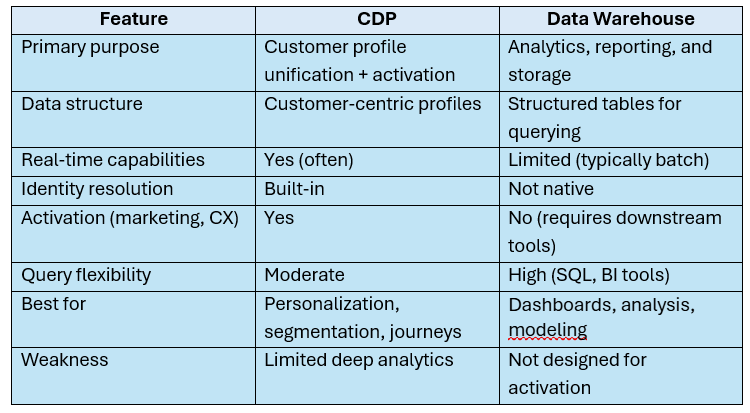
CRM helps teams do the work.
CDP helps teams know who they’re working with.
What Customer Data Do You Actually Need, And What Can You Stop Collecting?
You need the minimum data required to deliver the outcomes above. Anything else adds cost, risk, and confusion.
Keep data that is:
- Directly tied to a use case (personalization, service, sales, measurement)
- Reliable and easy to maintain
- Covered by clear permissions and purpose
Stop collecting data that is:
- “Just in case” data with no owner or use case
- Rarely used fields that go stale
- Duplicated across systems with no source of truth
What Customer Data Fields Need A Clear Source Of Truth?
The fields below should have one “winning” system and one accountable owner. Otherwise, your stack will argue with itself.
- Email and phone
- Account status
- Consent state
- Identity keys
- Lifecycle stage
How Will We Measure Value?
Track metrics like:
- duplicate reduction
- match rates for identity resolution
- segment accuracy
- time to launch campaigns
- agent handle time and resolution rates
- data quality scores
- model performance and drift
If you cannot measure it, you cannot defend it.
What Are The Biggest Governance And Privacy Traps In CRM And CDM?
The most common problems are boring. They are also expensive.
Duplicate Consent And Preferences
Preferences scattered across systems create inconsistency. Customers notice. Regulators can too.
Overcollection
Collecting everything “just in case” creates security risk. It also makes your stack harder to operate.
Weak Access Controls
If everyone can see everything, you have a problem. Sensitive fields should be restricted by role and need.
AI Without Guardrails
If AI is making customer-impacting decisions, you need governance, monitoring, and accountability. Otherwise, risk grows as you scale.
What Should You Look For When Buying CRM Systems In 2026?
Once you are past awareness, the buying questions shift.
Does It Fit Your Data Reality?
- Can it support your account structures?
- Can it store and use consent states clearly?
- Can it integrate cleanly with your data foundation?
Can You Extend It Without Breaking It?
- strong APIs
- flexible objects and workflows
- manageable admin experience
Does AI Feel Useful And Controlled?
Ask how AI features are grounded, monitored, and audited, and what data they require. Ask how errors are handled.
Does It Play Nicely With CDPs And Warehouses?
CRM does not need to do everything. But it must integrate well with what does.
When Do You Need A CDP, And When Might You Skip It?
A CDP can help when:
- identities are fragmented across channels
- segmentation is slow and inconsistent
- you need real-time activation
- you want orchestration-ready profiles
You might skip a CDP when:
- your warehouse approach already supports activation
- you lack the operating model to keep profiles clean
- your main problem is CRM workflow, not data fragmentation
The point is not to buy a CDP. The point is to stop guessing who your customer is.
What Are The Fastest Wins With Better Customer Data Management?
If you need momentum, aim for wins that teams can feel.
Win 1: Reduce Duplicates
This improves reporting and reduces customer confusion.
Win 2: Build A Single Preference Model
Make opt-outs and preferences consistent across channels.
Win 3: Create A “CX-Ready” Segment Library
Standard audiences save time and reduce errors.
Win 4: Improve Contact Center Context
Unified data helps agents solve faster and sell smarter.
Win 5: Make AI Less Risky
Cleaner data improves outputs. Governance reduces exposure.
These are not flashy wins. They are profitable ones.
Conclusion: What Should Your CRM And Customer Data North Star Be In 2026?
In 2026, the best customer experiences will feel personal, timely, and consistent. That does not happen because you bought one shiny tool. It happens because your customer data foundation is accurate, unified, and governed.
Treat customer data management like a core CX capability. Connect CRM systems, CDPs, and warehouses in a way that supports real decisions. Keep it clean and monitored. Keep it trustworthy.
Because the future of CX is not more data.
It is better data, used better.
FAQs
What Is Customer Data Management?
Customer data management is the process of collecting, cleaning, unifying, and governing customer data so it can be used safely across teams and tools.
What Is The Difference Between CRM And Customer Data Management?
CRM manages customer-facing workflows and interactions. Customer data management focuses on the quality, unification, and governance of customer data across systems.
What Is A Customer Data Platform Explained In Simple Terms?
A CDP is software that unifies customer data from many sources into profiles and then activates that data for CX use cases like personalization and segmentation. (IDC)
Do I Need Both A CRM And A CDP?
Many companies use both. CRM supports frontline action. A CDP can support unified profiles and activation. Your needs depend on your data fragmentation and goals.
How Do I Start A Customer Data Strategy Without Buying New Tools?
Start with outcomes, define sources of truth, fix identity and quality, and set governance rules. Then fill tooling gaps based on real use cases.