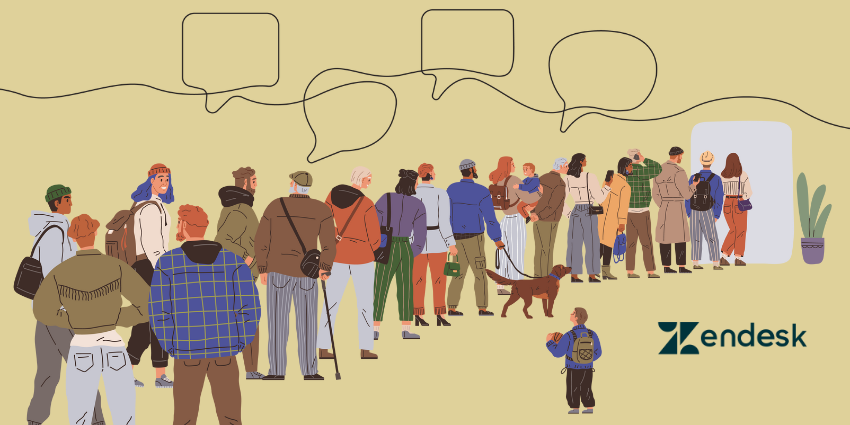

The queue is dead. Or at least, it should be.
For decades, customer service was designed around scarcity. Limited agents, finite capacity, customers waiting their turn. Hold music, queue positions, estimated wait times… all infrastructure for managing demand that exceeded supply.
But something fundamental is shifting. AI is enabling a redesign toward intelligent, conversation-driven journeys. Dynamic paths that adapt in real time. Proactive outreach that prevents problems.
I’ve been thinking about this since speaking with Nuri Gocay, Director of Platform Architecture at Zendesk for Contact Centers. The organizations getting this right aren’t just improving service. They’re reimagining what customer connection actually means.
The End of the Funnel
Traditional service journeys were predictable. Customer calls, enters queue, reaches agent, ticket closes. A straight line from problem to resolution. Except it rarely worked that smoothly. Customers repeated themselves across channels. Context got lost in handoffs. Systems didn’t talk to each other.
Nuri was honest about this. We’ve been talking about omnichannel for 20 years, but truly seamless experiences remain rare.
“We’ve been talking about omnichannel now for 20 years, but omnichannel is a lived experience. It’s happened to me maybe once or twice recently. So basically that puts the integration layer as the customer. The customer is the one now carrying that context around instead of your systems.”
AI changes that. Not because omnichannel is suddenly new, but because AI can finally access and surface the full context across every system. The customer’s history travels with them. When a conversation moves from chat to voice to email, the AI agent and human agents both see the complete picture. No more asking customers to repeat themselves.
From funnels to flows. From rigid paths to adaptive journeys.
Related Stories:
- Voice Isn’t Dead, It’s Just Got Smarter
- The Death of Hold Music: Why Waiting on the Line Is Over (Video Interview)
- Zendesk and Microsoft Target the Small Business Market in Latest Partnership
Proactive Without Being Invasive
There’s a fundamental change in how service works. Not just responding when customers call, but reaching out before problems occur. Order delayed? The system notifies you first. Appointment coming up? Reminder sent.
It requires a significant operational shift. You’re no longer just managing incoming demand. You’re predicting it, preventing it, sometimes creating it intentionally.
The challenge isn’t the technology. It’s building a proactive model that doesn’t feel invasive. The key is relevance, timing, and consent. Not “how do we handle the queue faster?” but “how do we eliminate the need for the queue in the first place?”
The Integration Challenge
Integration is not a technical detail. It’s the difference between a helpful answer and a resolved issue.
A modern platform needs to connect CRM, knowledge bases, AI, quality assurance, governance, and routing. All working together in real time. If they’re not connected, you get what Nuri called “swivel chairing.”
“Agents are literally switching screens, trying to find an answer, hunting for context, asking other departments for answers. I can’t imagine some of the internal Slack and Teams messages that basically mean, does anyone else know what’s going on with this?”
Zendesk’s approach is to build AI into the system of record from day one.
“Our approach is that AI is designed to work with the system of record from day one. That’s the data, the workflows, knowledge, agent experience, reporting governance. It’s not bolt on brain with no hands. It’s connected to the levers that actually resolve issues.”
Metrics That Actually Matter
For decades, contact centers measured average handle time, queue length, first-call resolution. All metrics designed around managing scarcity.
But in a world where AI answers instantly, where conversations flow across channels, where proactive outreach prevents problems… do those metrics still make sense?
“There’s a fundamental shift going on in some of our service rituals, right? We’re almost tearing up the book. Things like average speed of answer as a metric. Why does that matter when an AI is going to answer that immediately and take care of the customer’s problem?”
What should organizations measure instead? Resolution rates. Conversation quality. Sentiment improvement. Whether issues get solved, not just how fast tickets close.
The shift is toward outcomes that matter. Did the customer’s problem get resolved? Did they feel heard? Are they more likely to stay loyal? Those are the metrics that drive business results.
The Cultural Transformation
This isn’t just a technology project. It’s a cultural one. You’re asking teams to transition from managing queues to orchestrating conversations. That’s a different skill set, a different mindset.
The goal isn’t to replace agents with AI. It’s to give agents better tools, better context, better support.
“AI does those kind of unglamorous time savers, things like summarizing threads and drafting responses, routing by intent and priority, servicing the right knowledge instantly. And those minutes matter because queues are often just the accumulation of tiny inefficiencies.”
Nuri’s advice was straightforward:
“Find that sweet spot in orchestration, the right channel, the right context, the right guard rails, the handoff, so that customers feel the progress immediately, agents feel supported, and we stop designing for customer patience and start designing for customer progress.”
What Comes Next
What replaces the queue isn’t just faster service. It’s a fundamentally different relationship between businesses and customers. One built on anticipation instead of reaction. On flows instead of funnels.
“The real waste isn’t the call itself, it’s everything that happens in the background. Leaders run constant incident response for things that are normal work. They’re not managing service, they’re managing the consequences of preventable service demand.”
The organizations that understand this aren’t just improving their contact centers. They’re reimagining what customer connection means.
And that, I suppose, is the real opportunity.
For more on how AI is eliminating hold times and transforming voice service, read our previous story: Voice Isn’t Dead, It’s Just Got Smarter and watch the full video interview with Nuri Gocay.
Explore the broader industry transformation: 2025 CX Trends Part 1: How Agentic AI is Set to Deliver on Decades of Broken Promises
Learn more about Zendesk’s approach to conversation-driven service at zendesk.com.