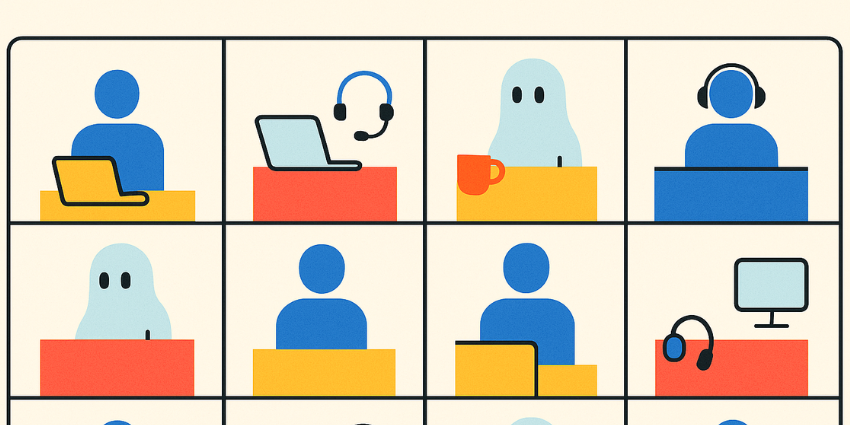

The standard “customer service team” has changed forever. It’s not humans handling the bulk of the work and bots dealing with automated FAQ experiences anymore. Now, we have a truly blended workforce, where machines and teams share the load.
In a lot of ways, this is a good thing. The evolution of AI colleagues capable of handling way more tasks in the workplace is driving measurable results. Agentic AI tools can tackle human burnout, help reduce handling times, and even give teams more useful data to work with.
Still, they create a new problem for business leaders: figuring out how to manage a combined system where humans and AI agents depend on each other.
An aligned approach to human and AI workforce management is about to become a real priority for business leaders. Salesforce is projecting a 327% jump in AI agent adoption, and Slack’s Workforce Lab is already preparing leaders for teams where AI assistants outnumber human staff.
Once that happens, staffing isn’t just staffing. It becomes orchestration. The “workforce” now includes tools that never get tired but occasionally hallucinate, plus people who can think creatively but arrive mid-conversation after the bot has already taken a few swings at the customer’s issue.
Related Stories:
- CX Trends Reshaping Security, Privacy, and Compliance – 2026
- Security, Privacy, and Compliance: How Do the Leading CX Platforms Compare?
- The Ultimate CX Security, Privacy, and Compliance Adoption Guide
Why Traditional WFM Models Break in AI-Supported Environments
Traditional workforce planning was built on a simple assumption: people handle the work, and volume follows patterns you can usually predict. That logic collapses once AI agents enter the queue. As soon as AI takes the first pass at customer intent, the entire mix of interactions changes shape. Straightforward questions disappear, leaving a heavier concentration of exceptions, policy-sensitive scenarios, and the emotionally charged calls that push agents to their limits.
That’s the first truth companies need to recognize when they’re investing in AI workforce management. AI doesn’t eliminate demand, it redistributes it. A clean hour of AI containment can be followed by a burst of escalations that hit all at once.
Forecasts built around historical patterns miss these swings because the new drivers are things like model confidence scores, routing choices, and whether the AI misunderstood the customer during the first attempt. These aren’t traditional WFM inputs. They’re operational signals from a different kind of worker.
Another crack in the old foundation shows up in training. With simple tasks handled by AI, agents lose the early-career exercises they relied on to build intuition. Work jumps straight to the hard stuff. The result is a workforce that ramps slower, burns hotter, and carries the emotional weight of problems that surfaced only after automation failed.
Human AI teams are sharing context, mistakes, and recovery work. Traditional WFM models treat them as separate layers, which is exactly why they’re breaking.
What Is Human–AI Workforce Management and Why Does It Matter?
Workforce planning starts to feel different once AI is treated as part of the team. The moment AI agents begin taking real volume, the entire planning discipline shifts from “how many people do we need?” to “how do all contributors share the load?” That’s the real entrance point of AI workforce management, and it forces leaders to think more like system designers than schedulers.
AI isn’t a side channel in CX today, it’s an active worker with throughput limits, quality constraints, and failure patterns. Human teams inherit the work AI can’t finish: usually the tougher, emotionally heavier, or more regulated cases.
Treating AI agents as “virtual staffing” also means getting specific about what they can and can’t handle. Each system behaves differently depending on:
- Confidence thresholds
- Latency and rate limits
- Drift after model updates
- Knowledge gaps
- Risk rules
Any one of those can trigger an unplanned handoff to humans, something that rarely shows up in traditional staffing models. It’s the kind of complexity that leaders need to start recognizing if they’re going to build a truly blended workforce.
How Should You Measure AI Capacity and Escalation Risk in CX?
Once AI starts handling customer interactions at scale, capacity planning becomes a balancing act between human capability and whatever the AI can realistically deliver. That’s where AI workforce management gets serious, because assuming the bot will take care of everything is naive, particularly since many customers still crave a human touch, and bots can only handle so much.
AI agents behave like workers with their own quirks. They move fast and they don’t complain, but they also misinterpret odd phrasing, stall when confidence drops, or hand off a conversation because a compliance rule kicks in. To treat AI as actual capacity, planners need to model it the way they’d model any other contributor:
- Throughput: tasks per hour, concurrency, and how these numbers change under load.
- Quality: containment rates, accuracy bands, sentiment impact, and the messy cases that routinely escape automation.
- Confidence thresholds: when the AI steps back and flags a human.
- Operating costs: API usage, time-outs, and the occasional spike in compute spend.
- Constraints: downtime, throttling, version updates, and the drift patterns that can influence AI behavior.
The toughest part is determining fallback behavior. AI failures don’t trickle into the queue; they land in clusters. A small hallucination issue, a misclassified intent, or a sudden drop in model confidence can produce a run of tightly packed escalations.
Modern predictive CX platforms are starting to expose these signals, but planners still need to factor them into everyday staffing. The handoffs don’t happen randomly; they happen for reasons the system will reveal if someone is paying attention.
AI Workforce Management: Forecasting Blended Workloads & Escalations
Forecasting used to be about finding patterns in human behavior. Now it’s about predicting how humans and AI will trade work back and forth across the day. Once AI agents start handling a slice of the volume, the remaining work becomes oddly lopsided: calm for a stretch, then suddenly dense with complex exceptions. Forecasting in this environment means treating AI workforce management as a joint exercise.
A modern forecast needs two layers:
- AI activity: containment rates, confidence dips, model drift, and the workflow choices the AI makes when it’s uncertain.
- Human activity: the intensity of escalations, the emotional load of calls that survived automation, and the unpredictability that shows up when customers arrive mid-journey after trying the bot first.
The tricky part is escalations. They aren’t random. They follow patterns teams can measure if they look at the right signals:
- Confidence cliffs (AI hands off because it isn’t sure)
- Policy triggers (refunds, regulated requests, edge-case IDs)
- Misrouted intents (the bot guessed wrong and the customer is already annoyed)
- Repeat attempts (a customer tried twice, then gave up)
Predictive models can flag these patterns early. A sudden shift in sentiment or a spike in retries usually hits humans within minutes.
This is where the concept of a blended workforce becomes operationally useful. Human AI teams aren’t just working side by side; they’re inheriting each other’s mistakes. Traditional forecasting can’t map that interdependence, but human AI collaboration depends on it. A forecast has to treat AI behavior as a first-class input or it’s already outdated.
Updating Skills Frameworks for Human–AI Teams
With AI managing more than ever (potentially up to 80% of future service queries), skills are going to change. The familiar ladder of junior agents learning through repetition, mid-level agents building judgment, and seniors handling the tricky stuff, doesn’t hold up anymore. AI eats the repetition. The early learning moments disappear.
What’s left is work that’s harder, more emotional, and far more dependent on context. That’s the environment AI workforce management has to support. The most valuable people on the floor aren’t always the fastest talkers or the encyclopedias of policy. They’re the ones who can:
- Read a customer’s emotional state after the bot has already messed up the setup
- Spot when the AI is drifting and quietly redirect the conversation
- Make sense of half-complete context from an automation workflow
- Use co-pilot suggestions without becoming dependent on them
- Switch between empathy and analysis without losing control of the call
Super-agents in the modern workplace thrive because they understand the division of labour between humans and AI. Companies need to recognize the recalibration of what the customer service job actually is today.
A blended workforce only works when people are trained to work inside the system, not around it, and human AI collaboration depends on skills that weren’t even on most competency maps a few years ago.
Scheduling Considerations for Human & AI Workforce Management
Once AI begins handling a meaningful slice of interactions, the timing of human work changes in ways most planners don’t expect. The day develops odd rhythms: long stretches of calm, followed by sharp clusters of escalations that carry more emotional heat than usual. A scheduling model built for humans alone can’t keep up.
Investing in AI workforce management adds new types of time to the roster:
- AI oversight time for checking drift, odd patterns, or new hallucination quirks.
- Recovery blocks after difficult escalations.
- Continuous learning windows, especially now that AI co-pilots and tools update faster than training materials.
- Micro-shift flexibility, since AI containment can change the workload on a dime.
- Shared queue moments, where humans and AI agents exchange context instead of operating in silos.
A blended workforce isn’t just about balancing coverage. It’s about making sure human AI teams can actually function when the AI hands back work at unpredictable times.
How Do You Govern and Monitor AI in Customer Service Teams?
Governance gets more interesting once AI is doing real work, too. The old approach doesn’t hold up when decisions are being made by systems that can rewrite their own behavior after a model update. Teams running mixed operations are learning this the hard way.
One quiet morning, the AI is handling refunds like a champ: an hour later, it’s misunderstanding a policy nuance and sending everything to humans in a panic. This is exactly why AI workforce management needs its own version of checks and balances.
- Clear rules for what AI is allowed to say or decide
- Guardrails for the handoff moments
- Monitoring that catches odd behaviour early
- A lightweight way for agents to flag “something feels off” before it becomes a trend
Also, customers need to know they’re not stuck talking to a machine when a human is required. Agents need to know they won’t be blamed for choices the model made upstream. Leaders need visibility into how the system actually behaves. Tools built around workforce intelligence help, but the culture matters more than the dashboards.
A blended workforce only works when people believe the system is being watched by adults in the room. Human AI teams operate on shared accountability, and human AI collaboration falls apart fast when the governance layer is vague or decorative.
New Playbooks for Human AI Workforce Management
Most teams need the freedom to experiment today. We’re all still figuring out what human and AI workforce management should really look like. A few steps make the whole thing a lot easier to get moving.
- Map the real workload: Pull transcripts, bot logs, and escalation notes. Look for the patterns automation misses. These gaps usually become clear once you compare intent patterns with the insights you get from predictive AI tools.
- Model AI capacity like a worker: Throughput, accuracy bands, confidence dips, failure triggers. Build the kind of profile you’d build for a new hire, just with different data.
- Rewrite the schedule: Add space for drift checks, recovery time, and fast handoff rules. Make room for AI co-pilots that update weekly and need a bit of grounding.
- Update the skills map: Blend emotional intelligence, system awareness, and judgment. Use whatever workforce intelligence tools you have to see who’s ready for the tougher escalations.
- Build a steady governance layer: Lightweight, not bureaucratic. Enough to catch odd behaviour before it ruins a day.
- Pilot small, measure honestly, scale slowly: Look at outcomes that actually matter, like resolution quality, agent strain, recontact rates, or sentiment shifts.
A blended workforce works when people understand the division of labour. Human AI teams work when the system feels predictable, and human AI collaboration gets easier once every part of the operation has a place to land.
Managing the New Blended Workforce
The mix of human expertise and automated capacity is already reshaping service operations, even in teams that think they’re “early” in their AI journey.
Once AI takes real volume, every part of the system shifts from the shape of demand to the emotional weight of escalations, the skills people need, and the way work moves hour to hour. That’s why the right approach to human & AI workforce management is so crucial.
A stable blended workforce comes from treating AI like a contributor with strengths and limits, not a cure for every human problem. It also accepts that when human AI teams share context instead of competing for control, the work actually gets easier: cleaner escalations, steadier queues, and fewer surprises.
FAQs
What is AI workforce management?
AI workforce management is the process of planning, forecasting, scheduling, and governing customer service operations where AI agents and human teams share responsibility for handling customer interactions.
How does AI change workforce forecasting in customer service?
AI shifts forecasting from purely volume-based planning to blended modeling. Leaders must account for AI containment rates, confidence thresholds, fallback behavior, and escalation clusters alongside human staffing needs.
Why do AI escalations happen in clusters?
Escalations often occur in clusters due to confidence drops, policy triggers, misrouted intents, or model drift. When AI fails in similar scenarios repeatedly, those interactions are handed to human agents in bursts rather than evenly over time.
How should companies measure AI capacity?
AI capacity should be measured using throughput, containment rate, accuracy bands, sentiment impact, operating costs, and fallback frequency — similar to how organizations measure human agent productivity.
What skills are most important in a human-AI service team?
Emotional intelligence, system awareness, AI oversight capability, contextual reasoning, and judgment under uncertainty are increasingly critical in blended service environments.