
If you’ve spent the last two years watching AI pilots promise transformation but struggle to scale, you’re not alone. The difference between a promising proof of concept and genuine enterprise impact often comes down to three things: data quality, operational integration, and the courage to deploy in high-stakes environments.
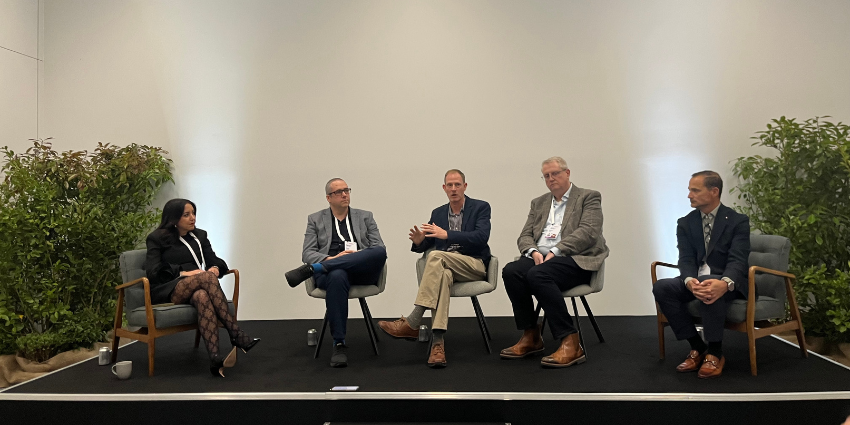
At Salesforce’s Agentforce World Tour 2025 in London, that courage was on full display. Zahra Bahrololoumi CBE, CEO of Salesforce UKI, hosted a panel featuring leaders who’ve moved decisively beyond experimentation.
“We’ve gone from pilot to scale,” Bahrololoumi said, noting that 70% of Salesforce’s top 10 global deals now include significant Agentforce and Data Cloud components.
“The proportion of Agentforce and Data Cloud being so central to those transformations is very typical of what we’re seeing across the UK.”
Bobby the Virtual Police Assistant: AI in Public Safety’s Most Sensitive Moments
One of the leaders on the panel was Chief Superintendent Simon Dodds from Hampshire & Isle of Wight Constabulary and Thames Valley Police introduced Bobby, the UK’s first AI-powered policing digital worker, live for just eight days but already handling critical cases.
Hampshire and Thames Valley forces handle approximately 5,000 contacts daily, with 2,000 to 2,400 being 999 emergency calls. Bobby handles non-emergency inquiries about lost property, bail conditions, or neighbor disputes, freeing human operators for critical calls.
However, it was the contextualization capabilities that really impressed the audience.
“We had a young child use Bobby, and they just put in ‘mum and dad are arguing, what do I do?’ And it recognized the use of mum and dad as being childish, and was able to put that through to an operator,” Dodds explained. “Within 10 minutes, we had a car on scene.”
In another case, a mother sought advice about a neighbor who repeatedly appeared when her daughter was in the garden. Bobby recognized language patterns suggesting vulnerability, stalking, and harassment, and escalated to a human operator immediately.
Despite these impressive examples, Dodds also highlighted that Bobby also has intentional limitations:
“There’s no way for Bobby to access any of our crime databases, and the data Bobby has is just the knowledge articles that our staff themselves would use.”
When asked about accountability, Dodds acknowledged the risk: “Our human operators will make mistakes, so Bobby might make some mistakes. That’s why we’ve got to make sure that we stay on top of the learning.”
Pandora’s Gemma: Bridging the Gap Between In-Store Magic and Online Shopping
Ricky Wilson, SVP of Channels, Customers, and Colleague Technology at Pandora, described how the jewelry brand is using Agentforce to replicate the personalized in-store experience online.
Pandora deployed Gemma to handle after-sales inquiries during peak demand and to bring conversational commerce to online shoppers.
Wilson explained how “the Net Promoter Score of those customers interacting with Gemma is 10.5 points higher, and that all comes down to customers actually just wanting something answered or something solved.”
The more ambitious goal is replicating the in-store consultation experience. “In store, we have this incredible experience where you can actually be guided by one of our members of staff to help bring your story to life, the reason that you’re buying this item,” Wilson explained. “What we’re trying to do is bridge that gap.”
Customers who interact with Gemma view more products, spend more time browsing, and ultimately spend more. One breakthrough highlighted during the keynote was the ability to complete purchases within a conversation, eliminating the need to navigate to separate checkout processes.
LIV Golf’s Agent Caddy: Transforming Fan Engagement and Broadcast Storytelling
Nick Connor, SVP of Technology at LIV Golf, outlined how the global golf league is deploying Agentforce across three dimensions: speed, scalability, and engagement.
“Speed is about being able to use Agentforce on top of our data to ask questions and get the answers that are needed to make decisions quickly,” Connor said.
For broadcasts, this means commentators can query statistics in real-time instead of waiting for colleagues to respond via Slack. “That’s really critical to how consumers and fans are getting the stories told.”
He also detailed how scalability extends across marketing, operations, and player support:
“We need to build that engagement with our fans globally, and Agentforce is helping us do that.”
Fans can access the same statistics surfaced to commentators and players, creating a richer experience that drives monetization.
The vision includes an “Agent Caddy” that could recommend the same golf club used by a player in a shot a fan just watched. But Connor emphasized the foundation:
“Data is critical. You can’t just throw stats at an agent and think it’s going to calculate metrics and work things out. It does need to be curated, properly managed in order to get the right responses.”
The Data Foundation: Why Most AI Initiatives Still Fail
When asked about the biggest stumbling block for AI initiatives, Bahrololoumi pointed to data quality, a theme that recurred throughout the panel.
“The amount of money that’s being wasted on DIY AI, I think we are going to see a meaningful and profound awareness in every company around what their core business really is,” Bahrololoumi said.
She predicted enterprises will abandon costly AI experiments in favor of focusing on their competitive advantages.
Wilson at Pandora also explained how data quality shapes agent performance: “The way in which we train Gemma is we ask our best in-store associates to codify their information and knowledge.”
This ensures consistency and captures expertise that would otherwise remain tacit.
What Comes Next: The Agentic Enterprise as the New Normal
In addition to the use cases and data discussions, panel members also shared ambitious visions for the future.
Wilson wants insights from customer interactions with Gemma fed back to in-store associates, creating continuous learning loops. Connor is excited about providing golfers with AI-powered insights on the course and enriching experiences for amateur players.
Moreover, Dodds envisions AI transcription services in contact centers. “You’ve got people trying to listen to really difficult calls, and at the same time they’re trying to input data,” he said.
“To be able to move the technology into a space where there’s transcription would allow operators to just concentrate on listening and providing the right response.”
Bahrololoumi recalled witnessing a domestic violence call where an operator used only keypad responses to deduce a victim’s situation and dispatch help while typing furiously. “If we could just take that burden away, that would be incredible,” she said.
Consider This: The Human Element in an Agentic World
The most compelling AI use cases are those that free humans to be more human. Bobby allows police operators to focus on empathy and judgment in crisis situations. Gemma enables Pandora’s staff to engage more meaningfully with customers. LIV Golf’s agents give commentators the data they need to tell better stories.
The shift from pilot to production is not just a technical challenge but a cultural one. It requires organizations to trust AI agents with real stakes, invest in data quality, and partner with those who understand enterprise transformation complexities.
The UK is emerging as a leader in this space because leaders like those on this panel are willing to deploy responsibly, learn, and iterate.
The question for CX professionals is no longer whether AI agents will transform customer and citizen engagement. It’s whether your organization is ready to move beyond experimentation and deploy them at scale.
Join the conversation with 40,000+ CX professionals in our LinkedIn community and subscribe to our newsletter for the latest insights on AI, customer experience, and enterprise transformation.