
Customer experience leaders are under pressure to do something that sounds simple and is brutally hard in practice: turn customer data into actions that improve experience and prove value. Most contact centers already measure plenty. However, the gap is interpretation, prioritisation, and follow-through.
That’s why Customer Analytics & Intelligence (CA&I) is getting so much attention. Done well, it moves teams from “having dashboards” to actually knowing what’s happening, why it’s happening, and what to do next. More importantly, it helps leadership answer the questions that decide budgets: are we improving outcomes, lowering cost-to-serve, and protecting revenue?
It also matches how buyers actually search. Discovery-stage teams rarely start with “customer analytics and intelligence”. They start with things like “how can I view customer data in one place?”, “how can I gain insight on customer data?”, or “why are customers contacting us more this week?” CA&I is the capability that turns those questions into answers you can operationalise.
And here’s the uncomfortable truth: many CX analytics programmes stall because they stop at insight. The problem is usually not data volume. It is timing, ownership, and execution. Data arrives too late, nobody owns the next step, and the business mistakes reporting for progress.
As CX Today has argued, real-time intelligence isn’t “faster reporting”:
“Real-time does not mean a prettier dashboard that refreshes more often.”
The CA&I Execution Loop is a simple operating model for turning insight into outcomes: Detect what changed, Diagnose why it changed, Assign an owner, Act inside the workflow, then Measure impact and repeat. If a platform cannot support that loop, it is helping you report on problems, not solve them.
Navigation
- What CA&I is
- Analytics vs intelligence
- How CA&I works
- Why most CA&I programmes fail
- Real-time metrics
- Use cases
- Customer journey analytics data
- 2026 trends
- Choosing a platform
- Customer analytics tools and platforms
- Implementation
- Proving ROI
- The future
- FAQs
If you want more news, analysis, and examples as you go, visit the CX Today Customer Analytics & Intelligence hub.
What is Customer Analytics and Intelligence?
Direct answer: Customer Analytics & Intelligence (CA&I) is the discipline of turning customer interaction, operational, and feedback data into actions that improve customer experience, contact center performance, and business outcomes.
In a CX Today context, CA&I is most useful when it’s anchored to the contact center. That’s where customer conversations happen at scale, where service friction shows up first, and where even small improvements can shift cost and loyalty fast. As a result, CA&I brings structure to that environment by helping teams measure what matters, detect problems early, and focus improvements on the highest-impact drivers.
CA&I often shows up as contact center analytics, customer experience analytics, and operational intelligence. You’ll also see it overlap with VoC analytics (Voice of the Customer analytics), customer journey analytics, and conversational intelligence (insight from voice, chat, and messaging conversations). In practical buying terms, it’s the category that connects customer analytics tools with the operating rhythm that makes them usable.
One important point: CA&I is not a dashboard project. Instead, it is an operating capability. Therefore, the output should be decisions, not charts.
What’s the Difference Between Customer Analytics and Customer Intelligence?
Direct answer: Customer analytics is the measurement and reporting layer. Customer intelligence is the interpretation layer, which is increasingly powered by AI.
Customer analytics is what most teams recognise first: KPIs, CX dashboards, trend reporting, performance scorecards, and segmented views. Customer intelligence builds on that foundation by using AI and automation to interpret large volumes of customer and operational data. As a result, it can surface themes, root causes, anomalies, and recommended actions, often in near real time.
A simple contact center example:
Analytics: “Average handle time increased today.”
Intelligence: “Average handle time increased because billing questions spiked and agents are searching for answers. Update knowledge content and route those intents to trained specialists.”
Analytics tells you what changed. Intelligence tells you why it changed and what to do next.
How Does Customer Analytics and Intelligence Work?
Get the full picture on CX Today
Direct answer: CA&I works by collecting customer and operational signals, standardising them into trusted metrics, and using analytics plus AI to convert those signals into actions and measurable outcomes.
Most enterprise CA&I environments follow the same flow, even when the tech stack varies: collect signals, unify context, interpret patterns, then push insight into the places where work happens (supervisor dashboards, agent workflows, quality management, case management, or journey orchestration).
In contact centers, CA&I runs in two modes. Real-time analytics supports intraday management, while historical analytics supports trends, coaching, forecasting, and continuous improvement. The strongest programmes connect the two. Real-time interventions feed learning, and historical analysis upgrades what happens in real time.
So what does CA&I actually consume?
- Interaction data: voice calls, chat, email, SMS, social messaging, IVR journeys.
- Customer context: CRM records, case history, identity/account details, purchase or subscription signals where relevant.
- Operational data: workforce management (WFM), quality assurance (QA), schedules, staffing, adherence, routing outcomes.
- Feedback data: CSAT (Customer Satisfaction), NPS (Net Promoter Score), CES (Customer Effort Score), post-contact surveys, and indirect feedback (complaints, repeat contact patterns, churn signals).
From there, the intelligence layer applies AI techniques like transcription, natural language processing (NLP), sentiment analysis, topic clustering, anomaly detection, and predictive customer analytics (for example, churn risk or repeat-contact likelihood). Ultimately, the end goal is not technical elegance. It is actionability.
Why most CA&I programmes fail
Most CA&I programmes fail for three reasons. First, data arrives too late to change what happens inside the shift. Second, teams can see an issue but can’t trace ownership across operations, digital, and customer-facing teams. Third, platforms generate more dashboards than decisions. The result is a familiar pattern: lots of visibility, very little intervention. That is exactly the gap the CA&I Execution Loop is designed to close.
Why Insight Without Action is the CA&I Failure Mode
Most organisations don’t struggle to collect data. Instead, they struggle to turn it into coordinated action across teams, channels, and systems. That’s why CA&I should function as an execution capability, not a reporting capability.
In Medallia’s 2026 State of CX findings, a perception gap stood out: 66% of CX professionals believe CX has improved, while only 17% of customers agree. The same CX Today analysis also highlights an execution problem: 30 to 40% of departments are not acting on feedback.
“To close this gap, brands will need to shift from interaction-level measurement to journey-level accountability.”
In practical terms, “action” usually means assigning ownership, changing workflows (routing, knowledge, escalation paths), improving agent support, updating digital self-service, and then measuring whether those changes reduce friction and improve outcomes. That is the Execution Loop in real life.
What are the Most Important CX Metrics to Track in Real Time?
Direct answer: The most important real-time CX metrics are the ones you can influence today, and that correlate with outcomes like resolution quality, customer effort, service levels, and cost-to-serve.
Real-time analytics matters because contact center work is time-sensitive. If you only learn you missed your targets next month, you cannot fix what happened today. Therefore, track a small set of metrics that drive action, not a large set that creates dashboard noise.
- Service level and access: wait time, speed of answer (ASA), abandonment rate.
- Resolution and effort: first contact resolution (FCR), transfer rate, repeat contact indicators.
- Efficiency: average handle time (AHT), after-call work (ACW), agent occupancy.
- Quality signals: QA scores (where available), compliance flags, escalation quality.
- Experience signals: real-time sentiment analysis or predicted CSAT, where responsibly deployed.
One useful rule helps: if a metric doesn’t change what a supervisor or operations lead will do in the next shift, it probably belongs in historical reporting, not a live board.
How do Customer Analytics Tools Improve Contact Center Performance?
Direct answer: Customer analytics tools improve performance by helping teams detect friction early, coach and support agents more effectively, reduce repeat contacts, and optimise self-service without damaging customer trust.
Most buyers do not purchase CA&I to “improve visibility.” They buy it to solve a specific operational problem faster than their current stack allows. That is why the strongest evaluations start with use case, owner, and success metric, not feature lists.
CA&I delivers value through repeatable use cases. The goal isn’t “more insight.” The goal is faster Detect → Diagnose → Assign → Act → Measure.
Predicting experience outcomes from conversations (instead of waiting for surveys)
Post-call surveys still matter, but response rates and representativeness are ongoing issues. Increasingly, CA&I tools use conversational signals to estimate satisfaction in near real time and trigger coaching or follow-up workflows. The takeaway isn’t to buy a predictor. Rather, the takeaway is to reduce the lag between experience happening and improvement happening.
Improving NPS and first-time resolution through AI-supported workflows
AI-supported service experiences improve when CA&I connects knowledge, intent, and workflow guidance. For example, in a CX Today case study on augmenting Vodafone’s virtual agent with GenAI, the organisation reported a 20% NPS increase and improved first-time resolution from 70% to 90%.
“70% first-time resolution to 90% … just because you have agents using GenAI.”
Scaling self-service without sacrificing satisfaction
Containment only matters when self-service resolves issues without increasing effort. Otherwise, customers recontact, effort rises, and the organisation pays later through churn and repeat demand.
CX Today reported that HubSpot’s AI Support Bot handled 35% of support tickets without sacrificing “high” customer satisfaction, with a target to reach over 50% before the end of 2025. The same story notes the AI Sales Bot handled over 80% of website chats and AI automation generated 10,000+ sales meetings in Q4.
“By combining the best structured and unstructured data, providing complete context about the customer… we are helping our customers shift to the age of AI.”
QA at scale (moving beyond manual sampling)
Traditional QA evaluates a small fraction of interactions. Modern CA&I makes it possible to analyse far more conversations for compliance, coaching opportunities, and experience drivers. As a result, conversational intelligence and sentiment analysis become practical tools, not buzzwords.
Reducing failure demand (repeat contacts caused by broken journeys)
Failure demand shows up as repeats, transfers, escalations, and customers switching channels to solve the same problem. CA&I helps teams detect the drivers (themes, intents, process bottlenecks) and then measure whether fixes reduce contact volumes and customer effort over time.
What Data do you Need for Customer Journey Analytics?
Direct answer: You need interaction data across channels, a way to connect interactions to customer identity (even when imperfect), event-level journey signals, and outcome metrics you can tie to business and experience impact.
Customer journey analytics works when it captures the story of an experience across touchpoints, not snapshots of channel performance. For many organisations, the hardest part isn’t dashboards. Instead, it’s connecting fragmented systems: CCaaS, CRM, digital analytics, and feedback management tools.
At minimum, journey analytics relies on event signals (what happened and when), identity linkage (who it happened to, or which account/session), and outcome signals (did the customer resolve, repeat contact, churn, complain, or convert).
Journey analytics becomes most valuable when it supports operational decisions. For example, it can detect where customers switch channels, identify high-effort paths, and spot journeys that correlate with churn or escalations. That’s why many buyers search for customer journey analytics tools that surface not just paths, but root-cause drivers and recommended actions.
Customer Analytics & Intelligence Trends Reshaping CX in 2026
See CX Today’s take on escaping the CX measurement trap
In 2026, CA&I isn’t mainly about new dashboards. Instead, it’s about accountability, trust, and execution. Several shifts are shaping what buyers prioritise.
Behavioural signals are gaining weight as survey response declines. CX Today’s Medallia coverage notes that more than half of consumers now prefer brands to infer satisfaction from behaviour rather than static responses. That pushes CA&I toward indirect feedback, repeat-contact patterns, sentiment signals, and operational intelligence.
AI insight is mainstream, but consistency is not. CX Today’s CCW Europe reporting highlights that only 5% of CX leaders say their AI-driven customer experience is “very consistent” across channels. Meanwhile, 83% of CX leaders recognise AI-powered experiences play a critical role in transformation. That gap is an operating model issue as much as a technology issue.
Real-time is becoming an expectation. Buyers increasingly expect intraday visibility, alerts, and feedback loops that route insight to owners quickly. This is why the Execution Loop matters. Faster insight only helps when it triggers safe action.
Trust and governance are moving to the centre. As AI scales analysis, buyers scrutinise explainability, audit trails, data handling, and privacy controls. This matters most where CA&I touches personal data, sensitive conversations, or automated decisioning.
Choosing the Right Customer Analytics and Intelligence Platform
Most discovery-stage buyers start with a practical question: how do we make sense of our customer data, and how do we see what’s happening across calls, chat, email, and CRM in one place? In vendor terms, that becomes a customer analytics platform or customer intelligence software search, followed by platform comparison.
Before you compare vendors, compare platform types and align them to your problem. Enterprise stacks often include a mix of VoC platforms, conversational intelligence, customer journey analytics, and BI for CX dashboards. Strong teams also invest in the foundations: identity, governance, and workflow ownership.
A simple rule helps buyers narrow the field. If your biggest problem is feedback visibility and closed-loop action, start with VoC platforms. If your biggest problem is contact center quality, coaching, and conversation insight, start with conversational intelligence. If your biggest problem is fragmented journeys across digital and service channels, start with journey analytics. If your biggest problem is reporting consistency, fix your data model and BI layer before buying another intelligence product.
Customer Analytics Tools and Platforms in 2026: What Buyers Actually Evaluate
This is where “education” turns commercial. Buyers don’t only want definitions. They want to know which customer experience analytics tools map to their use case, and which platforms can carry the Execution Loop.
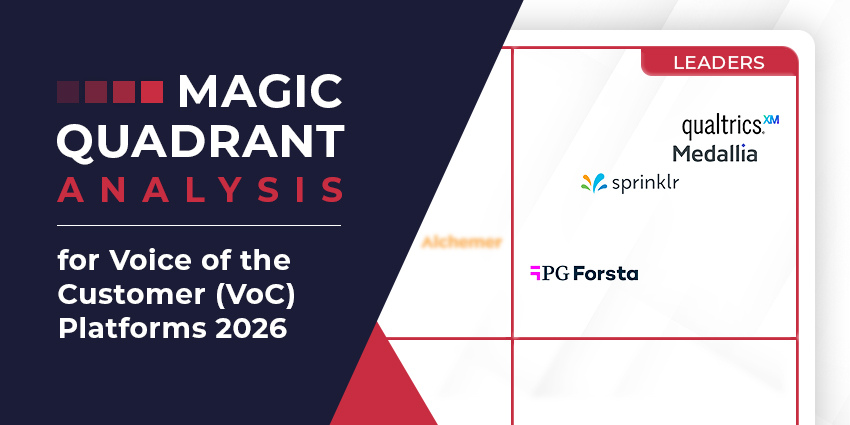
VoC platforms comparison: Enterprise teams often shortlist Medallia Experience Cloud and Qualtrics XM when the priority is feedback management, experience measurement, and closed-loop action at scale.
Conversational intelligence and contact center analytics: Teams evaluating conversation insight, QA at scale, and operational intelligence often look at NICE Enlighten AI and Verint Speech Analytics, especially where voice and digital interactions need consistent interpretation.
Customer journey analytics tools: When the need is cross-channel journey visibility (including digital behaviour), Adobe Customer Journey Analytics and Amplitude Analytics often enter the conversation. Google Analytics 4 can support digital signals, although contact-center-led CA&I usually needs deeper operational signals too.
CX dashboards and reporting layers: Many teams use Microsoft Power BI or Salesforce Tableau to deliver CX dashboards once data sources are connected and definitions are stable.
Whichever mix you choose, the same two questions decide outcomes: can the platform access and unify your core signals, and can it turn insight into workflow action (with measurement) rather than more reporting work?
Choosing a CX Analytics Platform: Evaluation Checklist
Here’s a practical way to evaluate a customer experience analytics platform without getting trapped in feature theatre. The goal is to confirm real-time capability, actionability, and governance, while staying grounded in outcomes.
- Data coverage: Can it ingest voice, chat, email, messaging, CRM/case context, WFM, QA, and feedback management signals?
- Real-time performance: Does it support real-time analytics with meaningful alerts, not just refreshed charts?
- Intelligence quality: Does it explain, detect patterns, and support predictive customer analytics in a way users can trust?
- Actionability: Can insight trigger workflows, assign owners, and close the loop on fixes and follow-ups?
- Governance: Does it offer audit logs, role-based access, and options for privacy controls and data residency?
- Time-to-value: Can you pilot a real use case in weeks, with baselines and measurable impact?
In practical terms, buyers should ask one hard question in every demo: show us how insight becomes action, who owns that action, and how the platform proves whether the intervention worked.
How to Implement Customer Analytics & Intelligence (First 30 to 60 Days)
CA&I implementation succeeds when the organisation treats insight as an operational input, not a reporting output. The first 30 to 60 days should focus on foundations and one high-impact loop, not “boiling the ocean.”
Weeks 1–2: define one version of the truth. Standardise metric definitions (AHT, FCR, CSAT, abandon rate, transfer rate) so teams stop debating numbers and start improving outcomes. Confirm data owners and access permissions early, especially for sensitive conversation data.
Weeks 2–4: choose one high-impact use case. Good candidates include intraday performance visibility, QA at scale, or a closed-loop feedback workflow that routes insight to owners. Set baselines and success metrics upfront. This is the moment you prevent a dashboard project from becoming shelfware.
Weeks 4–6: operationalise the loop. Build a simple rhythm: detect, assign, fix, validate. If insight has no owner, it isn’t an insight. It’s just data.
Weeks 6–8: expand responsibly. Scale only after the first loop proves measurable improvement. Add governance checks, model validation (where AI is used), and training for supervisors and analysts so the platform is used consistently.
How do You Measure ROI from Customer Analytics?
Direct answer: Measure ROI by linking CA&I changes to outcomes in three areas—experience, operations, and business impact—then tracking those outcomes over time against a baseline.
If you cannot tie a CA&I programme to fewer repeat contacts, lower cost-to-serve, better resolution quality, or improved retention, you do not have a proven analytics strategy. You have a reporting layer.
ROI proof fails when teams report tool usage or dashboard engagement. ROI proof works when teams track outcomes leadership already cares about.
A practical balanced scorecard covers:
Experience outcomes: CSAT, NPS, customer effort, sentiment trend, complaint rates, escalation quality.
Operational outcomes: AHT consistency, FCR, abandon rate, repeat-contact reduction, QA coverage and quality, training time to proficiency.
Business outcomes: cost-to-serve, retention or churn movement, conversion outcomes where relevant, and reduced failure demand.
Define the baseline before you intervene. Then measure movement after the change. For example, an insight-driven coaching programme should improve FCR and reduce repeats, not just increase “coaching sessions.” Likewise, a journey fix should reduce channel switching and escalations, not just improve a journey map.
The Future of Customer Analytics and Intelligence
CA&I is moving toward more real-time decision support and more automation. As intelligence improves, the contact center will increasingly run with always-on insight: anomaly detection, predicted outcomes, and recommended actions delivered inside workflows.
However, the future is not only technical. It is operational. The best programmes will win because they build trust and consistency: clear governance, explainability, and accountable ownership of improvements.
In short, CA&I will reward organisations that can turn measurement into execution at speed, while maintaining human oversight where it matters most.
Conclusion
Customer Analytics & Intelligence isn’t a niche category. It’s how modern CX teams prove progress, manage performance, and improve customer outcomes without relying on guesswork. The core idea is straightforward: use customer experience analytics to measure what matters, use intelligence to interpret it at scale, and build feedback loops that turn insight into coordinated action.
For most discovery-stage buyers, the best next step is not a full platform bake-off. It is choosing one high-impact use case, defining a baseline, assigning ownership, and proving the Execution Loop works in practice. That is how CX teams move from fragmented dashboards to a system that detects problems early, drives action quickly, and proves value in terms the business will recognise.
Frequently Asked Questions (FAQs)
What is customer analytics and intelligence?
Customer Analytics & Intelligence (CA&I) is the practice of turning customer interaction, operational, and feedback data into actionable insight that improves customer experience and business outcomes. It combines analytics (measurement and reporting) with intelligence (AI-powered interpretation and recommendations).
What’s the difference between customer analytics and customer intelligence?
Customer analytics focuses on measuring and reporting performance through KPIs, dashboards, and trend views. Customer intelligence focuses on interpreting those signals at scale, often using AI, to explain why outcomes are shifting and what actions will improve them.
How do customer analytics tools improve contact center performance?
They improve performance by enabling real-time visibility, better coaching, more consistent quality, reduced repeat contacts, and stronger self-service optimisation. The best tools also help teams link improvements to measurable ROI, not just operational reporting.
What are the most important CX metrics to track in real time?
The most important real-time metrics are the ones teams can influence during the shift: wait time, abandonment, AHT and ACW, FCR signals, transfer rates, escalation quality, and real-time experience indicators such as predicted CSAT or sentiment where appropriate.
How do you measure ROI from customer analytics?
Start with baselines, then measure improvement across experience outcomes (CSAT/NPS/effort), operational outcomes (FCR, AHT consistency, repeat contacts), and business outcomes (cost-to-serve, retention/churn movement). ROI becomes credible when improvements are tied to specific interventions, not tool usage.
What data do you need for customer journey analytics?
You need event-level interaction and digital behaviour data, customer identity linkage (even imperfect), and outcome signals such as resolution quality, repeat contact, complaints, churn risk, or conversion. Journey analytics works best when it supports operational fixes, not just mapping.