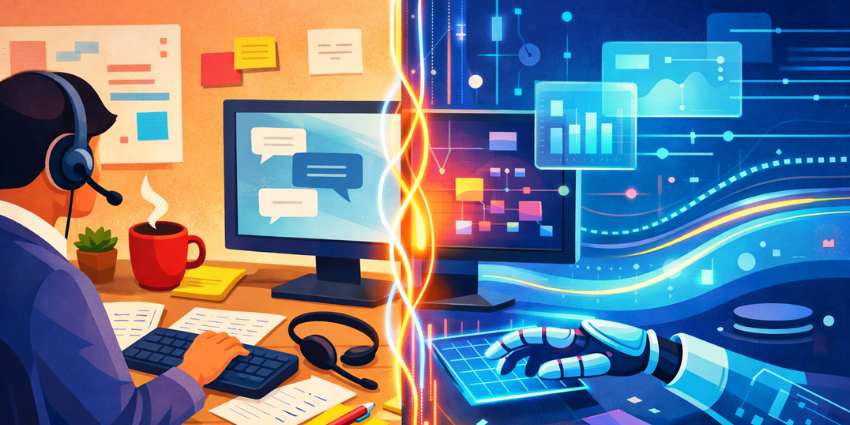

Leaders in the contact center didn’t wake up one morning and decide to break workforce management. It happened slowly. One bot here, a deflection win there, and suddenly, human and AI workforce management stopped behaving like a planning discipline and started acting like a live experiment nobody fully owns.
AI agents now handle a real chunk of customer work. Gartner says agentic systems could resolve close to 80% of routine service issues by 2029. Yet most AI WFM tools still assume that humans are the only workers that matter, and automation just “reduces volume.”
AI doesn’t remove demand cleanly. It reshapes it. Simple questions disappear. What hits human queues instead is heavier, sharper, and already irritated. You see it in handle times, rising agent fatigue, and when recontact rates creep up even as containment improves.
This is where workforce planning starts to break down. Shared queues don’t bend old WFM assumptions. They snap them. Arrival patterns change. Emotional load spikes. AI agent management becomes a staffing variable, whether you like it or not.
Related Stories:
- AI Knows When Your Customers Will Leave – Do You?
- The Best Predictive CX AI Providers 2026
- The Predictive CX Playbook: Using AI to Stay One Step Ahead of Your Customers
Why Does AI Make Workforce Planning More Complicated?
AI didn’t “take volume out of the system.” It rearranged the work in ways workforce planning models were never built to handle.
Most AI deployments start in the same places. FAQs. Password resets. Order status checks. Basic diagnostics. The low-risk, low-emotion stuff. That’s because early AI wins come from shaving off predictable demand, not solving hard problems.
But that success creates a second-order effect. Once AI handles the simple interactions, only the messy ones reach humans.
Escalations arrive later in the journey. Customers have already explained themselves to a bot. Sometimes twice. They’re more impatient. Often skeptical. According to Cisco forecasts, agentic AI is expected to handle 68% of contact center interactions by 2028, but the interactions that spill over carry more emotional weight and higher recontact risk.
Shaping workforce decisions around things like average handling time stops being useful. You’re not comparing apples to apples. You’re averaging trauma recovery, policy exceptions, and edge cases that automation couldn’t safely touch.
Shared queues don’t just change volume curves. They change the character of the work itself.
Why Do Shared Queues Break Traditional Workforce Planning Assumptions?
Classic WFM math was built for a world where work arrives independently, agents behave predictably, and “average” means something useful. None of that survives contact with shared human–AI queues.
Erlang models assume randomness. One call has nothing to do with the next. AI breaks that instantly. When an AI system loses confidence, hits a policy boundary, or misclassifies intent, it doesn’t fail once. It fails in clusters. Retries stack. Escalations land back-to-back. Humans don’t see a steady stream of work; they get hit with waves.
MIT Sloan and BCG’s research shows companies aren’t prepared. 79% of enterprises are already deploying AI in operations, but 47% admit they have no strategy for managing AI agents at all.
Forecasts based on historical human behavior can’t see confidence cliffs, retry loops, or model update windows. They miss the moments that actually matter. Shared queues don’t bend traditional WFM models. They snap them. Until leaders accept that the math itself is outdated, every staffing conversation is just guesswork.
How Should Contact Centers Rethink WFM For AI-Assisted Operations?
The problem is that workforce planning has turned into a systems problem, while most organizations are still treating it like a math problem. Once humans and machines share queues, decisions stop being linear. Every AI choice ripples forward, every escalation carries emotional residue, and every model update shifts demand shape midday.
Human and AI workforce management demands a brand-new approach.
Step 1: Model AI as “Virtual Headcount,” Not a Channel
Most organizations still treat AI like a series of tools, despite the growth of AI colleagues in the workplace handling more “human” tasks than ever.
If AI is touching real customers, it’s doing real work, and real work has capacity limits. This is the first hard reset in AI WFM: stop thinking in channels and start thinking in contributors. AI needs to be modeled as a virtual headcount with strengths, constraints, and failure modes, just like people.
That means tracking things WFM teams were never trained to care about:
- Concurrency limits
- Latency under load
- Confidence thresholds that trigger handoffs
- Retry behavior when the AI gets confused
- Clustered failures
Teams that feed AI performance metrics directly into their planning models see something interesting: staffing stops whiplashing. When AI slows down or escalates more than expected, the plan adjusts before the queues melt down.
One AI agent will never equal one FTE. But pretending it equals zero is worse. Once you quantify AI capacity honestly, Human and AI workforce management evolves.
Step 2: Forecast Blended Workloads, Not Volumes
Classic workforce planning asks one core question: how much work is coming in? Hybrid environments force a harder one: what kind of work will humans inherit after AI has taken its swing?
Because once AI enters the flow, volume stops being the most useful signal.
When confidence drops, when policies trigger, when retries stack up, escalations arrive in clumps. Ten quiet minutes. Then a wave. Then another. That pattern shows up over and over in real deployments, and it’s exactly why historical averages start lying to you.
Forecasts improve with AI only when AI behavior itself becomes an input. Containment rates alone don’t help if you can’t see confidence decay, retry loops, or escalation clustering forming upstream.
The smarter approach treats AI as an unpredictable coworker, not a volume sponge. Forecasts need to model:
- When AI confidence typically drops
- How often do customers retry before escalating
- Which intents explode after model updates
- Where sentiment turns sour before a human ever joins
This is where predictive CX data becomes really useful. The right platforms surface early escalation signals fast enough for WFM teams to respond, not explain later.
Step 3: Redesign Scheduling for Human–AI Teams
Leaders update forecasts. They tweak headcount. Then they keep scheduling humans like nothing upstream changed. Same shifts, shrinkage assumptions, and “coverage is coverage” logic. It doesn’t work anymore. When humans and AI share queues, time behaves differently.
AI doesn’t create a steady trickle of work for people. It creates long, calm stretches followed by sudden, ugly spikes. Suddenly, your agents aren’t just busy; they’re inheriting frustration that’s already been simmering.
Modern workforce planning needs new time blocks baked in:
- Escalation buffers, not just idle time
- Explicit AI oversight windows (someone has to notice drift early)
- Recovery time after emotionally dense interactions
- Micro-flex coverage when containment suddenly swings
Coverage without recovery capacity doesn’t create efficiency. It creates burnout that looks productive right up until attrition hits. If human and AI workforce management is serious, schedules have to reflect interdependence, not just presence.
Step 4: Update Skills Frameworks for AI-Supported Humans
When AI starts taking first contact, humans don’t get “easier days.” They get harder work all the time. Once AI handles the basics, agents stop building confidence through repetition. There’s no warm-up lap. People drop straight into escalations where the customer has already been misunderstood, bounced, or politely gaslit by a machine that sounded confident and wrong.
In Human and AI workforce management, skills shift away from speed and script adherence and toward things that are much harder to train and measure:
- Reading emotional temperature when the context is incomplete
- Understanding why an AI handed something off, not just what it said
- Knowing when to trust AI suggestions, and when to override them fast
- Recovering trust after automation failure without sounding defensive
MIT Sloan and BCG’s 2025 study found 64% of employees using agentic AI feel overwhelmed by the number of tools introduced at work. AI WFM models that ignore that inflate attrition risk.
This is where workforce planning has to grow up. The role isn’t “agent” anymore. It’s part investigator, part emotional translator, part system supervisor.
Step 5: Plan for New WFM Risk Scenarios
Most workforce plans quietly assume that once AI is live, things get calmer. Fewer contacts. Smoother curves. Predictable gains. That assumption breaks the first time an AI model drifts, a backend API slows down, or a confidence threshold flips midday.
AI downtime doesn’t create silence. It creates a surge. Customers don’t disappear when bots fail; they escalate, often all at once, already annoyed, already repeating themselves. If workforce planning hasn’t reserved human surge capacity, queues melt fast.
Model drift is quieter and more dangerous. Accuracy slips a few points. Confidence scores drop. Escalations spike slowly, then suddenly. Teams think demand increased, when in reality, AI agent management failed upstream.
Then there are behavioral anomalies. Retry loops. Misrouted intents. AI agents are hammering the same workflow repeatedly. From a WFM view, it looks like chaos. From a systems view, it’s a known failure mode that wasn’t modeled.
Risk scenarios need to be staffed, scheduled, and rehearsed the same way as outage response plans are. AI governance stops being a compliance topic and becomes a workforce safeguard. If your WFM model assumes AI behaves on its best day, it will fail on an average one.
Step 6: Optimize for Human Productivity and AI Efficiency
This is where a lot of AI WFM face serious scale problems.
Teams keep the old scorecards. Average handle time. Occupancy. Cost per contact. Then they bolt AI on top and wonder why morale dips while “efficiency” supposedly rises. The math looks better. The floor feels worse.
Here’s the problem: single-metric optimization breaks the moment human and AI workforce management becomes shared. Push AI too hard and humans inherit nothing but emotional clean-up work. Protect humans too much, and expensive automation sits idle, doing very little.
Modern human and AI workforce management needs KPIs that describe system health, not just speed. That means tracking things like:
- Escalation quality (did the human actually have what they needed?)
- AI confidence stability (how often models hand off under stress)
- Recontact probability after AI-first journeys
- Cognitive load indicators, not just shrinkage
CX leaders already leaning into predictive metrics are ahead here. Outcome-based signals outperform AHT once AI enters the flow. Speed alone can’t tell you whether the system worked, only whether it moved. The goal isn’t squeezing more out of people or machines. It’s building a system where neither burns the other out.
What Are the Risks of Poor Human-AI Workforce Management?
When human and AI workforce management go wrong, the side effects are obvious, to both your employees and your customers.
Understaff during an AI outage or model wobble, and queues explode in minutes. Not gradually. All at once. Every escalation lands on humans who have already inherited the hardest work. That’s how you end up with overtime spikes, SLA breaches, and agents logging off emotionally long before their shifts end.
Overstaffing during peak containment and the damage is just as real. Idle time creeps up. Leaders start questioning headcount. Confidence in AI WFM erodes because the savings everyone promised never quite show up. Automation gets blamed, even when the real issue is outdated workforce planning logic.
The burnout problem cuts deeper. When AI absorbs all the easy work, humans live permanently in exception mode. Angry customers. Policy disputes. Fixing mistakes they didn’t make. That kind of queue wears people down fast. Attrition rises. Training costs follow. Suddenly, the “efficiency” project is fueling churn.
Once trust breaks down, it’s hard to repair. Teams stop listening to forecasts. Leaders hesitate to invest further in AI agent management.
Human and AI workforce management isn’t a scheduling exercise anymore. It’s systems leadership. Design it well, and the operation holds under pressure. Get it wrong, and everything bends until it breaks.
FAQs
What is human and AI workforce management?
It’s what planning turns into once AI is no longer a side tool and starts doing a share of the work. You’re not just lining up people against incoming demand anymore. You’re dealing with how the AI behaves too; when it copes, when it hesitates, when it hands things over.
What happens to human workloads when AI handles the easy contacts first?
The work gets sharper. The quick wins disappear, so agents spend less time clearing simple requests and more time stepping into situations that didn’t land properly the first time. Customers arrive with more context, often less patience, and the interaction tends to carry more weight. It’s not always longer, but it is harder.
How should leaders forecast staffing when emotional load and complexity rise?
You have to stop pretending every contact is equal. A five-minute password reset and a five-minute complaint recovery don’t cost the same amount of time and effort. Forecasts start to improve when they account for that difference, looking at escalation patterns, sentiment, and how work bunches together in the contact center.
What does better planning look like in a mixed human–AI service model?
It’s a bit less polished, but a lot more grounded. Plans expect the AI to wobble sometimes. They allow for uneven demand, not just smooth averages. And they leave breathing space for agents to reset after tougher interactions.
What tools help with human and AI workforce management?
There isn’t a single system that solves it. WFM platforms are still part of it, but they need signals from elsewhere on how the AI is performing, where it’s handing off, what QA is picking up, and how customers are reacting. On their own, those tools just describe the workload. When they’re connected, they start to explain it.