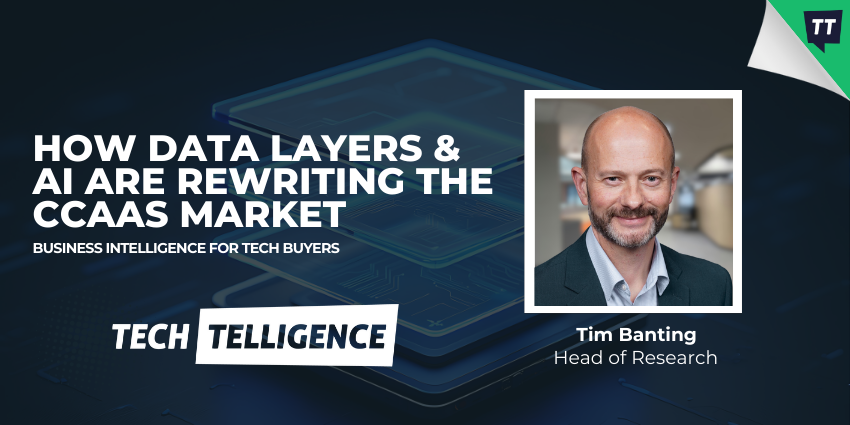

In 2026, CX leaders may find themselves talking less about product labels like CCaaS and more about where value actually sits in the enterprise stack.
That is the prediction from Tim Banting, Head of Research at Techtelligence, who argues that traditional UC and CX categories are starting to describe “the packaging and not the power and the value that it offers an enterprise.”
His view is not that contact centers or collaboration suddenly stop mattering. It is that the competitive battleground is shifting.
Buyers, vendors, and regulators will increasingly care about data gravity, AI outcomes, and how well platforms integrate across front office and back office workflows.
“I think what’s happening is we’re seeing the stratification of UC and CX. These categories don’t really explain value anymore.”
1) 2026 could be the year “categories don’t really explain value anymore”
Banting believes UC and CX are “stratifying,” with the old vertical stacks breaking apart.
“Those categories really describe the packaging and not the power and the value that it offers an enterprise.”
In his framing, modern enterprise communications are distributed across layers: “infrastructure data, AI, communications and collaboration, business insights through dashboards and reports.” As these layers become more visible, labels like UCaaS, CCaaS, CPaaS, and even “voice of the customer” may feel less useful as decision shortcuts.
Why? Because many capabilities now overlap across platforms, and features replicate quickly. Banting describes “this ongoing battle between features,” where “someone releases a feature, it gets duplicated a couple of weeks later.”
In 2026, he expects differentiation to come from where vendors sit in the stack and how they capture value over time, not from who launches the next UI tweak first.
For CX teams, the practical implication is that supplier selection will increasingly be about architecture fit. Where does customer data live? What is the AI model actually reading? What is the workflow surface area across departments? These questions are likely to matter as much as routing, WFM, and channel breadth.
2) Data as the control plane, AI as the value engine, and outcomes over features
Banting argues the industry’s build order is out of date.
UC and CX “were built from the bottom up,” where telephony and contact center came first, and “analytics came much later as an overlay, AI even later still as an add-on.”
That no longer matches reality, where AI is touching every single interaction, regardless of the channel,” and data needs to “persist across journeys and not just for each product.”
Read More:
- The five CX trends that defined 2025, according to Tim Banting of Techtelligence
- Predictive, Personal, and Proven – how CX leaders are demonstrating value faster
By 2026, Banting expects buying teams to judge platforms by outcomes and not by features. He points to the shift in monetization as a signal: “we’re seeing a move away from per seat pricing to sort of metered pricing with AI.” In other words, enterprises will see value tied to usage and results, not just licenses.
“Executives and business analysts and business level decision makers are judging platforms by outcomes and not by features.”
For CX leaders, this pushes ROI conversations up the chain. If AI can deliver “observable business benefits insights,” Banting believes that is where budget approval will be won. The contact center becomes both a service engine and a data engine, feeding insight into broader business decisions.
3) Data gravity, lock-in risk, and who wins the CX platform wars in 2026
Banting describes data as a “center of gravity” that is hard to escape. “You’ve got to put in a lot of thrust to break away from that center of gravity,” he says, especially when “this is our customer data… our intellectual property.” In 2026, that gravity could pull enterprises toward large systems of record and unified data layers, while pressuring smaller vendors that lack a clear data and AI strategy.
He also flags the regulatory tension.
“What becomes a moat for a vendor, becomes lock-in for a lot of customers.”
His prediction for winners is providers that “treat communications as like a programmable layer within a larger platform.” His warning for others is just as clear: “if your value proposition is better calling or better meetings, time’s not on your side.”
Summary & next steps
Banting’s 2026 outlook is that CX decisions will be less about picking a “CCaaS” product and more about choosing your stack position, your data gravity, and your AI value engine.
“Buyers that understand this sort of stratification stack will buy fewer tools and I think they’ll probably get better outcomes.”
Vendors that pick their layer strategy wisely, he argues, will survive consolidation. The rest may keep shipping features “until the market stops listening.”
If you’re involved in procurement decisions for your business, follow Techtelligence on LinkedIn for weekly insights, analysis, and expert advice to help you make smarter technology choices.
Explore more insights on the topic of the modern CX stack in Tim’s most recent blog post for Techtelligence.