
For many contact centers, the challenge is no longer collecting data; it’s doing something meaningful with it.
QA platforms now deliver unprecedented insight across voice, chat, and automated channels, but too often that intelligence stalls at the dashboard stage.
It’s like having a shed full of every tool imaginable, but not being able to locate the Phillips head screwdriver you need to change the batteries in your TV remote.
Or a pantry jam-packed with a delicious array of produce, but you haven’t got the recipe to help you put the ingredients together.
While CX leaders can analyze the data for patterns, agent behaviors, or policy inconsistencies, they often still struggle to translate these insights into organizational action.
According to Derek Corcoran, CEO and Founder of Scorebuddy, this isn’t due to a lack of understanding or effort from QA leaders. The real issue is bandwidth.
“Day by day, they’re focused on service delivery,” he says.
“That’s their primary focus. Sharing insight upward, and doing so consistently, is still a relatively new expectation.”
While the information is there, “the responsibility of the C-suite” is to recognize QA’s transformation and actively ask for those insights.
Corcoran notes that some more advanced customers now create executive-ready dashboards that are “automatically shared with the C-suite.” This increases visibility, sparks dialogue, and ensures strategic decisions reflect what customers are actually experiencing.
Why Reporting Isn’t Enough
QA programs often underperform not because the team lacks skill, but because the organization hasn’t defined how QA should influence coaching, policy, or CX design.
When insight remains siloed within the QA function, it loses its ability to shape decisions.
As Corcoran explains, “If I’m head down, day by day, focused on operational matters, it’s hard then to engage in that conversation at a strategic level.”
Building the loop requires elevating QA beyond its historically operational remit.
One theme Corcoran returns to repeatedly to help address this issue is the importance of the “human in the loop.”
He argues that you can’t just have evaluators validating AI outputs; you need agents taking part in the quality process, too.
As AI-driven evaluations grow more common, their impact becomes personal. They influence bonuses, performance perception, and career progression.
“You need to have confidence in the mechanisms,” Corcoran says, and agents must be able to challenge AI-generated scores.
For example, Scorebuddy includes a structured “challenge loop” so that if an agent believes an AI evaluation is “way off the mark,” it routes back to a human reviewer.
This maintains fairness, but it also reinforces a culture where feedback flows both ways. As Corcoran puts it:
“The AI will always answer the question, but not necessarily in the right way. Human oversight becomes the safeguard that keeps QA credible.”
Will Human Oversight Fade Over Time?
Whenever AI is mentioned in the customer service or experience space – and it’s brought up fairly often these days – the conversation inevitably reaches a point where someone asks, ‘Is AI going to replace agents?’
Corcoran doesn’t see that happening anytime soon.
Current AI tools, while powerful, remain highly sensitive to prompt-phrasing and the way scorecards are designed.
“With configurability comes great responsibility,” he cautions. Operational teams are discovering that AI reacts differently depending on the wording of criteria or the presence of subjective concepts, such as ‘went the extra mile.’
Humans intuitively understand context; machines don’t.
For that reason, Corcoran foresees more “checks and balances” rather than fewer. Leaders may run “a couple of passes” of AI evaluation to screen for bias or inconsistency, but ultimately, “the human in the loop is really important.”
Turning QA Insights into CX Strategy
Once organizations begin sharing QA insights more broadly – and trusting the mechanisms behind them – the impact can expand quickly.
At this point, QA has the potential to inform:
- Training priorities
- Script or workflow adjustments
- Policy changes
- Coaching frameworks
- Product decisions
- Executive planning
But doing so requires a shift in mindset. As Corcoran notes:
“QA now provides ‘business intelligence’ that simply didn’t exist before. The rest of the organization needs to be exposed to the possibilities and potential of what QA is uncovering.”
A major component of this shift is education. Operational teams must learn where AI excels and where it’s limited.
For example, asking an AI evaluator to produce ‘two areas for improvement and one exceptional area’ may generate vague output because the instruction is too abstract.
Calibration – once an unpopular extra task – is now essential, especially when aligning AI and human evaluators.
“You can iterate and then see if you can screen that out of the process,” Corcoran says.
By refining scorecards, prompts, and evaluation criteria, organizations can make QA insights far more reliable.
Closing the Loop with Scorebuddy
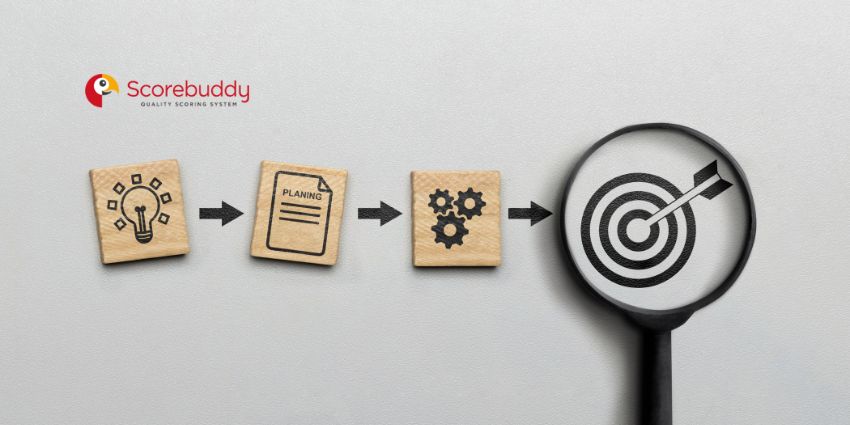
This is where Scorebuddy plays its most strategic role: connecting quality intelligence directly to action.
Through workflows, calibration tools, and multi-level reporting, teams can ensure insights reach supervisors, CX leaders, and the C-suite, ensuring that the right people take the right next step.
When this loop functions smoothly, QA becomes an engine for improvement rather than a reporting obligation. It reduces churn, strengthens performance, and guides CX direction with clarity that few other datasets can provide.
And in Corcoran’s words, agents help “keep everybody honest” by engaging directly with their evaluations and challenging misalignments.
That’s what a true feedback culture looks like, and what ultimately turns QA into a strategic asset.
Find out more about how to unlock value with your QA data by reading this article.
You can also discover Scorebuddy’s full suite of services and solutions by visiting the website today.