
CX Today’s 2025 Trends series gathers insights from industry leaders to identify the forces that will shape customer experience in the year ahead.
In our third and final round of CX trend predictions, our respondents highlight possible advances in personalization: AI capabilities are now reaching a level that enables enterprises to move from limited tailored responses to continuous personalized interactions.
The challenge has always been that true personalization requires knowing the customer deeply, acting on that knowledge in real time, and doing so across thousands or millions of interactions simultaneously. Earlier generations of technology couldn’t handle that complexity. AI can, but only if organizations deploy it in ways that enhance rather than replace the human elements that customers still value.
The predictions below suggest that 2026 will see expansion in personalization across channels as AI supports better decisions and more connected customer experiences, shifting from gradual to faster progress in the new year.
Meet the experts:
- Martin Schneider, VP and Principal Analyst with Constellation Research
- Katrina Gosek, Vice President of Product Strategy and Marketing at Oracle
- Samantha Richardson, Director of Executive Engagement, EMEA & APJ at Twilio
- Iqbal Javaid, Founder of Evolved CX
- Maxie Schmidt, CX analyst at Forrester
- Don Scheibenreif, VP Distinguished Analyst at Gartner
Mass Personalization Stops Being a Buzzword
Martin Schneider, VP and Principal Analyst with Constellation Research, predicts that agentic AI will finally deliver on the promise of mass personalization at scale.
“My prediction around CX for 2026 is with everything that we’re seeing in agentic AI and multi-platform agentic AI, we’re finally going to start seeing some of the leaders out there in terms of the practitioners start to see personalization or mass personalization at scale because now we’ve got these agents that can go and ask thousands of questions, look up dozens or hundreds of systems to find out more about the customers.”
The shift enables personalization in every interaction, not just the ones where someone manually intervened.
“And what that means is now that in real time and in every interaction, you’re able to know the customer better and provide a much more personalized experience. That’s in pre-sales, that’s through customer support, and that’s even just in the ongoing account management.”
Schneider sees the capability extending beyond reactive personalization. “So not only are we mass personalizing when customers come to contact us, we can actually mass personalize kind of outbound and right time and event-driven interactions, right?”
Trust and data privacy remain critical concerns, but Schneider believes agentic AI represents a fundamental leap forward.
“Of course, we’re going to have, you know, important guardrails, important data privacy and other issues and trust is going to be a big issue. You know, agentic AI is really unlocking the ability for us to have mass personalization at scale that really kind of changes the game and brings customer experience up a notch for a lot of businesses out there in 2026 and beyond.”
Humans Rising Above the Loop
Katrina Gosek, Vice President of Product Strategy and Marketing at Oracle, predicts that 2026 will mark the end of “human in the loop” as a framework.
“My prediction for 2026 is that humans are going to rise above the loop,” she says.
“I think in 2026, we’re finally going to admit the truth that human in the loop never really sounded very humanist. It’s reduced people to checkpoints and a machine, not experts with judgment.”
Gosek argues the shift happens because AI finally takes over the computational work that humans were never supposed to be doing in the first place.
“So I think in 2026, we’re going to outgrow that frame, not because AI replaces people, but because software finally starts using itself and humans get to do the work that only humans do. So if you think, you know, for decades, marketers, sellers, customer service agents have been the glue between systems. They’ve actually been doing the computer work instead of customer work.
“They’ve been clicking through screens, reconciling data, hunting for information, patching workflows that software honestly should have handled.”
That’s been a drag on CX, according to Gosek. “So that’s been a real drag on CX customer experience, that they’ve been doing computational work that should have been done by computer.”
When AI handles the systems work, humans can focus on judgment and expertise. “So simply said, I think in 2026, I think all of that work is gonna move back into the software. AI becomes the systems operator and humans become the experts again.”
Gosek believes that shift will accelerate improvements in customer experience. “And I think when that happens, CX is gonna improve fast. Problems are gonna be handled before customers notice. Issues are gonna be resolved in one interaction instead of three. So 2026 isn’t humans versus AI and it’s definitely not human in the loop.
“I think it’s humans above the loop, judgment on top, intelligent execution underneath because the software is finally gonna run itself.”
Storytelling as the New Differentiator
Samantha Richardson, Director of Executive Engagement, EMEA & APJ at Twilio, predicts that narrative and storytelling will become the differentiator for brands trying to cut through noise.
“My trend is that in an age of constant digital destruction and noise, the smartest brands will use the power of narrative and storytelling to build loyalty,” she says.
“Brands are working to create their own universes whereby they can cut through the distraction, they can welcome customers in and they can make them feel comfortable and crucially stay there.”
Richardson emphasizes that storytelling requires infrastructure. “But to do this, they need core infrastructure in order to capture and act on those insights.
“From smart brand extensions through to sophisticated loyalty programs that actually feel personalized, the leading brands will be carefully balancing that innovation and consistency to make their customer data work really hard.”
Personalization alone won’t be enough. Brands need to wrap that personalization in a narrative that resonates emotionally and keeps customers engaged over time.
The Human Comeback
Iqbal Javaid, Founder of Evolved CX, sees 2026 as the year physical experiences make a comeback alongside digital transformation.
“As far as predictions are concerned, in my view, 2026 will flip customer experience on its head,” he says.
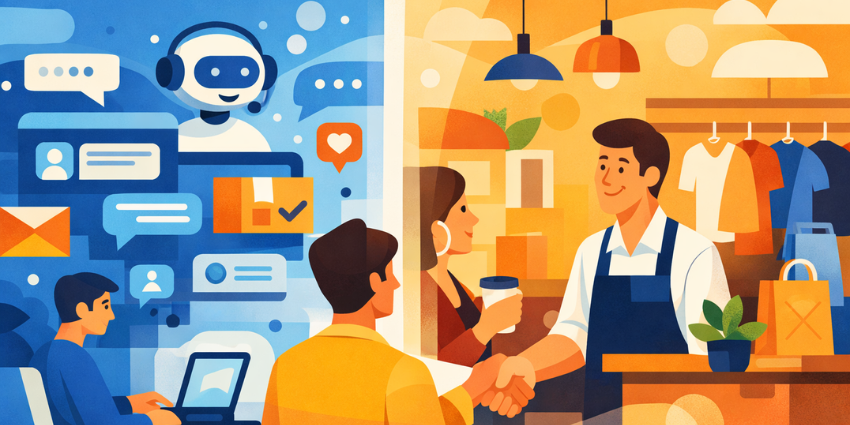
“We’re moving from clicks to connections, from chatbots to real conversations. First trend we will see is the human comeback. Now, after years of digital fatigue, consumers are craving in-person experiences again.”
Javaid cites data showing that demand for physical brand interactions is rising. “Now the data tells us that over half of adults will actively seek tactile offline brand moments. Now you’ve got brands like Starbucks, TikTok and Coach already investing in what my kids refer to as IRL in real life engagement. Because actually real world experiences build loyalty. You can’t just scroll past.”
Javaid also predicts the rise of single conversation experiences. “But I think the other big shift that I’m really excited about which is emerging is the single conversation experience,” he said.
“So by unifying every brand interaction into one seamless conversation. We’ve got companies like Nestle already blending shopping, service and promotions into a single AI driven chat. Soon we won’t need to switch between apps or agents. The conversation will follow the customer naturally.”
His conclusion ties both trends together. “Now the future of CX won’t be about online or offline. It will be about experiences that feel connected, whether you’re meeting face to face or chatting with an AI that genuinely knows you.
“2026 is the year we bring humanity back to customer experience, not powered by AI, but intelligent conversation.”
Embedding Insights Where Decisions Happen
Maxie Schmidt, CX analyst at Forrester, predicts that organizations will need to embed customer insights directly into the tools employees and AI agents use to make decisions.
“So if we think about the fact that we have faster cycles of change all the time, right? If you take that to the logical conclusion, we know that people will try to act faster and faster to keep up,” Schmidt says.
“They’ll feel like they don’t have time to pause and get customer insights first before they act because they have to make the decision, they have to make their MVP dates.”
Schmidt warns that skipping insights creates long-term problems. “But we also know that not stopping to do some key task is a huge problem.
“Just think what if you didn’t stop to wear your shoes before running a marathon? You’re sure far faster to the start, but you’ll, I guess, fall pretty far behind if you even finish the race at all, right?”
The solution is personalizing insights for decision-makers. “While we need to empower people at the edges of the organization to make faster decisions, we also need to give them the insights about customers that they need at the point of decision making. And the way that I think of this is like the internal personalization of insights for the stakeholder and his or her decision context that can happen by embedding these insights into the tools that they use.”
Schmidt extends the concern to AI agents. “But now think about that not only humans will make decisions, add in AI. So more and more AI agents will make decisions. And some of them are visible to us, but others are often invisible because these complex layers and networks of multi-agent AI.”
The risk is that AI will optimize for the wrong goals. “Now the problem with AI is AI will be so much better at optimizing for the goals we give it than the humans will be.
“So if the humans are trying to optimize for cost reductions short term, they might succeed sometimes, but AI will always succeed. So if you give AI these short-sighted objectives, the optimization will also be short-sighted.”
Schmidt uses a metaphor to illustrate the problem. “So this is kind of the system thinking notion of the fixes that fail. Like each short-term fix amplifies the analog problem requiring more more fixes, but like, I guess I can speak for myself, back pain. When you take painkillers that actually just mask the pain. So you continue your bad habits. You sit badly at your desk. You don’t do exercises and that makes them back verse and verse, need more and more more medication.”
The solution is better goal-setting. “And what I’m saying is that in the next year, we’ll hopefully find ways to avoid breaking the CX’s back, if you so will. So we need better goals and shared long-term value creation for customers and business.”
Machine Customers Get Their Own Business Units
Don Scheibenreif, VP Distinguished Analyst at Gartner, predicts that machine customers will become distinct enough to warrant their own channels and business units:
“My biggest prediction for 2026 when it comes to machine customers is that we believe by the end of next year, machine customers will actually have their own channels and business units creating new revenue streams and growth.”
“And this is based on the idea that we can’t treat machines the same way we treat humans when it comes to the sales, marketing, customer service, customer experience processes.”
The prediction reflects a broader recognition that AI-to-AI interactions will become a significant part of commerce and that organizations need to design experiences specifically for machine customers rather than forcing them through human-centric processes.
Personalization That Doesn’t Feel Robotic
The predictions in this article converge on a single idea: AI enables personalization at a scale that was previously impossible, but that personalization only creates value when it feels human.
Whether through storytelling, physical experiences, better goal-setting, or elevating human judgment above computational tasks, the organizations that succeed in 2026 will be those that use AI to enhance connection rather than replace it.
The technology can deliver individualized experiences to millions of customers simultaneously. The question is whether organizations will use that capability to build relationships that actually matter.
Check out CX Today’s CX Trends Part One for agentic AI predictions.
Check out CX Today’s CX Trends Part Two for data platform predictions.