As CX leaders, many of us talk about accessibility. Craig Radford built a company because he could not get it.
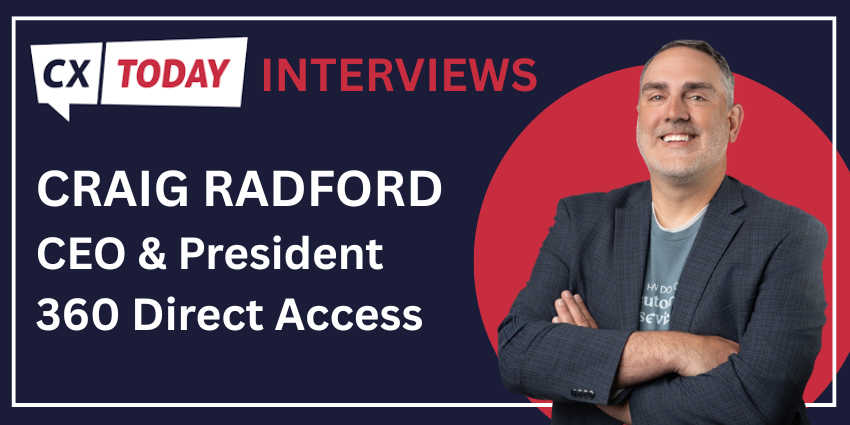
In a recent interview with CX Today Craig Radford, CEO and President at 360 Direct Access shared his personal experience.
“I remember several years ago, I was in an airport… I was on hold for 45 minutes trying to get an interpreter on the phone. After finally reaching an interpreter, I then waited another 45 minutes for the airline, only to discover the interpreter made a mistake and booked me on the wrong flight.”
For Radford, who has been deaf his whole life, that moment was a turning point.
“There has to be a better way… Why can’t I talk directly with somebody in my own language instead of going through the interpreter?”
That question became 360 Direct Access, a deaf‑led CX platform that is now winning global awards, securing blue‑chip clients, and reshaping how enterprises think about service for deaf and hard of hearing customers.
A Founder Story Built On Lived Experience
360 Direct Access was founded to “solve my own problem,” as Radford put it. Yet the challenge is far bigger than one traveler at an airport.
Deaf customers are typically pushed through third‑party video relay services or English‑only chat. For many, English is a second language, so every interaction adds cognitive load, risk of misunderstanding, and extra handle time.
Radford highlighted the scale in his CX Today conversation:
“A lot of companies think that [relay] is free, but they don’t realize that they’re paying the English speaking reps to receive those calls… Our services reduce the call time by 42 percent.”
Globally, more than 70 million people use sign language to communicate, with 240 sign languages in use worldwide. In the U.S. alone, deaf sign language users represent a multibillion‑dollar economy and over $86 billion in spending power.
360 Direct Access exists to give those customers what regulators call “functional equivalence,” and what Radford describes much more simply:
“It feels like functional equivalence, like hearing people… A lot of them cry… They feel that equivalence, the experience is powerful.”
Inside The 360 Direct Access Platform
At the heart of 360 Direct Access is a WebRTC video platform and widget that drops into an enterprise website or app. It is designed “by and for the deaf community,” with culture and language built into the UX.
Key capabilities include:
Direct Sign Language Contact Center
- Deaf and signing representatives provide video‑based support in American Sign Language and other global sign languages.
- Enterprises can use fully managed 360 agents or license the platform for their own deaf and signing staff.
This eliminates the random third‑party interpreter problem highlighted in the company’s business case, where agents often lack product knowledge and context, leading to confusion and longer calls.
AI‑Powered Accessibility Features
Radford told CX Today that the team has “developed some amazing AI technology for hard of hearing people with AI transcription,” along with sign language recognition for fast queries and answers.
The platform roadmap and collateral highlight:
- Real‑time AI transcriptions and multilingual translation.
- Sign language recognition and signing avatars that act as a sign‑language chatbot, handling quick questions before escalating to a live representative.
- Sign Message, which lets customers leave a signed video message and receive a signed response later, widening access beyond live sessions.
Behind the scenes, 360 Direct Access partners with Bakstage.ai on WebRTC and AI, layering in sentiment analysis, instant call summaries, and personalized insights tailored to deaf interactions.
Enterprise‑Grade Security
For CX and IT leaders, security is non‑negotiable. The platform is:
- SOC 2 Type II certified
- PCI DSS compliant
- HIPAA compliant
- GDPR‑aligned
360 Direct Access is also certified as a Disability:IN Disability‑Owned Business Enterprise (DOBE) and is approved by the U.S. Federal Communications Commission as a direct video entity, giving enterprises additional assurance around governance and accessibility standards.
Case Studies: From Banking To Consumer Electronics
The most compelling proof, of course, comes from live deployments.
Radford shared that “we just launched the first bank in the history of the United States called Fulton Bank” to provide direct video access. Deaf customers can now order new cards or handle day‑to‑day banking by speaking directly to a signing representative through the 360 widget on Fulton’s site.
In consumer electronics, LG Electronics uses 360 Direct Access so deaf customers with issues with a refrigerator or TV “connect directly, like, just like a hearing person.”
The impact lines up with FCC data cited in the company’s business case. Direct video calling has been shown to:
“Reduce call time by over 40 percent… and [drive] a 530 percent increase in new customers.”
For brands, this is not only about inclusion. It is a route to shorter handle times, higher first‑contact resolution, and a differentiated promise to a historically underserved segment.
Awards, Growth, And A Deaf‑Led Team
Recognition has followed. In his CX Today interview, Radford pointed to a string of recent wins:
“We work with one of the largest nonprofit disability organizations called Disability:IN… we did a pitch at their event, and we won the pitch competition in front of 5,000 people.”
That Disability:IN win helped open doors across the accessibility ecosystem. At CES, 360 Direct Access was named a top five innovation for accessibility.
Additional accolades include:
- Top 4 at Shark Tank–style Venture Atlanta
- First place and People’s Choice Award at the Pitch Perfect Challenge
- InnovateAble Top 3 and People’s Choice winner
- Top 15 startup recognition from Tampa Bay Wave
Behind those awards is a leadership team that is 100 percent disability, minority, and women‑owned, with deep roots in interpreting, SaaS, and CX operations. The company has doubled its revenue year on year for the last four years and is growing headcount rapidly, with Radford telling CX Today they expect to reach 50 employees, “90 percent of [them] deaf people and deaf lead.”
For CX leaders balancing accessibility mandates, cost pressure, and talent strategy, that combination of deaf‑led insight, measurable impact, and market traction is hard to ignore.
The Bigger CX Story
The 360 Direct Access story is not simply about one platform. It is about what happens when the people most affected by exclusion design the solution.
When deaf customers connect with deaf agents and no longer need a family member to make the call, Radford says, “That’s no longer the case. We solved that.”
For enterprises, the invitation is clear. Direct sign‑language support is no longer a niche experiment. It is a practical, secure, and commercially sound way to expand market reach, improve journeys, and live up to the promise of customer centricity.
The question for CX leaders is whether your brand will wait for regulation to catch up, or move early and let deaf customers feel that same “weight lifting” your hearing customers may already take for granted.
Join the conversation
Join our LinkedIn community (40,000+ members): https://www.linkedin.com/groups/1951190/
Get the weekly rundown: Subscribe to our newsletter: http://cxtoday.com/sign-up