
Agentic AI vs AI Copilots, What Buyers Are Actually Comparing
AI copilots arrived with a simple promise: help people work faster. In practice, that help often looks like meeting summaries, suggested next steps, and search or writing assistance.
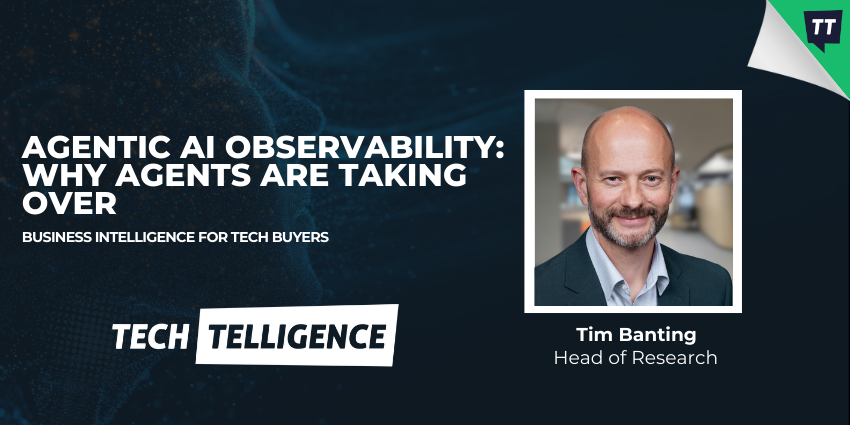
Tim Banting, Head of Research at Techtelligence, notes though:
“Those sorts of capabilities are just expected now.”
The market is already shifting to a different idea: agentic AI. While copilots typically assist a user inside a workflow, agentic systems aim to complete the workflow.
Banting sees copilots are like “Google Maps,” while agentic AI is “more like a self-driving car.” The distinction matters because enterprises are no longer judging AI by how polished its outputs look, but by whether it can take accountable action across real business systems.
That brings us to the keyword that will define the next buying cycle: Agentic AI Observability. If AI is going to act, buyers need to see what it did, why it did it, and what it used as evidence.
Copilot Compliance Hits a Trust Wall, Agentic AI Raises the Standard
For many organizations, the copilot story loses momentum at the point where legal, risk, and compliance teams get involved.
Just ask Air Canada. The company was found liable in a small claims court after its AI chatbot gave a customer inaccurate information. This precedent highlights that companies will be held responsible for any mistakes from its AI.
Banting explains that copilots are “falling short” because they still require people to verify results. That verification is not just quality control, it is liability management.
He points to the “trust wall” and the need for accountability.
“What people do is they end up checking whether AI has got the right answers. But they’d prefer to have observability to make sure that what AI is saying is rooted in some really good foundational insights and data.”
In other words, compliance is not only about policy, it is about provability.
This is where agentic AI becomes an upgrade, but also a bigger test. Agentic systems should be “auditable,” “enforceable,” and designed with observability so organizations can measure, review, and defend outcomes.
In practical terms, Agentic AI Observability becomes a core compliance feature, not a nice-to-have. It is what enables a risk officer to trace an AI decision to the underlying document, policy, or approved knowledge source.
Related Articles:
- How Data Layers and AI Are Rewriting the CCaaS Market
- A 2025 Review: The 5 Trends Every Head of CX Needs To Know
- Less Tech, More Flow: Why Orchestration Is the New CX Power Move
The Productivity Question: What Supports CX Staff
The productivity pitch for copilots is also facing scrutiny. If employees must constantly double-check, correct, and re-run outputs, time savings can evaporate. Banting cites Workday research that should make any CIO pause:
“Heavy users spend about one or two hours a week fixing AI’s outputs.”
This need for review and reworking adds up to a significant amount of lost productivity over time.
The issue is not only wrong versus right, it is the dangerous middle. He calls out the operational pain of partial correctness: “almost right is really, really challenging.” Because it sounds credible, this information forces employees to spend extra effort figuring out why the system arrived at a conclusion, and whether it is safe to act on.
Agentic AI, on the other hand, is a hot-property for the productivity layer.
For example, with Servicenow’s recent acquisition of Moveworks. The strategic move added a new tool to the company’s Agentic AI stack – one that provides an “intuitive entry point for employees to ask questions, search, and take action – all without navigating forms or portals”, according to CX Today.
Agentic AI is positioned as the upgrade because it is meant to execute end-to-end tasks across systems, without constant babysitting. The competitive bar, he says, is shifting from output quality to reliability – how often the work finishes correctly without human supervision.
That reliability is inseparable from observability. If an agent completes a workflow, teams need the chain of evidence showing what happened and where it pulled information from, especially when productivity metrics and compliance obligations collide.
Advice for Buyers and Vendors in the Agentic AI Space
Just last month, Snowflake and Anthropic signed a $200 million deal to advance agentic AI for the workplace. Alongside the ability to work through financial, operational and customer information – this new deal is set to deliver tools that can “show their work instead of just throwing back an answer” according to CX Today.
Banting echoes this point with a consistent message for vendors: observability wins.
“The winners will be those vendors that have got clear observability and can tell you the sources where AI has made those decisions.”
He also points to alignment with regulation as a market signal, for example the EU AI Act.
For buyers, the buying center is expanding. He notes that risk, compliance, and governance will increasingly sit alongside CX leaders and operational teams. Procurement will need to treat agentic AI less like a productivity add-on and more like a governed automation platform.
Here’s what to ask vendors (and what to validate in pilots):
- Can the system show sources and decision steps for every action it takes?
- What controls exist for auditability, enforcement, and approvals?
- How does it handle cross-tool workflow execution and context retention?
- What evidence can it provide that tasks complete correctly without “babysitting”?
- How does the vendor support regulatory alignment and governance reporting?
The goal is to ensure Agentic AI Observability is built in, not bolted on. It is the foundation that lets organizations scale agents without scaling risk.
The Takeaway: Workflow Completion You Can Prove
Copilots made AI feel accessible, but enterprise value now hinges on something tougher: trust you can defend, and productivity you can measure.
Banting sums up the direction of travel toward agentic systems that act across tools, complete workflows, and produce outcomes that stand up to scrutiny.
He summarizes what buyers should take into vendor evaluations:
“It fundamentally comes down to who can complete workflows across systems of record and prove it with data.”