
After countless CX conversations at Customer Contact Week Orlando, one tension kept surfacing. CX leaders know this is another big turning point for service, with AI at the center, yet many worry they are about to repeat the mistakes of earlier eras.
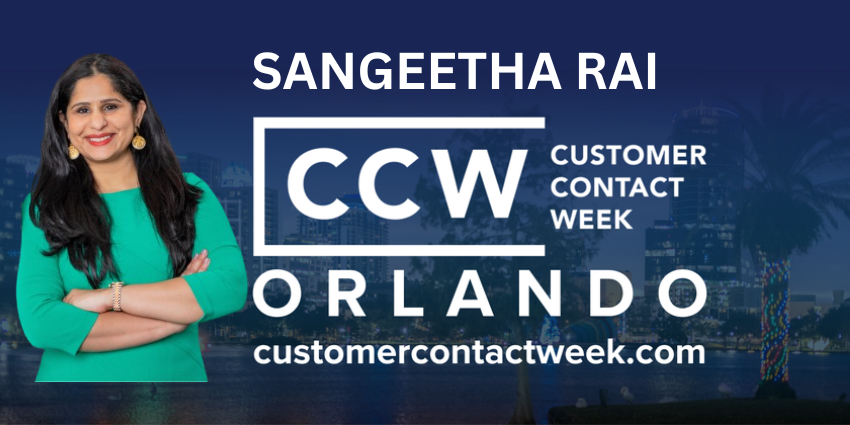
That was the starting point for Sangeetha Rai, COO at Barasch & McGarry, who led a session titled “3 Service Mistakes We Repeat Every Time the Industry Evolves.”
Her central claim was blunt and memorable:
“When you step back and look at this, it really is not a technology problem. It is a leadership problem.”
Rai’s message landed because it was grounded in five decades of service evolution, and in the reality of leading CX, technology, and operations teams in very different environments.
From branch networks and call centers, to global outsourcing and now AI, she sees the same leadership patterns play out while customers keep asking for the same basics.
Customers Have Not Changed as Much as Leaders Think
Rai framed the CCW Orlando conversation by looking across the last fifty years of service models. In every decade, leaders embraced new levers of efficiency such as centralization, offshoring, self service, and automation. On the surface, each new wave promised transformation.
Underneath, customers kept repeating a short list of needs, they want:
- Companies to respect their time
- Their history to be understood
- Issues resolved without being passed around
- Access to a person when the stakes are high
Rai summed it up in one line that resonated across the room, claiming that “we did not remove work. We just kept moving it, from people to systems, to customers, and now to algorithms.”
For CX leaders, that observation flips the usual AI narrative on its head. If customer expectations have been consistent for decades, then the real problem is not that expectations keep exploding. It is that our operating models have never fully caught up.
From that starting point, Rai walked through three service mistakes that show up in every era of change, including the current rush into AI.
Mistake 1: Chasing Outcomes Without Building a Foundation
Rai’s first recurring mistake is a lack of structural readiness. She sees many organizations diving into new service models without the basic foundations that let change stick.
She pointed to six elements that shape whether disruption stabilizes or destabilizes service:
- Process
- Knowledge
- Data
- Operating model
- Culture and psychological safety
- Change capability
You do not need all six at a world class level. You do need to avoid serious weakness in any of them, especially when embarking on a major shift such as AI or a new contact center strategy.
In our interview, Rai reflected on leading CX and technology in very different businesses and sectors.
“Regardless of the size of the company and the industry, I have led technology and customer experience teams. The problems have been the same.”
One story she shared involved a rapid move to offshore support. The business case focused on cost and coverage. The reality exposed missing foundations:
- Core processes were not properly documented
- Knowledge was fragmented across spreadsheets and individual agents
- The operating model between onshore and offshore teams was unclear
External partners promised a smooth transition. Internally, leaders underestimated the readiness gap. The result was a predictable rise in escalations, slower resolutions, and growing frustration on both sides of the Atlantic.
The lesson was not that offshoring is inherently flawed. The lesson was that every disruption magnifies what is already there. Strong foundations show their strength. Weak ones crack under pressure.
Rai also drew a sharp line between change management and change capability. Change management is the go live plan, the communications, and the training deck. Change capability is the organization’s “muscle” to absorb frequent change, experiment safely, and recover when things do not go to plan.
Without that muscle, every new wave, whether it is AI or a new routing strategy, feels exhausting for teams and customers alike.
Mistake 2: Modernizing Tools Without Modernizing Thinking
The second mistake Rai highlighted is behavioral readiness. Many CX leaders update their tech stack while leadership habits and decision models stay rooted in old assumptions.
In the session and in our follow up conversation, Rai contrasted “old thinking” and “modern thinking” in practical terms.
Old thinking often looks like this:
- Decisions driven by politics and local preferences
- Short term wins prioritized over long term coherence
- Adoption treated as a one time training event
- Individual teams buying “local” tools to solve their own problems
This pattern leads to fragmented journeys. Different tools do similar jobs. Different processes handle similar issues. Customers are left to navigate a maze that makes sense on an org chart, not in real life, as Rai explained:
“A lot of times, we modernize the tools before we modernize the thinking.”
She described how this dynamic played out in a large organization with more than a hundred contact centers. Over time, each center had layered on digital tools to meet local needs. On paper, the company had invested heavily in modernization. For customers, the experience was inconsistent and confusing.
When generative AI arrived, she and her colleagues chose a different path. Rather than adding another layer of local experimentation, they paused and aligned leaders first:
“We said, okay, now let us all think about customer experience and how we think about the use cases holistically, so the customers are not going to have a disjointed experience.”
That shift was more than a governance tweak. It was a choice to modernize thinking and decision making before modernizing another layer of tools.
For CX leaders, the implication is clear. A list of AI pilots is not a strategy. The real work sits in shared language, shared prioritization, and shared measures of success that cut across functions and geographies.
Mistake 3: Underestimating the Human Impact of Disruption
Rai’s third mistake is about the human element, which can be easy to underplay in board slides yet decisive in the real world.
Every new era of service introduces the same tension:
Customers are promised faster, smarter experiences.
Employees are asked to change habits, learn new tools, and live with uncertainty about their roles.
Research cited in the session points to a rapid increase in AI related restructuring. Some organizations announced headcount cuts on the assumption that automation would permanently replace volumes. Many of those same organizations are now quietly rebuilding teams as they rediscover that complex, emotional, or high risk interactions do not vanish. They concentrate.
The impact goes beyond staffing levels. Early stage AI and automation often need time to reach acceptable accuracy. If customers live through that learning period without back up from well supported humans, trust in the brand can erode long before the model matures.
At Barasch & McGarry, Rai is acutely aware of the stakes. The firm represents survivors of the 9/11 attacks and their families, many of whom face long term health issues and trauma. For this community, CX is not a convenience layer. It is a core part of care, as she explained:
“We need to treat them with that white glove service. We want to be proactive, so we are making sure we have proactive solutions, proactive notifications. We are co creating anything with our clients, and when they do reach out to us, we want to make it as simple as possible so they do not have to repeat themselves, they do not have to go to multiple teams.”
To deliver that, Rai is reshaping both the external experience and the internal employee journey:
- Service roles are being reframed toward advocacy, so individuals own more of the client lifecycle
- Proactive outreach and notifications are built into journeys, reducing the need for clients to chase updates
- KPIs and SLAs apply across the firm, including attorneys, to normalize shared accountability for experience
Designing CX for the Next Shock, Not the Last One
Rai’s leadership playbook is influenced by a story from outside business altogether. On a visit to Tokyo, she learned about how Japan rebuilt after the Kobe earthquake. Before the disaster, much of the infrastructure met the standards of the time. The earthquake exposed how “good enough” failed under real conditions.
The recovery mindset was not to patch and return to the previous baseline. It was to assume disruption would happen again and design for resilience.
“Tokyo did not wait for the next disaster to fix what broke. It assumed disruption would happen again and designed for resilience,” Rai said.
She sees a direct parallel in CX. At Barasch & McGarry, that philosophy shows up in:
- Using frameworks such as CMMI for process maturity and Medallia’s model for data maturity to set explicit targets
- Creating roles that bridge business and technology to keep the operating model aligned as tools and expectations shift
- Bringing in external voices and sending people to events like CCW to keep learning open and active
- Sharing weekly leadership messages that normalize experimentation and continuous improvement
Rai’s reflection on her CCW Orlando session brings the point home:
“I do not think it is anything new that people do not know. But I think it is an aha moment to actually say, okay, here are the disruptions over the last 50 years. We are making the same mistakes, and customers are saying that same five things. Let me take some of these ideas back so we can start working on them, not only for this age of AI, but for whatever comes next.”
The real test for CX leaders is not whether they can name the three mistakes. It is whether they can design their next wave of change so that those patterns finally start to break.
Conclusion: Will We Still Be Having This Conversation in 10 Years?
Insight is easy. Execution is the differentiator.
Listening to Rai at CCW Orlando, and then digging deeper in conversation, the through line is hard to ignore. Every decade brings new tools and new terms, customers keep repeating the same simple needs and many organizations fall into the same three traps.
For CX leaders, the question now is whether AI becomes another chapter in that story or the moment where the pattern breaks. The foundations you invest in, the thinking you modernize, and the way you treat people through disruption will decide which way that goes.
Ten years from now, there will be a new set of technologies on the agenda. The real measure of progress will be whether we are still talking about the same basic service mistakes, or whether this generation of leaders finally changed the playbook.
Join the conversation: Join our LinkedIn community (40,000+ members):
https://www.linkedin.com/groups/1951190/
Get the weekly rundown: Subscribe to our newsletter:
http://cxtoday.com/sign-up