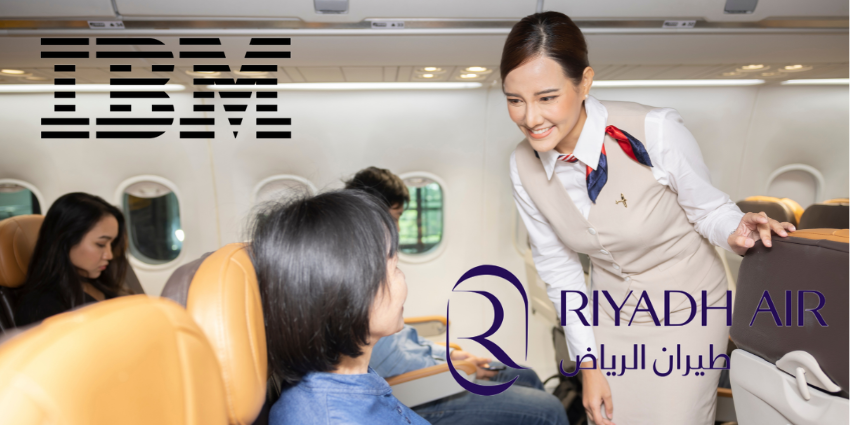

IBM and Riyadh Air have confirmed plans to launch the first AI-native airline to improve customer travel services.
This new collaboration strategy is the latest in both enterprises’ long-standing partnership aimed at enhancing travel customer experience by adopting AI bots and agents to deliver customized support.
The airline will be utilizing several IBM tools to turn this dream into an end-to-end strategic reality, with an expected first commercial service date release in early 2026.
As a first-of-its-kind innovation, the companies will provide AI-driven operations by implementing both generative and agentic AI capabilities into Riyadh Air’s workflows.
This will, in turn, create a unified environment to allow teams to work together effectively, ensuring the delivery of high-quality customer service.
Adam Boukadida, Chief Financial Officer at Riyadh Air, recognized that this fast-moving industry meant that any initiatives would have to be implemented as soon as possible to ensure its position in the competitive curve.
“We had a clear choice – be the last airline built on legacy technology or the first built on the platforms that will define the next decade of aviation,” he said.
“With IBM, we’ve stripped out fifty years of legacy in a single stroke. Riyadh Air isn’t just built for today; it’s built for the future and creating a pathway for many airlines to follow in the years to come.”
Mohamad Ali, Senior Vice President at IBM Consulting, highlights Riyadh Air’s role in bringing about the next trend in customer experience expectations for air travel technology.
“By embedding AI into the very foundation of its operations, Riyadh Air is setting a new blueprint for what it means to build a modern, adaptive enterprise from the ground up,” he explained.
“As a company born in the AI era, Riyadh Air is redefining what’s possible in aviation and it’s been a privilege for IBM to help make that vision a reality.”
This latest collaboration strategy is designed to be built from scratch, simplifying the process for a speedier launch.
This means that this initiative won’t require IBM’s expertise to tackle and update any legacy patchwork.
Furthermore, this collaboration strategy will also require utilizing IBM’s tools and expertise to ensure that an AI-native solution will operate effectively within Riyadh Air’s system.
These tools will include IBM Consulting, IBM Consulting Advantage, and IBM watsonx Orchestrate to provide Riyadh Air overall support in achieving success in its strategy without incurring major risks:
IBM Consulting
This tool will act as the system’s primary integrator, coordinating and managing 59 workstreams and over 60 partners, including Microsoft, Apple, and Adobe. This will ensure that Riyadh Air meets its expected AI visions for the strategy by also enforcing standards across its vendors to bring about unification and avoid risks of fragmentation.
IBM Consulting Advantage
Working as an AI-powered delivery platform, this tool performs and manages delivery and execution at a seamless rate across programs, tracking workstreams and deployments, monitoring potential coordination failures to minimize delays, and supporting risk control.
IBM watsonx Orchestrate
This is an AI layer that is expected to operate as an AI-native enterprise right at the beginning of the launch. It can allow AI agents to work automatically across multiple platforms and support customer-facing teams with real-time decision support.
Who is Riyadh Air?
Riyadh Air, managed by the Public Investment Fund (PIF), is a Saudi Arabian airline that launched its operations back in March 2023.
Just 8 months after the company’s launch, IBM had publicly agreed to build the technology foundation for the airline by implementing IBM Consulting to enhance its digital strategy.
Since that initial collaboration, IBM has implemented over 50 airline-focused technology solutions for data, security, infrastructure, and integration.
Today, this expanded collaboration could allow Riyadh Air to become a pioneer in the AI travel industry and likely set the stage for future innovations in air travel and AI-driven travel experiences.
What Will This Mean For The Customer Travel Experience?
Alongside offering tools for teams across the business, this collaboration also aims to provide capabilities for both customers and customer-facing services to ensure positive customer journeys.
For customer-facing teams, this collaboration offers mobile apps for air travel crews to allow connectivity between the customer and the crew through powered AI capabilities.
By implementing IBM watsonx Orchestrate, Riyadh Air can build concierge experiences to offer context-heavy insights, actions, and next steps for when interacting with customers to provide customized services. This could include fast-track service option offerings for customers running late through the airport.
For customers, this collaboration offers them AI voice bots and agent assist to drive customer-focused support, leveraging contextual data to advise customers on next steps that align with their travel requirements.
Speaking with CX Today, Gal Orian Harel, Customer Feedback Expert and CEO of Blix, explains how this strategy can effectively improve customer experiences in travel, even before the customer steps on the plane:
“The AI-based concierge and the agentic workflows for the crew and staff are intended to eliminate the barriers and decision fatigue, thus enabling the employees to take their time and deliver exceptional service rather than getting stuck in operational tasks.
“They are harnessing AI to improve the efficiency of operations, the profitability of routes, and the quality of customer interactions, which are creating a distinct advantage in competition.
“Old systems have always put airlines in a position where they were not flexible and responsive, however, Riyadh Air’s strategy is demonstrating the opposite that the digital-first, AI-powered approaches can open up new ways of selling, win back customers, and grow fast.”
With Riyadh and IBM’s expanded collaboration set in motion, this strategy launch outcome could set the tone for customer travel experiences, with more customers possibly expecting more seamless, personalized, digital-first services.
Furthermore, if airlines begin to offer perks such as Riyadh’s suggestion of ‘fast-track services when running late’, then more airlines are going to be expected to follow suit with customer rewards.
Improving Customer Travel Service at Berlin Brandenburg Airport
However, Riyadh and IBM aren’t the only ones in the travel industry trying to improve their customer experience sector.
Berlin Brandenburg Airport has already begun its shift to improve customer travel experiences by looking at customer journeys as a whole, ensuring that their commute from A to B is as seamless as possible.
Speaking with CX Today, Christian Draeger, Senior Vice President for Passenger Experience at Berlin Brandenburg Airport, highlights how customer experience begins before the initial service has started.
He said: “We’re not just starting at the airport door or at the entrance door. We’re already looking at customers, how they can get prepared for their travel, even days ahead of the actual travel plans.”
The airport also offers various support services during a customer’s time in the facility to offer as much convenience as possible.
“If somebody left their laptop on the aircraft… they would get the right information who to contact to resolve that issue,” he said.
“When you have the connecting flight and your incoming flight is late… they will then take you physically by the hand and expedite you to your transfer gate.
“Customers nowadays want to minimize all of the experiences that they have where they have to do things or where they have to stand in line or queue up.”