
AI receptionists are becoming one of the first practical and profitable uses of AI in customer experience.
In many cases, businesses can justify these tools because the impact is measurable, the risk is limited, and the business case is clear.
By reducing missed calls for steadier revenue increase, companies can begin to build up automation across an entire contact center, but are CX Leaders giving these tools enough attention?
Daniel Keinrath, CEO & Co-Founder at fonio.ai, argues that AI receptionists are gaining credibility because the work they perform is predictable and clearly defined.
“The reason why AI receptionists are emerging as the first truly credible form of digital labour is because inbound reception, appointment booking, call routing, and after-hours coverage are structured workflows with clearly defined outcomes when properly prompted in the backend,” he explained.
“This makes the use case low-risk, and easy to justify internally – and is also a great way to diminish AI fears in some companies.
“In many verticals, the AI already resolves up to 85% of calls autonomously, forwarding only edge cases to human operators.”
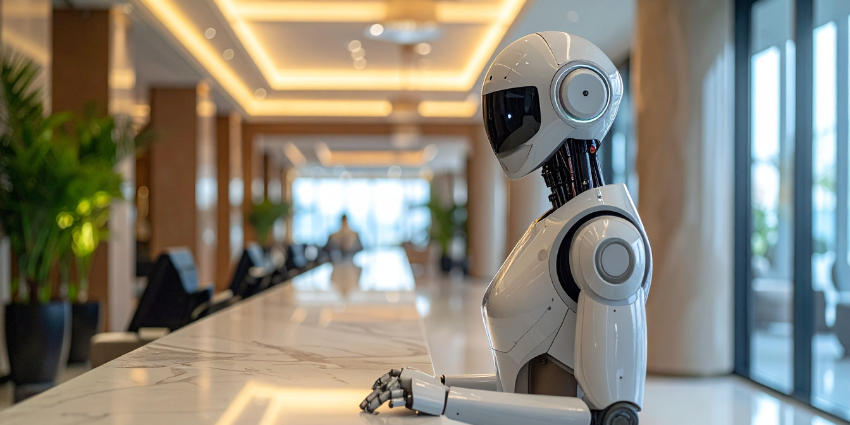
AI receptionists are voice and chat systems that answer inbound calls or messages and perform basic front-desk tasks automatically.
This typically includes 24/7 call answering, caller identification, call routing, appointment handling, and answering common questions.
Many modern AI receptionists connect to business systems such as CRMs, scheduling tools, or industry platforms, allowing them to perform tasks rather than just provide relevant information.
With increased calls answered, appointments booked, this ensures higher captured demand, higher conversion rates, and reduced revenue loss from missed opportunities.
This also ensures businesses are provide consistent customer experiences and routing logic, reducing wait times and avoiding variability that occurs when customer-facing teams are overloaded.
AI Receptionists are not Experimental Automation
As AI receptionists operate in structured, measurable environments and deliver direct business outcomes, they are not experimental automation.
With clearly defined workflows, AI interactions follow predictable patterns, performing best in bounded use cases with repeatable inputs and outputs.
As technology matured, modern versions of these receptionists take on natural language processing, intent detection, and integrations with CRM and scheduling systems.
And because return on investment is measurable, many AI initiatives struggle to prove value in comparison because they’re deployed in areas where outcomes are indirect, whereas receptionists affect metrics that are already tied to revenue and service performance.
AI receptionist risk is also manageable, as escalation paths are defined, governance is made simpler compared to fully autonomous service models.
AI receptionists are not experimental because they automate a structured, high-volume function with clear financial impact, mature integrations, and defined oversight.
The Popularity of AI Receptionists
These receptionists solve numerous business problems with measurable impact, while also improving in capabilities and reliability as integrations with CRM and scheduling platforms mature.
In 2025, RingCentral launched its own AI receptionist, highlighting the tool as a real-world use case to maximize the value of AI and redefine customer experiences, rather than remaining an experimental concept.
Furthermore, AI voice system capabilities have recently been advancing in accuracy, contextual understanding, and real-time integration with business platforms.
They can interpret natural language, identify intent, access CRM data, trigger workflows, and hand off conversations to human agents while preserving full context.
In December, Salesforce and Vonage announced their intent to advance voice AI, with AI voice no longer being a basic menu system, this capability ensures customer conversations are intelligently routed, resolved, or escalated with full data continuity.
Virtual and human agents can share context, routing logic, and customer data, as well as assess caller intent, authenticate users, and resolve straightforward tasks.
In the example of fonio.ai, implementing an AI receptionist has demonstrated measurable time savings and ROI improvements.
“On average, front desk use cases save 15–20+ hours per week,” Keinrath continued.
“In one specific case, fonio.ai saved a company the equivalent of an entire month of work through automation.”
AI receptionists represent a turning point where voice AI moves from experimental automation to dependable digital labor that delivers measurable operational and revenue impact at the front line of customer engagement.
CX Leaders Need To Pay Attention
With a direct operational and financial impact, CX leaders should care about implementing AI receptionists at a basic level due to the value of AI voice capabilities.
Since missed calls are regarded as a CX failure, AI receptionists ensure that all relevant calls are answered to reduce customer friction.
This improves accessibility and reduces complaints from hold times or unanswered calls.
And by turning direct results into experience and revenue, this makes it easier for CX leaders to justify investment and demonstrate impact.
Chris Angus, Director of CX Expansion at 8×8, notes that, given the highly visible impact of AI receptionists, more CX leaders will need to pay attention to them for direct results.
“AI receptionists are gaining traction because they solve a very specific, measurable problem,” he explained.
“Front-desk and inbound workflows are bounded, rules-based, and high volume, making them ideal entry points for what many are calling ‘digital labour’.”
AI receptionists represent the first practical, measurable form of digital labor for many businesses, handling structured, high-volume tasks like call routing, appointment booking, and after-hours inquiries for reduced missed opportunities, focus on higher-value work, and improved customer accessibility and consistency.
For CX leaders, the rise of AI receptionists signals a shift toward scalable, action-oriented automation, offering a clear starting point for expanding digital labor across the customer journey.